Traffic Mirrors

“’For I know the plans I have for you. ‘declares the Lord, ‘plans to prosper you and not to harm you, plans to give you hope and a future.’”                        Jeremiah 29:11

Curved Mirror

The urban sprawl of Tokyo has grown slowly over the centuries on top of an ancient network of roads, hilly terrain and even encompasses over a hundred river and canal arteries. Many of Tokyo’s streets were originally little more than footpaths and presently bear more resemblance to a wide sidewalk or an alley rather than a conventional thoroughfare. These minor roads snake through residential areas and many of them are reduced to a single lane, allowing passage for only one car at a time. On top of this, they are generally fraught with numerous curves, severely limiting vision of what lies ahead. This makes navigation quite challenging and even dangerous at times as drivers can’t anticipate oncoming cars, bicyclists and pedestrians.

Because of these difficult conditions, Japanese traffic engineers have developed and implemented an ingenious, yet simple device to help facilitate safety. It is called a “kābu mirā “(カーブミラー), which is basically a large convex (curved) mirror mounted at the top of a pole. These special mirrors enable drivers to literally see around the blind corner or sharp bends in the road to determine if it is safe to proceed. We relied on these mirrors daily when bicycling or driving to the office from our home and I’m sure they prevented countless accidents for us and many others.

Unfortunately, we don’t have the luxury of such mirrors to help us navigate the inevitable unknowns of life. There are no kābu mirā that reveal the coming of major health problems, employment setbacks, relationship breakdowns, financial challenges or natural disasters such as the recent COVID-19 pandemic. As a result, our lives often seem to be unpredictable, chaotic and without purpose as we feel victimized by one crisis after another.

But this is not what the Bible teaches. The God who created life is depicted time and time again as the same God who knows, sustains and directs our lives and the affairs of this world (Psalm 139:1-18). God reassures His own people of this truth while they were living in exile in a foreign land as a result of their disobedience. “’For I know the plans I have for you. ‘declares the Lord, ‘plans to prosper you and not to harm you, plans to give you hope and a future.’”  This verse is not a promise that all their problems will immediately disappear, but rather, an offering of hope in the midst of despair. That hope is not placed in the possibility of coveted changed circumstances, but instead, in the very person of God. A God who loves us. A God who will do what is best for us. A God who reigns above the forces of evil and calamities that sometimes seem to dominate this world.

God has a plan for the nations and He has a plan for us. That plan is good. But saints of old were only provided glimpses and hints of how those plans would unfold. Like us, they could not see beyond the curve in the road, so they just continued to drive forward in faith. Fears of turmoil, dire consequences and impending economic collapse currently dominate the news cycles and social media, but as people of faith, our well-being and future are not dependent on the affairs of this world. Therefore, we would do well to emulate the Psalmist and pray in this way: “Search me, God, and know my heart; test me and know my anxious thoughts. See if there is any offensive way in me, and lead me in the way everlasting.” (Psalm 139:23-24) If God is visible in your kābu mirā, that is all you need.
Unseen Danger

“For we are not fighting against flesh-and-blood enemies, but against evil rulers and authorities of the unseen world,”                                      Ephesians 6:12a (NLT)

radiation monitor

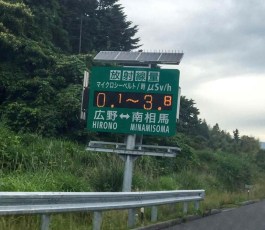
A shroud of silence hung eerily over deserted streets, homes, businesses, schoolyards and other public places that once bustled with activity. Outside of a few lonely security guards wearing protective clothing, there were no normal signs of life. No people, no pets, no stirring. Wherever we looked, nature appeared to be taking over each vacant town as greenery and wildlife seemed to be flourishing unchecked by human interference. It was as if all human life had been squeezed out of the area by an invisible, deadly force. Temporary gates now barred entrances to every street and driveway.

Entering the vicinity, we passed massive dumps filled with radioactive waste and radiation monitors posted along the road flashed cryptic numbers warning us of unseen dangers. We were driving through the Fukushima radiation exclusion zone that had once been the thriving home of 150,000 inhabitants. They had been suddenly forced to flee following the Great East Japan Earthquake of March 2011 and the resultant tsunami that compromised the local nuclear plants.

The radiation exclusion zone was initially off limits to everyone, but several years later, it was now possible to drive through portions of the formerly forbidden region. With the passing of additional time, residents were eventually allowed to return to designated areas that were declared safe for human habitation. As part of a massive decontamination effort, a literal army of government workers had laboriously scrubbed down the more effected areas of those previously deserted towns and even removed thousands of tons of radioactive topsoil and vegetation. The nuclear reactors were also decommissioned and together, the resultant cleanup attempts had served to lower some of the radiation markers. However, despite these large scale endeavors, the majority of the local residents were understandably hesitant to return to their homes and businesses. To lure them back, the government had rebuilt or reopened schools, shopping areas, sports centers, hospitals, housing complexes and offered additional financial incentives. But the scars on both the land and in people’s hearts still stubbornly remained; such wounds will likely take decades to fully heal.

Now, around the world and a couple of years later, silent city streets, daily news postings of COVID-19 related deaths and accompanying fears have an uncanny similarity to that unique experience in Fukushima. Interestingly enough, on that day when we drove through those modern Japanese ghost towns, my thoughts were drawn to other unseen dangers besides the flashing numbers on the radiation monitors. Since we live in a physical world, it is natural to become preoccupied with matters of physical safety. However, the Apostle Paul warned the Ephesian Christians (Ephesians 6:12) that ever present dangers of a different nature were potentially far more lethal. These dangers are the radioactive seeds of pride, selfishness, anger, apathy, strife, slander, lust and greed that are sown unseen by the Evil One himself, silently destroying healthy lives and communities. This form of pandemic can be far more destructive than any physical terror we might have to face in the present or in days to come. Fortunately, God has graciously provided His Word, His Spirit and His people to serve as warning monitors to assist us as we travel through life facing seen and unseen perils. Our safety and well-being are, thankfully, in His hands, but we must give heed to the warnings posted for our protection.

Shinto Blessings

“From the Lord comes deliverance. May your blessing be on your people.”  Psalm 3:8

shinto blessing2

While sitting in the office of the local Shinto priest, my gaze fixed upon a placard on the wall which advertised (in Japanese) set charges for services rendered:

  • ¥10,000 for a car blessing
  • ¥5,000 for a school entrance exam blessing
  • ¥10,000 for a baby blessing
  • ¥15,000 for a new home blessing
  • ¥10,000 for a marriage blessing

The whole concept stunned me on many levels and several questions came to mind as I chatted with my gracious host in a very unfamiliar setting. “How can mere mortal men place themselves in the position of dispensing blessings on behalf of the gods?” was something I asked myself. I did my best to politely nibble around the edges of this concept as I conversed with the Shinto priest. He explained, according to the Shinto religion, that nearly all objects, including both animate and inanimate, possess a spiritual essence known as kami (神). These kami are everywhere, but they are not regarded as omnipotent, omniscient, or even immortal. The term “Shinto” (神道) means literally “way of the kami” and they reportedly number over eight million. These spirits are duly venerated across Japan at various public shrines and private god shelves. It is believed by many adherents that kami have the power to dispense blessing on their devotees through rituals, good luck charms and designated intermediaries such as the priests.

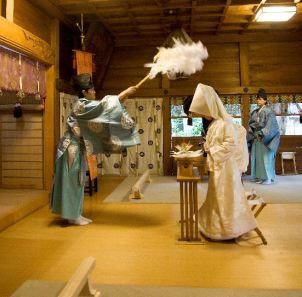
As I sat in the office of the local priest, other questions continued to fill my mind such as: “How can one charge money for a blessing?” From my perspective, such a practice seemed to reduce religion to a mere business transaction. This thought led naturally to another related question, which was, “Why would people actually participate in such obvious duplicity?” Perhaps the explanation to this conundrum resides in the standard practice of Shinto religious ceremonial procedures, where devotees have a sense that they cannot approach the kami with a request without some form of ritual purification to remedy their unclean state. This rite of purification is called harae (祓) and it usually begins with a symbolic washing using water near the shrine entrance. The next phase in absolution is conveniently performed by the priest (for a fee!), who rhythmically waves a large paper shaker called an ōnusa (also referred to as a haraegushi) over the object or person to be purified and blessed. Only after these procedures are performed can one approach the kami and hope to have their request granted.

Lying at the heart of the many intricate rituals of Shintoism is the basic human desire to be blessed by something or someone greater than one’s self. We want a healthy baby, success on a test, protection from infectious diseases, safety on the road, a good paying job, and a happy marriage, but such objectives often elude us because they lie beyond our control. Therefore, we are tempted to turn to a higher power to obtain them. Fortunately for us, there is a Higher Power who graciously dispenses such blessings on His people (Psalm 3:8) despite our unclean condition. We are beckoned to approach this God to request such favors, not because of our worthiness or the intercession of others, but because of the forgiveness provided through the cross by His Only Son. No fee is charged; God has paid it all. A few years later, this same priest reached the same conclusion and turned to Jesus for eternal absolution.