

“He made himself nothing by taking the very nature of a servant, being made in human likeness.” Philippians 2:7
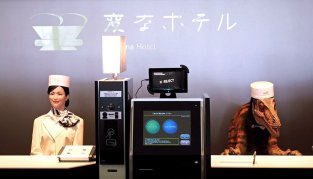 Opened in 2015, the Henn Na Hotel chain in Japan (translated “Weird Hotel”) is largely staffed by robots. Upon entering this unique hotel, guests are initially greeted in the lobby by a female-faced android, followed by a multilingual dinosaur proceeding to check them in. Another robot soon appears to transport the guest’s luggage to their assigned room and a face recognition system conveniently unlocks the door. An assortment of other robots fill various work roles in this impressive semi-automated lodging. However, half of the robotic labor force was recently “laid off” as some of the robots tended to create more work rather than reduce it. Innovation to improve the efficiency and capacity of robots continues to progress, not just within this hotel chain, but throughout Japan where robots are increasingly utilized.
The general purpose of robots, which are called “robotto” (ロボット) in Japanese, is to free up humans from difficult or mundane tasks while vastly improving productivity. This purpose explains why the industrial usage of robots has skyrocketed, with Japan ranking among the world leaders in robotic technology along with South Korea, Germany, Singapore and Taiwan. Many experts think that the solution to Japan’s chronic shortage of labor, due to population decline, is automation, not immigration. This accounts for the country’s heavy reliance on robot labor. Japan’s love affair with robots is somewhat rooted in its past, echoing back to karakuri ningyo, or mechanical dolls that were developed in the 17th century using imported European clock-making technology. Such ingenious developments eventually led to the creation in 1928 of a robot called “Gakutensoku” by Nishimura Makoto. This robotto could make facial expressions and perform a few rudimentary actions. It was the first of its kind in all of Asia.
Robotic technology now dominates the industrial sector of Japan and android robots are becoming increasingly common, performing a variety of duties in social, medical, security, entertainment, senior care, food service and educational circles. It is not uncommon to discover a robot in airports, places of business or hospitals greeting people and performing some kind of basic service. Aibo, the first mass-produced commercial robotic dog sold on the market by Sony, became the precursor of other robotic inventions designed primarily for entertainment. Life-like robots that perform certain religious functions at temples and shrines have also been deployed and used on a limited basis. The city of Yokohama recently put on display the world’s largest robotto which stands 60 feet in height (18 meters), weighs over 25 tons and is modeled after the Gundam robot from the famous anime series.
The advancements in robotic technology are very impressive as robots continue to improve in their imitation of human skills, intelligence and appearance. However, all such developments pale in comparison to the greatest transformation of all, where God took on full human form to redeem mankind (Philippians 2:6-8). This was no poor imitation like a robot, but rather, God fully submitted Himself to take on all the frailties of human flesh to such a degree that He hungered (Mark 11:12), grew tired (John 4:7) and most telling of all, He wept (John 11:35). As the writer of Hebrews so aptly put it: “He too shared in their humanity so that He might break the power of him who holds the power of death.” (Hebrews 2:14a)

 Ippo Ippo