

“with a gesture of extreme devotion, she broke the flask and poured out the precious oil on him.” Mark 14:3b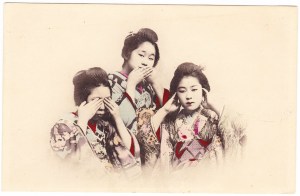
A cursory glance through our old family photos soon reveals that the McGinty gene pool contains a number of unique features, including noses that often range in XL to XXL sizes. Living in Japan, a land typified by smaller noses, I sometimes felt a little self-conscious of this feature, so I was slightly offended one day when someone pointed to their nose while talking to me. I initially thought that the individual was singling my nose out, but after considering the context, I grasped that she was merely pointing to herself. In Japanese culture, it is common for a person to indicate themselves in a conversation by pointing to their own nose.
Every culture has an array of gestures to communicate certain things and Japan is no exception. For example, one of the more common hand signals in Japan is to cross one’s index fingers or forearms when facing someone indicating a response of “stop” or “no.” When wanting to make my way through a crowd, I soon learned to use a hand chop sort of motion to politely encourage people to move aside. If one is unsure of how to answer a question, a simple tilting of the head will convey their uncertainty to their conversation partner. Conversely, if the answer is a clear “yes,” or “okay” when talking to a group of people, you can make a big O with your arms while bringing your hands together above your head.
Below are a few gestures that are commonly used in Japan:
- Asking for a favor or forgiveness—place your palms together in a praying motion in front of your chest
- Beckoning someone to come—extend one hand with the palm down and move fingers back and forth
- Indicating your answer is “no” or “something different”—hold an open hand at a 90° angle in front of your face and wave back and forth
- Communicating that someone is smart or well educated—use two fingers to wiggle a pair of pretend glasses up and down
- Counting—hold one hand open and fold in the thumb to indicate the number “one.” To indicate the number “two” fold in your index finger along with your thumb. Proceed in order with the other fingers when counting three, four and five.
- Demonstrating anger—place your fists with the index fingers pointing up on both sides of your head which represent demon horns.
- Expressing determination—Flex one arm while placing the opposite hand on the bicep
- Signaling rejection or taunting— pull down your lower eyelid to expose the red underside and stick your tongue out. This particularly strange gesture is called akanbe or “red eye” in Japanese.
One of the more memorable gestures recorded in the Bible was the anointing of Jesus by Mary shortly before His crucifixion. Breaking open a flask of pure nard, representing a year’s wages, she poured the entire contents on Jesus’ head and feet (Mark 14:3-9). She then proceeded to wipe his feet with her hair which represented her glory as a woman. Mary’s sacrificial act of worship of her Lord, while misunderstood by others in the room, was commended by Jesus and is commemorated to this day. Unknowingly, she was preparing Jesus’ body for burial following God’s ultimate gesture, His Son’s death on a cross. Through this unparalleled event, God extends His hand to us, beckoning us to come to Him and believe.

 Ippo Ippo