

“Suppose one of you wants to build a tower. Won’t you first sit down and estimate the cost?”
Luke 14:28a
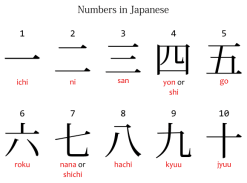
Learning to count is usually one of the first objectives in acquiring a foreign language, but mastery of this seemingly simple task is no small feat in Japanese. It is much more challenging than English, which simply utilizes ordinal numbers (1,2,3…) to indicate the quantity of something or cardinal numbers (1st, 2nd, 3rd…) to point out the position of something in a list. That’s it. But Japanese takes counting to an entirely different level that can easily befuddle the novice learner. For starters, it doesn’t help that Japanese employs two different basic numbering systems, with one based on ancient Chinese called “kango” (漢語) and another, known as “wago” (和語), with Japanese origins. Using the kango system, 1,2,3 becomes ichi, ni, san, but the same numbers transform into hitotsu, futatsu, mitsu using the wago counting system. This is where the fun begins.
Wago is basically a generic means for counting objects that don’t exceed ten in number, but kango is usually combined with an assortment of “counters” that vary according to the object being counted. For example, if you are counting long, cylindrical objects like pencils, a “hon” (本) is combined with each number so the simple 1, 2, 3 in kango becomes ippon, nihon, sanbon and so forth. Flat, thin objects like paper are indicated by the counter “mai” (枚) so 1, 2, 3 pieces of paper becomes ichimai, nimai, sanmai. Small objects use the counter “ko” (個) and large objects are “dai” (台). Small animals are “hiki” (匹), but large animals are “tō” (頭). Pairs of socks are counted using “soku” (足), birds are numbered by “wa” (羽) and bowls or cups of liquid are indicated by the counter “hai” (杯). Altogether, there are approximately five hundred Japanese counters, although many are rarely used.
To add to this confusion, there are many other aberrations to keep in mind when counting in Japanese. An additional quirk is the frequent substitution of the numbers 4, 7 and 9 with an alternative word. The typical word for four is “shi,” which is the same pronunciation for the word death (死), so people often use “yon” as a substitute. Along the same line, the number nine is “ku” in Japanese, which can also mean “suffering” (苦), so that is often replaced with “kyū.” The number seven (shichi) sounds very similar to the number eight (hachi) so it often becomes “nana”.
Counting in Japanese is obviously a difficult challenge, but there is another form of counting that is even more formidable. As Jesus’ influence continued to grow, which in turn attracted more followers, it became necessary for Him to identify those who were fully committed to pursuing the whole purposes of God. Therefore, Jesus gave two parables in Luke 14 where He encouraged potential disciples to count the possible cost of abandoning their comfortable lives in order to follow Him. Such a radical commitment could estrange them from family, incur the loss of personal possessions and even be life threatening. Rather than blindly entering into such a life-changing commitment, Jesus wanted His followers to consciously calculate the risks and sacrifices that may be demanded of them in their new faith journey. They would learn soon enough that taking up one’s cross to follow Jesus was both a difficult and dangerous form of counting. But those who learned to count in such terms in this life accrued a heavenly treasure in the world to come.
 Ippo Ippo