Tunnels

“In his hand are the depths of the earth, and the mountain peaks belong to him.” Psalm 95:4

Soon after we arrived in Japan in 1984, we noticed several flashy billboards dotting the countryside of Hokkaido featuring a sleek bullet train racing through a tunnel under the ocean. The signs heralded a coming new age in transportation with the construction of the Seikan Tunnel. When completed, this remarkable tunnel would dramatically improve access to Japan’s northernmost island by traversing the large body of water known as the Tsugaru Strait located between Japan’s two largest islands, Honshῡ and Hokkaidō. In a country crisscrossed by tunnels because of its widespread mountainous terrain, the Seikan Tunnel was championed as the ultimate in engineering achievement, incorporating the latest in Japanese technology and financed by a booming economy.

According to historical records, Japan’s first man-made tunnel was built almost 400 years ago. By March 2024, the number of tunnels in Japan had skyrocketed to 10,922, second only to China. Although difficult and expensive to build, tunnels provide shortcuts that can significantly reduce travel time. Throughout the country, cars and trains now routinely pass through vast stretches of roads and rails embedded in an ever-expanding underground network. Japan has become one of the world’s leaders in tunnel construction technology and can boast of several achievements in this area. For example, the Gotthard Base Tunnel bored through the Alps in Switzerland is officially the longest tunnel in the world, but the Seikan Tunnel is recognized as the longest undersea tunnel at 33.5 miles (54 km).* Japan also set the standard for underwater tunnels by digging the first undersea railroad tunnel in 1942 and more recently, the world’s longest undersea road tunnel spanning the Tokyo Bay.

It actually took a natural disaster in 1954 to stimulate a plan for building a previously inconceivable tunnel that would link up Japan’s main island of Honshῡ with Hokkaidō. At that time, a powerful typhoon swept through these same two islands and sank five ferry boats resulting in the tragic loss of 1,430 lives. Amidst national grief, the Japanese public clamored for a safer means of transportation between these two population centers. Due to unstable weather patterns and geographic conditions, a bridge seemed too risky so the novel concept of constructing a tunnel was eventually proposed and adopted. Construction started for the ambitious project in 1971 and the first train passengers made the historic journey 17 years later through this man-made wonder. The tunnel now accommodates approximately fifty trains per day and from 2016 special tracks were installed for high-speed bullet trains. Ironically, since the innovative idea of building the Seikan Tunnel was first proposed, flights to Hokkaido have become much more common, faster and notably cheaper, prompting most people to fly rather than take a train. However, preliminary plans are now being considered for constructing another tunnel specifically designed for cars and trucks.

The increasing advancement of civilization and accompanying technology have led to even more ambitious projects as mankind continues to extend its dominion over the earth. While some such exploits extend to the heavens, they also take us to the depths of the earth reflecting the ingenuity and industriousness of man. But these efforts pale in comparison to the works of God as the Psalmist notes in wonder: “My frame was not hidden from you when I was made in the secret place, when I was woven together in the depths of the earth.” (Psalm 139:15) We may applaud the achievements of men who build tunnels in the depths of the earth, but only God can build people.

* The Seikan Tunnel is officially longer than the Chunnel, connecting England and France, but the Chunnel has a longer underwater segment.
Tōkyō

“Come, let us build ourselves a city… otherwise we will be scattered.”                            Genesis 11:4

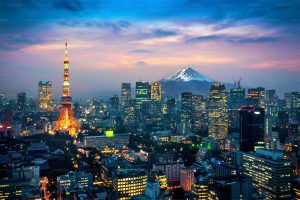
We were somewhat daunted by our initial challenge of driving across Tōkyō after living many years in the more sparsely populated areas of the country. Despite our apprehensions, we pressed forward through the endless maze of skyscrapers and high-rises crammed against one another, blindly trusting our car navigation system to take us safely across a vast sea of humanity. With a population over 37 million people, Greater Tōkyō is recognized as the largest metropolitan center on earth today and also in history. It boasts the busiest intersection in the world at Shibuya, where up to 3,000 pedestrians cross at a time and the busiest train station at Shinjuku that accommodates an average of 3.6 million passengers per day. As Japan’s capital, economic, educational and cultural center, Tōkyō also serves as the nation’s international gateway for millions more visiting the country on an annual basis. The city is a unique blend of the ultramodern with its bright lights, fast pace and creative architecture, while preserving its traditional heritage evidenced by the many historical temples scattered throughout the city and the ancient imperial palace located at its center.

Tōkyō traces its history to a small fishing village called Edo that in 1603 became the seat of the newly formed Tokugawa shogunate when power was centralized throughout Japan. As a result, this once sleepy town began to prosper and rapidly expanded its influence. With the eventual collapse of the shogunate two centuries later and the empowerment of the emperor under the Meiji Restoration, the name Edo was changed to Tōkyō (東京), meaning “Eastern Capital.” Presently, Greater Tōkyō consists of 62 municipalities that includes 23 wards, 26 cities, 5 towns and 8 villages that were absorbed by the ever-increasing sprawl of the original city. Some of Tōkyō’s more famous districts include Ginza, Shibuya, Asakusa, Roppongi, Akihabara, Harajuku and Odaiba, with each one featuring certain attractions that appeal to both international and local visitors.

Despite its immensity, Tōkyō is surprisingly recognized as one of the world’s most livable cities and is regularly listed among the safest places to visit or live. Foreign influences are also conspicuous with many tourists flocking to visit Disney Land, Disney Sea or to dine at one of the many five-star restaurants boasting cuisine from around the world. International customers also enjoy the privilege of tax-free shopping in the many name brand luxury stores. The Tōkyō Tower, another popular tourist attraction, was inspired by the Eiffel Tower but is now dwarfed by the Tōkyō Sky Tree, the second tallest structure in the world. All of these activities are made possible by an incredible transportation system that efficiently moves up to 40 million passengers per day to every corner of this modern urban miracle.

From the lofty perch afforded by the Sky Tree, one cannot help but marvel at the sheer vastness of Tōkyō, the masses of people that call it home and the incredible infrastructure needed to sustain it all. Everywhere you look there are people. It serves as a reminder that God loves people and that one of His initial commands to mankind was to “be fruitful and increase in number; fill the earth and subdue it.” (Genesis 1:28) The record of Genesis traces the partial fulfillment of this decree but also humanity’s intentional refusal to disperse when they said to themselves “Come, let us build ourselves a city… otherwise we will be scattered.” (Genesis 11:4) Their stated objective was to “make a name” for themselves (Genesis 11:4) signifying their self-reliance and deliberate independence from God. Therefore, God intervened and forcibly dispersed them by confusing their language. (Genesis 11:7) This does not mean that God opposes the establishment of cities but rather, He desires nothing to come between Him and people who are created in His image. Tōkyō and all its inhabitants are His.

Expensive Edibles

“The kingdom of heaven is like a merchant looking for fine pearls. When he found one of great value, he went away and sold everything he had and bought it.”                                                Matthew 13:45-46

Expensive tuna

The clamor slowly subsided at the Toyosu fish market auction on New Year’s Day in 2019 after a new record had just been set: 3.1 million US dollars for a gigantic bluefin tuna weighing 612 pounds. Businessman Kiyoshi Kimura, sometimes referred to as the “Tuna King,” was the dubious winner who paid more than five times the going rate for top grade tuna because of his desire to create more publicity for his chain of sushi restaurants.

In that same year, another record was set for the purchase of two Yubari King melons sold at the season’s initial auction in the city of Sapporo. The top tier of this particular melon commonly sells for $200 US, but a pair of them were bought for the exorbitant sum of $45,000. Yoshihiro Iwate, the president of Pocca Sapporo Food and Beverage, declared that the purchase was an expression of his company’s gratefulness to the agricultural industry and to the local melon farmers.

While these expenditures for such items seems wildly excessive, similar outrageous sums of money are often spent for other unique food products in Japan. For example, a single bunch of Ruby Roman grapes was recently auctioned off for $12,000 which meant that each individual grape was valued at $400. A single 12-ounce Kobe Beef steak that is served at a wagyu restaurant in Akasaka set a new world record with a $2,500 price tag. Japan now produces some of the world’s finest whisky, but a single bottle of Suntory’s Yamazaki 55, prized for its rarity and quality, sold in 2020 for over $800,000.

These astronomical prices for perishable, consumable commodities are, admittedly, difficult to understand. The factors of publicity, scarcity, labor intensity and appreciation tend to play significant roles in inflating product values. For example, purchasing the so-called top-of-the-line of a particular item brings with it widespread publicity which can easily be used to promote sales. Other items, like the special whisky and, increasingly, the overfished bluefin tuna, are scarce goods so the economics of the free market naturally drives those prices up. Cultivated products like the grapes, Kobe beef and melons only achieve their superior quality through intensive, costly labor that is considered a source of pride in a land that stereotypically strives for perfection. Then finally, Japan is a country where gift giving and expressing formal appreciation is a huge value, so such expensive gifts can serve to fill this influential social obligation.

The pursuit and discovery of an object of value is actually a biblical concept that Jesus employed in two parallel parables to teach a significant truth. In them Jesus communicated that the importance of the kingdom of heaven can be compared to a man selling all he had to acquire a treasure in a field or to obtain a pearl of great value. (Matthew 13:44-46) These two simple, but profound parables, served to shine a spotlight on what we should value in this present world as we reflect on the world to come. When put in these terms, it does seem unwise to invest the best of our time, money and efforts in things that have only temporal value. While it may be tempting to dine upon prize winning tuna, melons, steak and grapes, we should never forget that as the redeemed people of God, we will one day feast at His banquet table. There, we will never hunger or thirst again. The only food that will truly satisfy our souls is to be found in the presence of God, because of the mercy of God. When in eternity we dine at the feast of the Lamb, we will celebrate that we, too, “were bought at a price. Therefore honor God with your bodies.” (I Corinthians 6:20)