A High Place

“He makes my feet like the feet of a deer; he causes me to stand on the heights.”            Psalm 18:33

high ground 2

The importance of being located near a high place or “takadai” (高台) in a tsunami prone area became vividly real to us shortly after we arrived to assist with relief efforts following the cataclysmic Great East Japan Earthquake of 2011. At the bottom of one particular set of stairs leading up a steep hill in a tsunami ravished town, we were puzzled to discover a jumble of carts typically used for transporting small children. When we raised our eyes to survey the landscape below us, we soon noticed what remained of a Japanese preschool that had been obliterated just a few days earlier by the massive onslaught of water. Then we understood the mystery of the jumbled carts. Following the siren warnings of a coming tsunami, teachers at that school had obviously snatched up all the children in their care and fled to the nearest takadai for safety. Later, we were thankful to learn that only one child from that particular school perished that day, but stories up and down the coast were far more sobering.

As many of the towns and villages in that part of Japan are forced to hug the coastline due to adjacent mountains, inhabitants can become easily trapped by an incoming tsunami. Therefore, it is important to know where a nearby takadai is located and how to access it. Evacuation signs to higher ground are common place in these areas and sets of stairs that often seemingly lead to nowhere are part of the proactive measures taken to save lives in the event of another disaster.

Much of the energy on those ravaged coastlines continues to be focused on ensuring the safety of residents against future calamities. In some localities, major construction projects are raising the level of towns while leveling nearby mountains for fill dirt, that in turn become alternative sites for rebuilding on higher ground. Crumbled seawalls are also being demolished and reconstructed according to taller specifications, as the general aim is to move everything higher. The quest for a takadai understandably seems to be the preoccupation of most surviving local residents who seek to rebuild their homes, businesses, schools and hospitals on higher ground. There they would have assurance of safety, security, normalcy, and more importantly, a measure of control over their lives which they dramatically lost on March 11, 2011.

Under such circumstances, one can easily understand the desire to obtain a takadai, but an imbalanced pursuit of safety and security in a world full of potential threats can actually lead us astray. As we struggle with the inevitable challenges of life, we may be tempted, apart from God, to seek “higher ground” upon which to build our lives, with safety and security being our sole objectives. God does not guarantee such things in our present life but instead, we are exhorted to flee to Him when life seems dangerous or out of control. He alone is our takadai or higher ground. There is no place safer.

Family for Rent

“Whoever does God’s will is my brother and sister and mother.”   Mark 3:35

rental family

Without warning, Mrs. Tanaka’s* husband left her a year ago and consequently, she struggled to move forward with her shattered life as a young, single mother. She felt abandoned and longed for someone to lean on, and her young daughter needed a father figure in her life. In addition, the kindergarten where Mrs. Tanaka was hoping to enter her child was more inclined to accept children of married couples. Determined to get help, she contacted a professional rental family agency or rentaru kazoku (レンタル家族) to provide a substitute father.

Mrs. Tanaka’s case is not unusual. Estrangement, illness, abuse and death can leave huge gaps within families. Therefore, a new industry has sprung up in Japan to fill these needs. Actors and actresses are hired out by agencies to clients like Mrs. Tanaka to temporarily stand in as substitute parents, spouses, friends or coworkers at one-off social events like weddings. Depending on the situation and need, they may fill a designated role for extended periods of time. For example, an elderly woman may periodically want a substitute grandchild to take out shopping. A bride-to-be longs for a substitute father to walk her down the aisle in her dream wedding. A businessman estranged from his family might rent a part-time wife and child to ease his loneliness. A single woman with marriage-obsessed parents may temporarily rent a fake boyfriend or fiancée to escape their unwanted pressure. The list of social situations lending themselves to recruiting suitable substitutes is surprisingly quite extensive in a society that tends to emphasize appearance over substance.

A single actor can actually play multiple roles in several families at the same time as part of their profession, but it can be extremely difficult to keep personal feelings in check in every situation. However, these role players are instructed to do their best to promote positive outcomes in each assignment and ideally, eventually make themselves redundant in the client’s life. Of course, client dependency is a possible hazard in the family rental business as the customer may desire more from the fabricated relationship than the rental person is able or willing to provide.

The creation of the rentaru kazoku industry is an achingly sad testimony of the many genuinely hurting people who long for healthy, satisfying relationships, which of course is not a problem restricted to Japan. Real families and friends can inevitably disappoint us, so it is only natural to turn to substitutes or other inadequate alternatives to ease our pain. Such wounds are not easily eradicated, but God has offered an amazing life-giving, life-healing relationship through His Son. Jesus welcomes us in our brokenness in a broken world and promises to receive us like a beloved family member if we turn to Him and seek His will. There is no pretense in this relationship and no fees are charged as membership into this exclusive family was purchased at the cross. While God does not promise to redeem all of our earthly relationships, acceptance into His forever family is an amazing gift that is not to be taken lightly. It also means we are members of an extended spiritual family that can bring tremendous comfort in this life and in the world to come.

*Fictitious name and situation

Lost & Found

“if they find lost property…they must return…the lost property they found.”             Leviticus 6:3-5

Wasuremono

Following my usual morning routine, I inserted money into the local vending machine to purchase a can of ice coffee before heading off to work for the day. Later on, I realized to my chagrin that I had neglected to retrieve my ¥900 change, worth almost nine dollars, from the vending machine. When I returned home almost twelve hours later, I checked the vending machine out of curiosity and was pleasantly surprised to discover my money still waiting for me untouched in the coin return. Such stories are actually not unusual in Japan.

Everyday throughout the country, literally thousands of misplaced wallets, cell phones, keys, bikes, umbrellas, bags etc. are turned in by conscientious Japanese at collection points conveniently located in stores, train stations and local police boxes. These lost articles, known as “wasuremono” (忘れ物) or literally “forgotten item,” are dutifully collected, tagged and stored for a period of time with the hope of returning them to their rightful owner. Signs are posted everywhere reminding people not to forget personal items which still inevitably occurs, but fortunately, the Japanese are extremely diligent in returning other people’s property. Amazingly this widespread practice of honesty extends even to lost money, where roughly 75 percent of the cash that is reported as wasuremono is eventually returned to the owner. The Japanese typically keep detailed records of such matters so they know that 26.7 million items were reported to police departments in 2015, highlighting the widespread extent of this practice and also the challenge of practically dealing with it.

Although many are not aware of it, Japan actually has a “Lost Property Law” prompting citizens who find lost items to turn them into the police. Even though they are entitled to a proportional reward from the owner, most people would decline any remuneration if it was offered to them. In cases where the owner is not located within three months, the finder is entitled to keep the lost article as a variation of the more traditional “finders keepers” approach. The question naturally arises as to why Japanese are so diligent in this practice of returning misplaced items when compared to many other cultures. The most likely answer is probably rooted in the moral education commonly taught and practiced in schools and then reinforced in countless ways on the public consciousness.

Many Japanese would consider keeping a lost item to be the moral equivalent of stealing, which aligns closely with scriptural teaching on this topic (Leviticus 6). The concept of “lostness” actually taps into a deep, yet central theological theme pointing to our need for a Savior. In Isaiah 53:6, the whole of mankind is described as sheep that “have gone astray,” wandering away from the purposes and heart of God, their Shepherd. This theme is reiterated in other passages and powerfully illustrated by Jesus Himself through three parables in Luke 15 where He uses the analogy of a lost sheep, a lost coin and a lost son to teach about His Heavenly Father’s passion for restoring what is lost, namely us. In fact, Jesus identifies this as being the very purpose of His coming to Earth when He said “For the Son of Man came to seek and to save the lost” (Luke 19:10). This means that God has by grace enacted His own “Lost Property Law” when He offered His Son on a cross, so that we might be restored to God, our rightful owner. As the famous line of the hymn “Amazing Grace” so aptly phrases it, “I once was lost, but now I’m found.

Punctuality

“There is a time for everything, and a season for every activity under the heavens.” Ecclesiastes 3:1

Punctuality

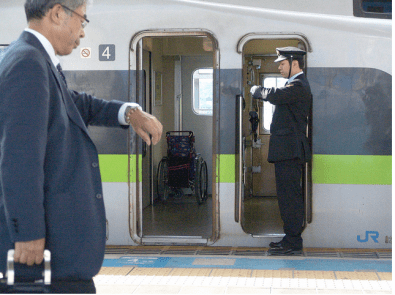
Japan has a well-earned reputation as a country where things run on time. For example, thousands of trains every day across the country, routinely pull into their assigned stations exactly on schedule. Customers send packages or luggage through a nationwide delivery service and then choose a date and four-hour window in which they want their item delivered, which usually occurs without fail. At construction sites for buildings or roadwork, signs are posted notifying when the job will be completed and they are seldom wrong. Fast food service seems effortlessly fast in Japan and repairmen show up as promised on time, if not early.

In the rare cases where a scheduled appointment is broken, service is slow or a train pulls into a station late, extensive apologies are usually expressed with the promise to do better in the future. When a train is unavoidably delayed due to an earthquake or a tragic suicide on the tracks, causing thousands to be inconveniently delayed, rail officials will diligently hand out “late notes” to affected commuters to cover their tardiness at work. One train recently departed from the station 25 seconds early, which became quite a scandal in Japan and called for new measures to prevent a repeat of such a disastrous scenario.

This seemingly obsessive focus on punctuality drives employees to arrive, not just on time at their place of work, but to actually get there early, so they can begin their job precisely as scheduled. No one quite knows when this meticulous focus on time began in Japanese culture, but it was certainly invigorated when Japan joined the family of nations in the 19th century and later took on even greater importance as part of the rebuilding process following WWII. However, companies are discovering that an emphasis on punctuality doesn’t always correspond with increased efficiency. Others who endure endless mind-numbing meetings wonder why there is such a preoccupation with starting on time, but almost an indifference with ending such meetings on time.

To the outsider, Japan seems like a well-oiled machine, where everything works and runs as planned, which for the most part, is a really admirable characteristic. It is a helpful reminder that God is a God of order, who has created a universe that is governed and measured by time. Although He Himself is not bound to the restraints of time, it is one of many resources placed at our disposal and we are expected to be wise stewards as to how we use it. This does not excuse an imbalanced obsession with time, but should rather encourage us to treat each hour, each day and each year as a gift from God that we should use for His eternal purposes and not for our own. We serve the Master of the Universe, and as such we are not slaves to time but rather, time exists to serve us. May we use it wisely.