

“Do not take revenge, my dear friends, but leave room for God’s wrath.” Romans 12:19a
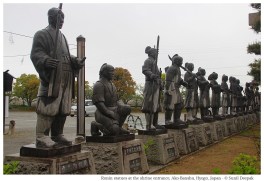
In 2013, Hollywood released the film “47 Ronin” which was loosely based on a famous event in Japan and starred Keanu Reeves. In the ensuing years, this well-chronicled historical incident gained notoriety through several plays and numerous movie versions. As the title indicates, the story centers around rōnin, or former samurai who have been relegated to social outcast status in Japan’s feudal class system. This loss of prestige is usually due to the death or disgrace of a samurai’s master. Rōnin (浪人) literally means “wandering wave person” and the term is now commonly applied to other societal misfits or wanderers. In modern Japan, the word rōnin is frequently used to describe unemployed white-collar workers or high school graduates who have not been accepted by a university.
According to ancient traditions, a samurai was given the opportunity to commit seppuku (ritual suicide) upon the loss of his master rather than endure a life without honor or status as a rōnin. To do otherwise invited shame, but many rōnin became mercenaries, joined the merchant class or got involved in criminal activities. However, the story of the 47 rōnin was an extreme exception to this pattern.
The legendary tale of these unusual rōnin began with the forced seppuku of Asano Naganori, a minor feudal lord who had assaulted a powerful court official named Kira Yoshinaka in April 1701. However, contrary to accepted traditional patterns, 47 of Asano’s samurai refused to accept their fate and secretly vowed to avenge the death of their master. Led by a samurai named Ōishi, they agreed to disperse and take on ordinary roles as tradesmen and monks to lull their enemy into complacency. Over a year later, on January 31, 1703, the 47 rōnin broke through Kira’s lax defenses and succeeded in killing him, carrying out their intricate plan for vengeance. Knowing that authorities would not condone their vendetta, this band of dedicated rōnin proceeded to place Kira’s severed head on their master’s tomb in the Sengaku-ji Temple and then laid down their weapons in surrender. These infamous assailants were then ordered to commit seppuku, which only served to further cement their legendary status throughout Japan. As Asano’s devoted retainers, the 47 rōnin were ceremonially buried near their master, which over time, become a place of veneration due to their enduring example of loyalty, perseverance, honor and sacrifice.
Although there are many noble attributes associated with this famous tale, the darker motive of revenge primarily drives the narrative. While it is certainly true that the name and honor of Asano Naganori was restored through the heroic deeds of his loyal subjects, they too had something to gain. Their honor as samurai was preserved, a wrong was avenged and their names live on in history. But this does not overlook that the essence of revenge is basically rooted in selfishness where one tries to get even for a personal wrong suffered at the hands of corrupt or uncaring people. The core premise of revenge is that another form of evil must be used to counteract evil.
However, the Scriptures call us to pursue a higher alternative based on faith and grounded in the character of God. “Do not take revenge, my dear friends, but leave room for God’s wrath, for it is written: ‘It is mine to avenge; I will repay,’ says the Lord.” (Romans 12:19) The very act of revenge requires one to assume the role of God, dispensing justice and retribution based upon personal slights and a limited understanding of transpired events. We live in a world that seems dominated at times by injustice and lies, but we must remember that ultimate justice and truth are God’s exclusive domain. As an act of faith, we must leave these matters in His hands and to His Son, who was shamed like a rōnin but died on our behalf. The cross paradoxically represents both justice and injustice. It is an unprecedented story, with only one hero, who changed the course of not just history, but eternity.

 Ippo Ippo
Really struggling with forgiveness and revenge…if I bow out of taking revenge in order for God to handle it, it feels as though my heart is in the same condition & place of unforgiveness. The not taking revenge is purely from a desire to obey God and a fear of disobedience, not of forgiveness and love. The feeling of forgiveness feels impossible & I worry I’ll never be the same after experiencing what I have. How is this remedied?
PS-I enjoy reading your posts
LikeLike
Thank you for your very honest and vulnerable response. It appears that you have had some deep pain inflicted upon you at some point in your life that is understandably, hard to get past. Forgiving someone in such a situation may seem like you are surrendering control to them but in essence, you are surrendering control to God… your anger, your desire for revenge, your pursuit of justice and your pain are all laid in the hands of God and at the foot of the cross as an act of faith not feelings. Such wounds can be healed through the mercy of God, but they inevitably leave behind scars. Some of these scars remain with us for the duration of our lives but they serve as a testimony of the power of God and His mercy in our own lives. As you so aptly stated, genuine forgiveness does not come naturally, but is in fact a supernatural act where we are given opportunity to emulate our Heavenly Father who has forgiven us of much, much more. You are wise to wrestle with all the thoughts and emotions associated with whatever was unfairly done to you, but freedom is what you seek and it will never be gained by choosing to remain where you are. The 47 ronin sought their own form of revenge for a an act of injustice, but as children of God, our feelings and the fate of our oppressors are God’s domain and we do well to acknowledge that to Him in a prayer of surrender. Such an act is not condoning any evil done to us, but rather, a cry from our heart that God will do what is right in my life and in the lives of those who have hurt me. The Psalms are full of such vulnerable and honest prayers and reading them may be a good place to start on the road to forgiveness. May God give you grace and strength for such matters.
LikeLike
Thank you so much for taking the time to respond so thoughtfully and thoroughly. “…but as children of God, our feelings and the fate of our oppressors are God’s domain and we do well to acknowledge that to Him in a prayer of surrender. Such an act is not condoning any evil done to us, but rather, a cry from our heart that God will do what is right in my life and in the lives of those who have hurt me.”
This in particular hits the hardest. It is surrender and it is a cry from the heart …I don’t know that I’ve done that in earnest. I will start there and with the Psalms. Thank you again.
LikeLike
I have been reading through Tim Keller’s book “The Songs of Jesus” which is a devotional series on the Psalms. I think you will find it to be helpful. My devotion today on Psalm 35 was particularly relevant to your recent comments. Blessings, Mike
LikeLike
Blessings on your journey of trusting God in new ways. It can be unsettling and even frightening at times, but there is no better place to be. Paradoxically, these can be the hardest lessons in life but they can be the most precious as we learn to lean into God in new ways. Proverbs 3:5-6
LikeLike