Inside/Outside

“Here there is no Gentile or Jew, circumcised or uncircumcised, barbarian, Scythian, slave or free, but Christ is all, and is in all.”  Colossians 3:11

Inside-Outside (2)

In the natural world, it is common for similar species to congregate together for purposes of security and survival. There are quite a variety of names for these different animal clusters. For example, a group of cattle is called a “herd.” Wolves gather in a “pack.” A collection of lions is referred to as a “pride.” Fish swim together in a “school” and penguins huddle side-by-side in a “colony.” Birds fly in a “flock,” baboons live together as a “troop” and an infestation of caterpillars is called an “army.” Along a similar vein, the Japanese tend to identify themselves as belonging to certain social groupings that are described as being either “uchi” (内) or “soto” (外). Uchi means literally “inside” and soto means “outside.”

This uchi/soto distinction is a basic concept woven throughout Japanese society and is even reflected in Japanese language patterns. In contrast to the West, with its focus on the individual, in Japan, inter-social relations and group consciousness take a much higher priority. People generally view themselves as either uchi or soto depending on the particulars of their immediate circumstances and their self-perceived identity within a given setting.

Nowhere is this more evident nor more complex than in the workplace. For example, within a division of a company, one typically regards his or her boss as soto and everyone on their own level as uchi. This perception determines the language patterns one would use when addressing someone considered above you and therefore outside of your group. However, in the case where you are speaking to a person from another company, then you would regard all the personnel of your company as being uchi, which would correspondingly affect your mannerisms and speech patterns. The general idea is that those who are outside of your group should be honored, and those within your group should be humbled. Such patterns of perception and behavior are also evident within schools, clubs, various social circles and even within churches. Obviously, such self-classifications are not static due to ever-changing circumstances, but they do serve to provide one’s need for identity and security within a hierarchical environment.

The concept of uchi and soto is evident on a macro level as well, shaping Japan’s national perception in relation to other countries. It is therefore common practice for the Japanese to refer to themselves as “we Japanese” and all foreigners are classified as “gaijin,” translated literally as “outside person.” While this tendency towards nationalism is common throughout the world, the uchi/soto concept adds another layer of separateness that can make it even more difficult for foreigners to fully integrate into Japanese society.

Such social and ethnic distinctions are certainly not unique to Japan, as the world is rife with divisions based on numerous factors. The message of the Gospel, though, and the establishment of the early church cut across these ancient and discriminatory lines in an unprecedented manner. Even the old barriers between the Jews, or God’s adopted people, and those on the outside known as “Gentiles,” were forever broken down through the power of the cross (Colossians 3:11). More importantly, we were all outside of the grace of God, regarded as “soto,” but in Christ, we are now eternally “uchi.” This stunning change is the miracle of the church and an amazing testimony of the mercy of God.

Neighborhood News

“And who is my neighbor?” Luke 10:29b

Kairanban

We had not lived in Japan very long before we discovered that community is an important value and good communication within the local neighborhood is considered a critical element for a healthy community. To facilitate this worthwhile objective, we paid a “voluntary” monthly fee to the local neighborhood association for the privilege of membership. This membership kept us in the information loop through a periodic circular notice folder, called a kairanban (回覧板), that is dutifully passed on from neighbor to neighbor. The contents of this folder varied each time, touching on a number of different topics. Some examples of this are local road construction news, dates for public health screenings, information on the neighborhood cleanup day, safety precaution advisories, any changes in garbage collection procedures, notification of local festivals, appeals for charities, local school news, reports of unusual criminal activity, scheduled senior events, and advertisements for local businesses. Most important of all was the routine announcement of the next neighborhood association meeting and the not-so-subtle reminder to attend.

We normally skimmed through the enclosed sheaves of papers, making sure we weren’t missing anything critical in nature, and then stamped our personal seal on it along with the date. This verified that we received the neighborhood news before passing it on to the next person on the list. Although it could be bothersome at times, the kairanban did serve as an additional reminder that we were not just a collection of individuals, but were part of a community.

Since we frequently moved, we were members of many communities in Japan over the years. The strength of our bonds within these communities varied, depending on how long we lived in a particular place, the age of our children and our time availability. In time, we increasingly came to appreciate this structured sense of belonging where neighbors were encouraged to look out for each other and personally invest in the community. We also realized that as foreigners, we were probably under the neighborhood microscope more than the typical Japanese resident. This reality was brought to our attention when a neighbor expressed her sadness at our impending departure, noting that we always put our trash out on the correct days, were diligent in our snow removal, kept our garden up and spoke politely to everyone!  This interaction confirmed what we had long suspected, that as foreigners in the neighborhood, we lived in a goldfish bowl with many people observing us. While this was somewhat intimidating, it was also reassuring that members of the community genuinely cared about us.

 In hosting his long running children’s TV show, “Mr. Rogers’ Neighborhood,” Fred Rogers always opened the show with a corny song titled “Won’t You be My Neighbor?”  Through this simple ditty and for the duration of the show, Mr. Rogers emphasized the importance of being a good neighbor. But when another man, from a different era, asked Jesus a similar question, “Who is my neighbor?” (Luke 10:29b) we are told that his real intent wasn’t to promote neighborly behavior, but rather, to justify himself. (v.29a) In response to the man’s question, Jesus proceeded to tell the famous parable of “The Good Samaritan.” (vv. 30-37) This seemingly simple story took the concept of being a neighbor to a much deeper level, revealing the compassionate heart of God and the natural inclination towards self-centeredness in man. Now that we live in the States, a kairanban is no longer delivered to our door but we still have abundant opportunities to practice community on a daily basis. The good Samaritan and Mr. Rogers serve to remind us that our love for God should be reflected in our love for others. This truth is not just a lesson for children. Won’t you be my neighbor?

Empty Foundations

For he was looking forward to the city with foundations, whose architect and builder is God.”   Hebrews 11:10

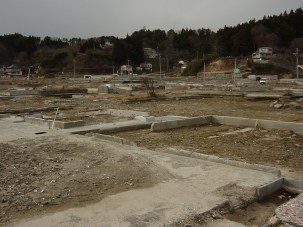
Empty FoundationsFollowing the Great East Japan Earthquake in March 2011, a familiar sight along the 500-kilometer (310 miles) stretch of devastated coastline were empty foundations in field after field where bustling towns and villages once stood. Over several months, mountains of debris caused by the tsunami were painstakingly removed and the only remaining evidence of prior human habitation were thousands of vacant concrete slabs. Vegetation slowly took over and the seemingly empty fields eventually begin to appear like ancient archeological ruins lingering from a previous civilization. Long stretches of collapsed sea walls usually accompanied these sites, offering muted testimony of their failure to protect the inhabitants against the destructive forces of nature.

Most of the survivors from this massive disaster were relocated to hastily assembled temporary housing units that were tucked further inland on higher ground. There, the survivors stoically waited for months and then years for the return of normalcy and some form of permanence in their lives. Each community worked with government officials to develop master plans for rebuilding and renewal as they struggled to recover from the past and yet still dreamed of future prospects.

This process understandably took time, and transpired in phases as mammoth machines moved earth and rubble to give way to a new infrastructure, hosting new communities. As part of this transition process, temporary buildings sprang up everywhere, almost like weeds, providing a variety of badly needed services. Temporary grocery stores, gas stations, drinking establishments, restaurants, local shops, business offices, clinics, police stations and even a public bath dotted the landscape, reminding everyone of past and present hardships while fostering hope of a better future. Some businesses managed to reopen on the top floors of badly damaged structures that would later be demolished. All of this served as a constant reminder that we lived in the midst of a deeply stricken community desperately struggling to survive.

Living in such a prefab world only served to increase our thirst for things of a permanent and even eternal nature. As we tread carefully among the rubble of people’s lives, our thoughts were often lifted heavenward and we began to “look forward to a city with foundations, whose architect and builder is God.” (Hebrews 11:10) Much like our spiritual father Abraham and other heroes of the faith, many of whose lives are chronicled in that same chapter, the incompleteness or temporary nature of things characterizing our lives reminded us daily of heavenly realities that yet awaited us. As we often pondered on what those empty foundations represented in the past, they also served as a powerful reminder of much greater things that were only visible through eyes of faith. That’s the city we should seek in the midst of life’s storms.

Sumo Ring

“Your path led through the sea, your way through the mighty waters, though your footprints were not seen.”  Psalm 77:19

yobidashi

If you ever watch or attend a sumo tournament, your attention will be naturally drawn to the behemoth wrestlers in the center of the ring. There, the two contestants skillfully grapple with one another until one wrestler loses by either stepping out of the ring or touches the dirt with any body part besides his feet. Often unnoticed in the midst of this exciting activity are assistants hovering attentively off to the side. These are the yobidashi (呼び出し), the handymen employed by the Japan Sumo Association to perform a number of key tasks essential to the success of every sumo event.

Among their many assigned chores, yobidashi play taiko drums outside to attract customers, display banners before the match, attend to the various needs of the wrestlers and judges, hand out prizes and make certain announcements. However, their chief responsibility entails the proper construction of the elevated sumo ring (dohyō) and they must diligently maintain it throughout the tournament. As part of the maintenance routine, the yobidashi frequently sweep the ring to remove all marks so the judges can readily determine if a wrestler has touched the dirt when the outcome of the contest is uncertain.

The term yobidashi means “to call, or to summon,” which can refer to their role of calling out the wrestlers for a match or to their position of being “on call” for various tasks associated with a sumo tournament. The yobidashi, like the wrestlers themselves, operate within a strict hierarchy, often entering their unique occupation as teenagers and steadily working their way up through the ranks. No more than 45 yobidashi are employed at any given time and they are carefully trained in their techniques with the goal of becoming almost invisible on the sideline as they carry out their duties.

Other sports around the world similarly employ an army of workers and tools for a variety of tasks related to sporting events. Consider the instant replay booth, which helps verify a wide range of actions that take place on the field of competition. Like marks left in a recently swept sumo ring, these technological advances provide additional evidence of what actually transpired, even when such actions escape notice of the human eye in real time. In the same way, the works of God and His activity in the affairs of the world around us, often remain unseen to us. This does not mean that God is not proactively engaged in the things that concern us, but rather, we often fail to perceive it. Therefore, we are instructed to “live by faith and not by sight” (II Corinthians 5:7); evidence of God’s handiwork is often not readily apparent to us.

Sometimes, the absence of such “marks” can lead us to speculate as to what God may or may not be doing as we seek to faithfully fulfill His purposes here on Earth. But every once in a while, we are provided glimpses of God’s power and grace in our lives like a mark left in the sumo ring before the passing of time sweeps it away. Such “footprints” (Psalm 77:19) serve as reminders of God’s presence and power as we journey by faith in a world full of uncertainties.

New Year Money

“…though you are evil, know how to give good gifts to your children…” Luke 11:13a

Otoshidama2

Christmas was over for our children, but they soon reaped an unexpected, additional windfall with the onset of the Japanese new year. They would receive otoshidama. Over the next few days, several of our Japanese friends kindly gave our kids small envelopes of money that they were to use for themselves. This custom supposedly dates back to the Edo period (1603-1868), when wealthy individuals gave mochi (rice cakes) to others at New Year’s and presented some as offerings at the local Shinto shrine. These treats were called “toshidama” (年玉), which meant literally “rice ball/treasure.” Over the course of time, these presents of mochi were replaced by small toys to children which eventually were substituted by cash gifts.

Otoshidama is typically given to school age children by immediate relatives, close family friends and in some cases, even neighbors. The amount of money generally varies upon the nature of the relationship with the child and the child’s age. For example, elementary children average ¥2-3,000 ($20-30) per envelope, junior high kids ¥5,000 and high school students ¥10,000. The money is traditionally placed in a miniature envelope called a puchibukuro that is decorated with a popular anime figure, cartoon character or an animal matching that year’s Chinese zodiac. Only new bills of money are included and it is neatly folded into thirds before being placed in the envelope.

Surveys indicate that most children use these monetary gifts to purchase video games, manga, or toys, but some set part of the money aside for future purposes. It is considered impolite for children to open the puchibukuro in front of others and the majority of parents carefully monitor the otoshidama to ensure it is spent appropriately. We certainly did so with our children as we helped guide them with purchases that were usually beyond our limited resources and we also encouraged them to save a portion of this special new year money.

In teaching His disciples about prayer, as recorded in Luke 11, Jesus used the simple analogy of a father giving good and appropriate gifts to his children to drive home an important point. Just as parents are eager to provide for their children, God delights in providing for us as His children. Therefore, we are to confidently approach our Heavenly Father to ask, because it will be given to us. To seek, and we will find. To knock, and the door will be opened to us (v.9). However, like children entrusted with sizable sums of cash, we are also obligated to use the bountiful gifts of God wisely, in line with His eternal purposes and life-giving guidelines. We may not get all the toys and trinkets that this world has to offer, but God places into each of our envelopes exactly what we need. Otoshidama come only once a year and end altogether when one reaches adulthood. But the gifts of God come unexpectedly in many forms and without limit. Every day is a new year with God.

Foreign Holidays

“This is a day you are to commemorate;” Exodus 12:14a

Christmas in Japan

It was our first Christmas Day in Japan and everything felt wrong when I surveyed the world around me. Children were in school, the banks were open and the stores were full of customers. Besides the beautiful blanket of snow covering the ground, there was no visible evidence of Christmas. In the preceding weeks, we had managed to procure a Christmas tree, wrapped our collection of gifts and even tracked down a place that sold turkeys as part of our preparation to celebrate Jesus’ birth. But Christmas was obviously not a major event in Japan.

Many years later, Christmas is still not recognized as a national holiday in Japan, but it is certainly on the nation’s radar. For example, Christmas music is now commonly played in numerous venues. Christmas trees and decorations are sold everywhere. People are increasingly putting up Christmas lights on their homes and giant light displays known as “iruminēshon” (illumination) have become popular attractions. Christmas Eve is generally considered to be a romantic time for young couples in love who celebrate the occasion by going out for a special meal, exchanging gifts and visiting a local iruminēshon. Japanese have even developed their own genre of Christmas music composed and performed by famous artists. A sample of this is a song by Takeuchi Mariya called “Sutekina Kurisumasu” (“Lovely Christmas”). Local merchants are naturally very enthusiastic about anything that puts more money in their pockets, which also accounts for the increasing popularity of other foreign special days like Easter, Valentine’s Day and, more recently, Halloween. Tokyo Disneyland has particularly capitalized on these trends featuring special events, displays, menu items and merchandise that match these festive occasions.

Of course, Japan has its own standard holidays like Constitution Day, Sports Day, Children’s Day, Respect for the Elderly Day, the Emperor’s Birthday, Labor Day, Marine Day and Vernal Equinox, but these do not easily lend themselves to celebratory events. Churches throughout Japan are understandably keen to capitalize on people’s interest in Christmas, so they typically sponsor a variety of meetings designed to share the true meaning of Christmas and the wonder of God’s visitation to Earth.

Special days are often set aside around the world to commemorate significant historical events and this was also true of God’s people. Following the miraculous phenomenon associated with their liberation from Egyptian bondage, God instructed the Israelites to commemorate the penultimate plague, Passover, with a unique celebration that was to be observed on an annual basis (Exodus 12). As God continued on other occasions to intervene in history to deliver His people, additional festive events were instituted and observed by generations that followed. The stated purpose of these special days was to recall the mighty deeds of God as an act of worship. But God’s ultimate intervention in the affairs of man went unnoticed by all except for a handful of shepherds and a few faithful individuals who longed for His appearing. Unexpectedly, and inexplicably, God voluntarily took on human flesh and dwelt among us. Jesus came to “save his people from their sins” (Matthew 1:21) and this arrival is the wondrous event we commemorate with every Christmas season. Immanuel. God is with us. Let us bow in worship.

Bicycles

“In those days it was not safe to travel about,” II Chronicles 15:5a

Long before the advent of the popular minivan and SUV, my wife adapted her bike to fill basically the same purposes, at a greatly reduced cost. Strapping a baby on her back, with our oldest son sitting behind her in a child seat and our middle child riding in another seat attached to the handlebars, she would head off to the local grocery store to do our shopping. She rode what is commonly called a mamachari, which is translated as a “mom bicycle,” getting its name from the slang terms for mother and bike.  A mamachari is a basic bike that typically comes equipped with a chain guard, fenders, a dynamo light, a basket, a simple lock and a rear rack. These inexpensive bikes are extremely practical for transporting small children and local purchases over short distances. They are popular not just with moms, but also with businessmen commuting to work, students heading to school and elderly people running local errands.

There are over 80 million bicycles (called jitensha—自転車) in Japan, which ranks among the top worldwide in bikes per capita. Oddly, though, Japan is not known as being a particularly bike-friendly nation. Bicycle lanes are almost non-existent, forcing pedestrians, bicyclists and cars to often share the same space. In addition, designated parking areas for bikes located near stations and shopping areas are often grossly inadequate. Even then, fees are routinely charged for such services and hefty fines levied for parking violations. Thievery is uncommon in Japan, but bikes seem to be an exception to this rule, with the majority of bikes stolen for reasons of convenience rather than profit. We learned this lesson the hard way many years ago when my wife’s newly purchased bike was swiped from a public parking lot in front of a large department store. To combat such crimes, everyone is now required to register their bike with the police for a one-time fee.

Japan is a country that has rules for many things and this also includes bikes. The use of cell phones, umbrellas and headphones while cycling is prohibited, as well as any kind of alcoholic consumption prior to bicycling, due to the safety risks these activities invite. Riding on sidewalks is also illegal, but these rules are often conveniently ignored by the general populace and usually overlooked by the police. In a safety-conscious country, it is interesting to observe that helmets are optional but their usage is gradually becoming more prevalent among school children. E-bikes (electric bikes) have been quite common for a number of years among young mothers who use them year-round to taxi their children to and from day care centers. I have been left in a trail of dust on many occasions by a mom or elderly woman zipping by me as I strenuously labored to climb a steep hill on my more conventional bike.

Travel takes many forms and each one is accompanied by its own set of risks. Each time a person ventures forth from his or her home via bike, bus, car, train or plane, they are entering into additional circumstances where many elements are beyond their control. King Asa of Judah was confronted by such perils during his tumultuous reign when it was said, “In those days it was not safe to travel about.” (II Chronicles 15:5a) Despite having at his disposal an army comprised of over half a million fighting men (II Chronicles 14:8) and having achieved many great victories, King Asa and his people continued to be vulnerable to a multitude of dangers. Although he undertook many additional measures to secure his kingdom and protect his subjects, King Asa is primarily praised for grasping the limitations of his power and leaning into God who can “help the powerless against the mighty.” (v.11) While it is common sense to take practical measures to protect ourselves while traveling, no helmet, safety belt or life preserver can provide the safeguard we really need.

Yakuza

“Now the earth was corrupt in God’s sight and was full of violence.” Genesis 6:11

My first introduction to the world of yakuza was at a Japanese hot spring where a sign discreetly indicated that anyone with tattoos was prohibited from using the facility. This directive was a euphemistic way of saying that yakuza were not welcome. After all, it was easy to enforce such restrictions upon a certain dark segment of society who are readily identified by their rather unique and prominent tattoos known as “irezumi.” I soon learned that there were other means for picking out yakuza, or Japanese gangsters, in society. For example, they are sometimes missing a part of a finger and they often drove large foreign cars like Cadillacs, which were very scarce in Japan.

Yakuza are members of a large organized crime syndicate in Japan with its roots dating back to the Edo Period (1603-1868). Their criminal activities usually center around extortion, racketeering, human trafficking, drugs, gambling, questionable real estate practices and even arms smuggling. Different yakuza factions focus on different enterprises with some of these extending beyond the borders of Japan. The yakuza reached their zenith of influence in the 1960s with a membership of more than 200,000, but since then their numbers have significantly dropped. This decline is primarily due to the enactment of several laws restricting their activities and changes in market opportunities. The present number of yakuza is estimated to be roughly 28,000 members; the island of Kyushu has historically served as their prime recruiting ground. Approximately 60 percent of yakuza members come from burakumin, or members of the traditional outcast class, and 30 percent are recruited from Japanese-born Koreans.

The Japan film industry created a popular genre of movies centered on the yakuza world. Several manga series have also picked up on this theme and, together, they romanticize the underworld activities of these Japanese gangsters by emphasizing their strict codes of conduct and rigid hierarchical structure. Yakuza gangs tend to mimic the senior/junior (sempai-kōhai) relationship pattern common throughout Japan, but do so on an exaggerated scale as members are required to cut their family ties and transfer their loyalties to a gang boss. Sometimes this fealty is demonstrated through the partial or complete amputation of the left little finger in a ritual known as yubitsume, which is also used as a form of penance for any perceived failure. Some yakuza now wear prosthetic fingertips to hide this distinctive mark and avoid attention.

A propensity towards violence was one of the initial indicators of man’s fall and departure from godly behavior. The first crime recorded in scripture following man’s eviction from the Garden of Eden was Cain’s extreme violent act of murdering his own brother. Violence among mankind then escalated to such an extent that God felt it necessary to exercise judgment on the entire earth in the form of a flood because it “was corrupt in God’s sight and was full of violence.” (Genesis 6:11) Pride and violence are sometimes linked together in the Bible (Psalm 73:6) because a self-centered independence from God (pride) can potentially unleash horrific actions normally condemned in civilized societies. The yakuza are well-known as occupants of the dark underworld in Japan, but another form of darkness occupies the hearts of all mankind and it is only the grace of God that curbs its full manifestation.

Pest Preventatives

“’I will prevent pests from devouring your crops, and the vines in your fields will not drop their fruit before it is ripe,’ says the Lord Almighty.” Malachi 3:11

Carrion crow on a trash bag, Germany, Europe

Japan has an ongoing battle with crows who seem doggedly intent upon opening and spilling out the contents of trash bags across the country. As a result, local residents have taken up arms to thwart these annoying and unsanitary activities. Although this conflict continues to rage back and forth, it has reached a stalemate in many areas as various measures known as “karasu yo-ke” (カラス除・stop crows) have been implemented to frustrate the objectionable deeds of the crow population. Such innovative efforts typically involve placing bags of garbage securely under nets or in sturdy cages and in addition, limiting the hours when residents are allowed to put their trash out for pickup. But the crows, who are quite clever, continue to offer resistance and repeatedly find ways to circumvent such advanced tactics.

Crows are not the only unwelcome pests in Japan. A wide variety of repellents known as “yoke” have been developed to ward off the possible activities or presence of other unwanted creatures. Topping this list of offenders would probably be mosquitos, as evidenced by the vast array of products for sale that advertise themselves as “mushi yoke,” or insect repellents. Mice repellents (nezumi yoke), snake repellents (hebi yoke), deer repellents (shika yoke) and wild boar repellents (inoshishi yoke) are available in various forms promising positive results if properly applied.

We encountered our most interesting form of yoke while we were camping in a remote area of northern Japan. Our sleep was interrupted several times that particular night by a loud “BOOM!” that continued like clockwork every fifteen minutes. When we groggily talked to fellow campers the following morning about this strange occurrence, we were informed that the noise was a “kuma yoke,” or bear repellent, that was designed to scare intruding bears away. However, a more bizarre form of yoke is the strategic placement of clear water bottles in many people’s gardens that theoretically serve as neko yoke, or cat repellent. According to popular belief, sunlight reflecting off of these bottles will discourage cats from using the garden as their personal restroom facility. Whether this is truly an effective deterrent, or just an urban legend, is not clear, but the intended objective is obvious: to keep cats out.

Unwanted pests are certainly not a modern phenomenon, but clearly date back to ancient times as mankind struggles to tame and rule over the physical world that God entrusted to his care. (Genesis 2:15) Elements of that struggle were undoubtedly intensified following mankind’s initial fall into sin and the consequential curse upon the created world (Genesis 3:17-9; Romans 8:20-22) Some might even argue that mosquitos were part of the original curse, and if true, I would be tempted to include crows among the chief offenders in the aftermath of the Fall!

But other scriptural passages point to the absence of such destructive pests as evidence of God’s blessing upon a certain individual or people group. Just the opposite occurred when God utilized various pests (frogs, gnats, flies, locusts) among the infamous ten plagues to punish Egypt for its disobedience. In contrast to this, the prophet Malachi exhorted the Israelites to offer up their full obedience, and in return, God promised to bless them by thwarting the destructive activities of pests upon their crops (Malachi 3:11). While mankind strives to develop various forms of yoke to control unwanted creatures, none can compare with the power of God who provides the protection we really need. This is no urban legend.

Robots

“He made himself nothing by taking the very nature of a servant, being made in human likeness.” Philippians 2:7

  Robot Hotel  Opened in 2015, the Henn Na Hotel chain in Japan (translated “Weird Hotel”) is largely staffed by robots. Upon entering this unique hotel, guests are initially greeted in the lobby by a female-faced android, followed by a multilingual dinosaur proceeding to check them in. Another robot soon appears to transport the guest’s luggage to their assigned room and a face recognition system conveniently unlocks the door. An assortment of other robots fill various work roles in this impressive semi-automated lodging. However, half of the robotic labor force was recently “laid off” as some of the robots tended to create more work rather than reduce it. Innovation to improve the efficiency and capacity of robots continues to progress, not just within this hotel chain, but throughout Japan where robots are increasingly utilized.

The general purpose of robots, which are called “robotto” (ロボット) in Japanese, is to free up humans from difficult or mundane tasks while vastly improving productivity. This purpose explains why the industrial usage of robots has skyrocketed, with Japan ranking among the world leaders in robotic technology along with South Korea, Germany, Singapore and Taiwan.  Many experts think that the solution to Japan’s chronic shortage of labor, due to population decline, is automation, not immigration. This accounts for the country’s heavy reliance on robot labor. Japan’s love affair with robots is somewhat rooted in its past, echoing back to karakuri ningyo, or mechanical dolls that were developed in the 17th century using imported European clock-making technology. Such ingenious developments eventually led to the creation in 1928 of a robot called “Gakutensoku” by Nishimura Makoto. This robotto could make facial expressions and perform a few rudimentary actions. It was the first of its kind in all of Asia.

Robotic technology now dominates the industrial sector of Japan and android robots are becoming increasingly common, performing a variety of duties in social, medical, security, entertainment, senior care, food service and educational circles. It is not uncommon to discover a robot in airports, places of business or hospitals greeting people and performing some kind of basic service. Aibo, the first mass-produced commercial robotic dog sold on the market by Sony, became the precursor of other robotic inventions designed primarily for entertainment. Life-like robots that perform certain religious functions at temples and shrines have also been deployed and used on a limited basis. The city of Yokohama recently put on display the world’s largest robotto which stands 60 feet in height (18 meters), weighs over 25 tons and is modeled after the Gundam robot from the famous anime series.

The advancements in robotic technology are very impressive as robots continue to improve in their imitation of human skills, intelligence and appearance. However, all such developments pale in comparison to the greatest transformation of all, where God took on full human form to redeem mankind (Philippians 2:6-8). This was no poor imitation like a robot, but rather, God fully submitted Himself to take on all the frailties of human flesh to such a degree that He hungered (Mark 11:12), grew tired (John 4:7) and most telling of all, He wept (John 11:35). As the writer of Hebrews so aptly put it: “He too shared in their humanity so that He might break the power of him who holds the power of death.” (Hebrews 2:14a)