

“This is a day you are to commemorate;” Exodus 12:14a

It was our first Christmas Day in Japan and everything felt wrong when I surveyed the world around me. Children were in school, the banks were open and the stores were full of customers. Besides the beautiful blanket of snow covering the ground, there was no visible evidence of Christmas. In the preceding weeks, we had managed to procure a Christmas tree, wrapped our collection of gifts and even tracked down a place that sold turkeys as part of our preparation to celebrate Jesus’ birth. But Christmas was obviously not a major event in Japan.
Many years later, Christmas is still not recognized as a national holiday in Japan, but it is certainly on the nation’s radar. For example, Christmas music is now commonly played in numerous venues. Christmas trees and decorations are sold everywhere. People are increasingly putting up Christmas lights on their homes and giant light displays known as “iruminēshon” (illumination) have become popular attractions. Christmas Eve is generally considered to be a romantic time for young couples in love who celebrate the occasion by going out for a special meal, exchanging gifts and visiting a local iruminēshon. Japanese have even developed their own genre of Christmas music composed and performed by famous artists. A sample of this is a song by Takeuchi Mariya called “Sutekina Kurisumasu” (“Lovely Christmas”). Local merchants are naturally very enthusiastic about anything that puts more money in their pockets, which also accounts for the increasing popularity of other foreign special days like Easter, Valentine’s Day and, more recently, Halloween. Tokyo Disneyland has particularly capitalized on these trends featuring special events, displays, menu items and merchandise that match these festive occasions.
Of course, Japan has its own standard holidays like Constitution Day, Sports Day, Children’s Day, Respect for the Elderly Day, the Emperor’s Birthday, Labor Day, Marine Day and Vernal Equinox, but these do not easily lend themselves to celebratory events. Churches throughout Japan are understandably keen to capitalize on people’s interest in Christmas, so they typically sponsor a variety of meetings designed to share the true meaning of Christmas and the wonder of God’s visitation to Earth.
Special days are often set aside around the world to commemorate significant historical events and this was also true of God’s people. Following the miraculous phenomenon associated with their liberation from Egyptian bondage, God instructed the Israelites to commemorate the penultimate plague, Passover, with a unique celebration that was to be observed on an annual basis (Exodus 12). As God continued on other occasions to intervene in history to deliver His people, additional festive events were instituted and observed by generations that followed. The stated purpose of these special days was to recall the mighty deeds of God as an act of worship. But God’s ultimate intervention in the affairs of man went unnoticed by all except for a handful of shepherds and a few faithful individuals who longed for His appearing. Unexpectedly, and inexplicably, God voluntarily took on human flesh and dwelt among us. Jesus came to “save his people from their sins” (Matthew 1:21) and this arrival is the wondrous event we commemorate with every Christmas season. Immanuel. God is with us. Let us bow in worship.



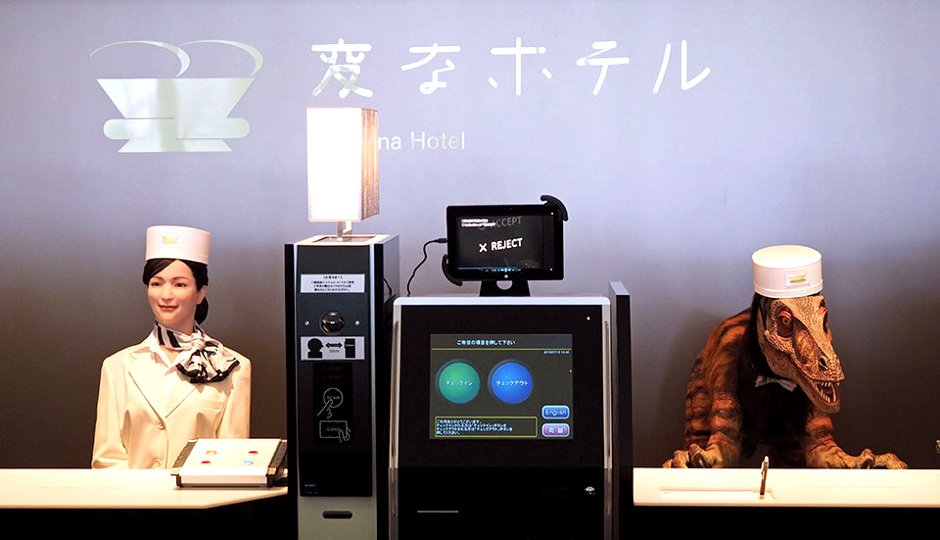 Opened in 2015, the Henn Na Hotel chain in Japan (translated “Weird Hotel”) is largely staffed by robots. Upon entering this unique hotel, guests are initially greeted in the lobby by a female-faced android, followed by a multilingual dinosaur proceeding to check them in. Another robot soon appears to transport the guest’s luggage to their assigned room and a face recognition system conveniently unlocks the door. An assortment of other robots fill various work roles in this impressive semi-automated lodging. However, half of the robotic labor force was recently “laid off” as some of the robots tended to create more work rather than reduce it. Innovation to improve the efficiency and capacity of robots continues to progress, not just within this hotel chain, but throughout Japan where robots are increasingly utilized.

 After a few months in Japan, I was starving for some familiar American junk food. McDonald’s (pronounced “Makudonarudo”) was already fairly common at that time, but my friends and I were particularly hungry for pizza. When someone informed us that there was a Shakey’s Pizza located downtown that offered an all-you-can-eat buffet for only ¥500, we immediately organized an expedition to satisfy our pent-up cravings. Upon arrival, we strategically located ourselves at a table closest to the serving counter so we could be the first to pounce on the fresh pizzas as they were brought out. A couple of minutes later, when a pizza was pulled out of the oven and sliced up for the waiting customers, we sprang into action. To our dismay, the main topping on this particular pizza was corn, so we reluctantly returned to our table to wait for a better offering. Shortly afterwards, we leapt into action when another pizza was served, but this one was covered with octopus tentacles so again, we took a pass. The next one looked like a cheese pizza which we hungrily scooped up, but one bite revealed the “cheese” was actually mayonnaise! We were eventually rewarded with some pizzas that looked and tasted more familiar, but that day served as a reminder that common foods back home may be mixed with some uncommon ingredients in Japan.
 Christmas was drawing near and as newcomers to our neighborhood, we thought it would be a nice gesture to take a gift of homemade Christmas cookies to each of our neighbors. We should have known better. Within hours of dispensing our holiday goodies, our doorbell started ringing. It was payback time. Through our unsolicited gifts, we had unintentionally obligated our neighbors to correspond in kind. Therefore, several of them responded to our meager gift by reciprocating with something of equal value. In Japan, no one wants to be put in the awkward position of indebtedness to someone else.
