

“He made himself nothing by taking the very nature of a servant, being made in human likeness.” Philippians 2:7
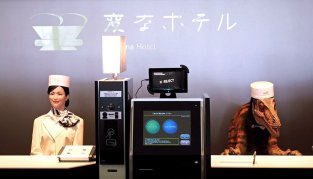 Opened in 2015, the Henn Na Hotel chain in Japan (translated “Weird Hotel”) is largely staffed by robots. Upon entering this unique hotel, guests are initially greeted in the lobby by a female-faced android, followed by a multilingual dinosaur proceeding to check them in. Another robot soon appears to transport the guest’s luggage to their assigned room and a face recognition system conveniently unlocks the door. An assortment of other robots fill various work roles in this impressive semi-automated lodging. However, half of the robotic labor force was recently “laid off” as some of the robots tended to create more work rather than reduce it. Innovation to improve the efficiency and capacity of robots continues to progress, not just within this hotel chain, but throughout Japan where robots are increasingly utilized.
The general purpose of robots, which are called “robotto” (ロボット) in Japanese, is to free up humans from difficult or mundane tasks while vastly improving productivity. This purpose explains why the industrial usage of robots has skyrocketed, with Japan ranking among the world leaders in robotic technology along with South Korea, Germany, Singapore and Taiwan. Many experts think that the solution to Japan’s chronic shortage of labor, due to population decline, is automation, not immigration. This accounts for the country’s heavy reliance on robot labor. Japan’s love affair with robots is somewhat rooted in its past, echoing back to karakuri ningyo, or mechanical dolls that were developed in the 17th century using imported European clock-making technology. Such ingenious developments eventually led to the creation in 1928 of a robot called “Gakutensoku” by Nishimura Makoto. This robotto could make facial expressions and perform a few rudimentary actions. It was the first of its kind in all of Asia.
Robotic technology now dominates the industrial sector of Japan and android robots are becoming increasingly common, performing a variety of duties in social, medical, security, entertainment, senior care, food service and educational circles. It is not uncommon to discover a robot in airports, places of business or hospitals greeting people and performing some kind of basic service. Aibo, the first mass-produced commercial robotic dog sold on the market by Sony, became the precursor of other robotic inventions designed primarily for entertainment. Life-like robots that perform certain religious functions at temples and shrines have also been deployed and used on a limited basis. The city of Yokohama recently put on display the world’s largest robotto which stands 60 feet in height (18 meters), weighs over 25 tons and is modeled after the Gundam robot from the famous anime series.
The advancements in robotic technology are very impressive as robots continue to improve in their imitation of human skills, intelligence and appearance. However, all such developments pale in comparison to the greatest transformation of all, where God took on full human form to redeem mankind (Philippians 2:6-8). This was no poor imitation like a robot, but rather, God fully submitted Himself to take on all the frailties of human flesh to such a degree that He hungered (Mark 11:12), grew tired (John 4:7) and most telling of all, He wept (John 11:35). As the writer of Hebrews so aptly put it: “He too shared in their humanity so that He might break the power of him who holds the power of death.” (Hebrews 2:14a)


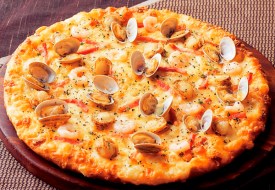 After a few months in Japan, I was starving for some familiar American junk food. McDonald’s (pronounced “Makudonarudo”) was already fairly common at that time, but my friends and I were particularly hungry for pizza. When someone informed us that there was a Shakey’s Pizza located downtown that offered an all-you-can-eat buffet for only ¥500, we immediately organized an expedition to satisfy our pent-up cravings. Upon arrival, we strategically located ourselves at a table closest to the serving counter so we could be the first to pounce on the fresh pizzas as they were brought out. A couple of minutes later, when a pizza was pulled out of the oven and sliced up for the waiting customers, we sprang into action. To our dismay, the main topping on this particular pizza was corn, so we reluctantly returned to our table to wait for a better offering. Shortly afterwards, we leapt into action when another pizza was served, but this one was covered with octopus tentacles so again, we took a pass. The next one looked like a cheese pizza which we hungrily scooped up, but one bite revealed the “cheese” was actually mayonnaise! We were eventually rewarded with some pizzas that looked and tasted more familiar, but that day served as a reminder that common foods back home may be mixed with some uncommon ingredients in Japan.
 Christmas was drawing near and as newcomers to our neighborhood, we thought it would be a nice gesture to take a gift of homemade Christmas cookies to each of our neighbors. We should have known better. Within hours of dispensing our holiday goodies, our doorbell started ringing. It was payback time. Through our unsolicited gifts, we had unintentionally obligated our neighbors to correspond in kind. Therefore, several of them responded to our meager gift by reciprocating with something of equal value. In Japan, no one wants to be put in the awkward position of indebtedness to someone else.
 Japanese has a reputation for being a very difficult language for native English speakers to master, but it actually incorporates a considerable number of English words in its vocabulary. Unfortunately, many of these words are often unrecognizable. Called
  Soon after our initial arrival in Japan, we were a little bewildered by some things we observed when we joined a Japanese family who had kindly invited us over for a meal. Before we even sat down to eat, the husband proceeded to demean his wife’s efforts in cooking and house cleaning. Unlike the typical American domicile, we didn’t notice any family photos capturing activities of the children or anything commemorating their individual achievements. Little mention was actually made of the children outside of our hosts’ minimal responses to our polite inquiries. We also thought it odd when they referred to their son as a “baka musuko” (stupid son). We went home that evening rather puzzled by our experience, but later learned that it is considered socially taboo to praise one’s own family.
 Ippo Ippo