


“So we make it our goal to please him.” II Corinthians 5:9a
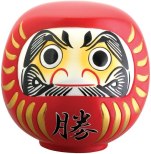
The one-eyed daruma (達磨) doll, with its unusual shape, appeared almost comical as it seemed to stare at me from its perch on the shelf. I later learned that when initially purchased, all daruma dolls have blank spots in the place of eyes, which are added later according to custom. The dolls are traditionally brightly colored, made of papier-mâché into a rotund shape, and are often weighted at the bottom so that they will return to an upright position when tipped over. Some say this tendency to remain upright symbolizes success and the ability to overcome adversity. The typical daruma has eyebrows in the shape of a crane and a beard resembling the vague form of a tortoise as both creatures represent longevity in Japanese culture.
Darumas trace their origin to Bodhidharma, who is recognized as the founder of the Zen tradition of Buddhism. Bodhidharma lived around the 6th century and several legends are associated with his ascetic lifestyle. For example, it is said that he stared at a wall in meditation for nine years without moving, which caused his arms and legs to atrophy and eventually fall off through disuse. This odd bit of folklore supposedly explains why daruma dolls have no arms or legs. Another legend connected to this famous Buddhist monk is that he once fell asleep during his meditation and became so angry at his failure to stay awake that he cut off his eyelids to prevent such a reoccurrence. Perhaps this fable accounts for the attention given to the eyes of a daruma.
Although some consider daruma dolls to be just a toy, they are widely regarded as a sort of talisman that can bring the owner good luck. The general practice when purchasing an eyeless daruma is to paint in one of the eyes after identifying a desired goal. Once that goal comes to pass, it is customary to paint in the other eye. It is believed that this unusual process will motivate the daruma to grant one’s wish since he will regain full sight once the goal is achieved. This curious custom also serves to remind the owner of their intended goal every time they see the one-eyed daruma sitting on the shelf. It is no surprise then that people running for a political office often purchase a daruma and paint in one eye when announcing their candidacy and then paint in the other eye if they are elected. At the close of the year, people customarily return their daruma to the temple where it was purchased and then priests will burn it in a formal ceremony.
Darumas are associated with achieving a stated goal or desire, but such objectives are typically self-centered. These goals can include such things as success in the financial world, a favorable outcome in a desired relationship, good grades on an exam, a victory in a sporting activity or advancement at work. Such desires are certainly understandable and in many cases commendable, but as the people of God, we are called to seek something higher. Stated simply, our overarching goal should be to please God and everything else in life must be made subservient to this heavenly objective. This focus requires us to remove self from the center of our personal universe and let God take His rightful place as “we make it our goal to please Him.” (II Corinthians 5:9a) Such a recalibration of our heart and mind does not require us to purchase and reconfigure a talisman to achieve our goal. Rather, it involves the simple act of surrender of our will to the All-Seeing, All-Powerful God of the universe who does not need us to create eyes for Him.
 Japanese has a reputation for being a very difficult language for native English speakers to master, but it actually incorporates a considerable number of English words in its vocabulary. Unfortunately, many of these words are often unrecognizable. Called
  Soon after our initial arrival in Japan, we were a little bewildered by some things we observed when we joined a Japanese family who had kindly invited us over for a meal. Before we even sat down to eat, the husband proceeded to demean his wife’s efforts in cooking and house cleaning. Unlike the typical American domicile, we didn’t notice any family photos capturing activities of the children or anything commemorating their individual achievements. Little mention was actually made of the children outside of our hosts’ minimal responses to our polite inquiries. We also thought it odd when they referred to their son as a “baka musuko” (stupid son). We went home that evening rather puzzled by our experience, but later learned that it is considered socially taboo to praise one’s own family.


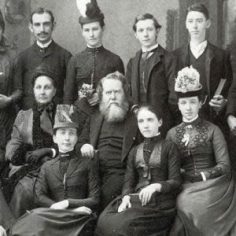 Long before the term “selfie” carved out a unique niche in our lexicons, the Japanese used an alternative word that eventually became a part of our personal vocabulary and history. It is called “kinen shashin” (記念写真) and it is roughly translated as “commemorative photograph.” Whenever a group assembles for a particular occasion, someone inevitably calls for a kinen shashin to be taken to commemorate the event. If you browse through our personal photo albums (back in the day when we collected physical photographs), you will discover quite a few of these kinen shashin scattered among other pictures portraying family and friends in various locations and activities.


