

“So I went down to the potter’s house, and I saw him working at the wheel.” Jeremiah 18:3
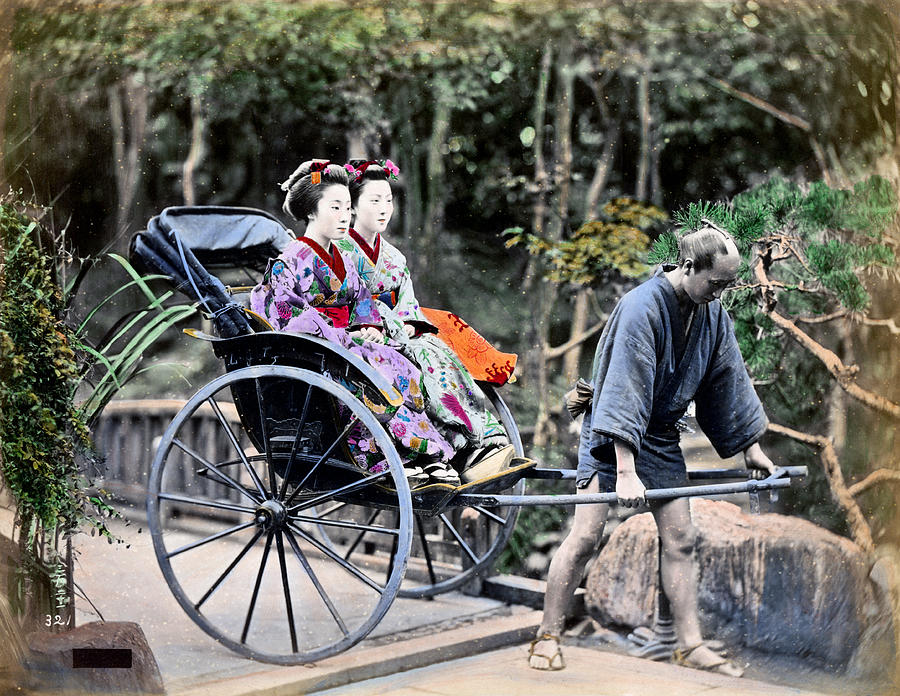
Japan is a land of many unique happenings, including an interesting historical oddity when the general usage of the wheel was banned during the Edo Period (1603-1867). This unusual law was reputedly enacted by Tokugawa Ieyasu, a powerful shogun (a supreme military leader), following a century of brutal conflict that culminated with the ascendency of the Tokugawa clan to absolute rule. Numerous theories have been proposed to account for this unusual measure involving the restriction of wheels, but it is probably a combination of two major factors. One theory is that a law prohibiting the usage of wheels throughout Japan likely discouraged competing feudal lords from opposing the shogunate rule since the ability to swiftly transport warriors, weaponry and supplies would be significantly hampered. Other historians conjecture that the mountainous terrain characteristic of Japan made wheels difficult to use unless a network of roads was constructed, which would require a huge financial outlay by the governmental authorities. Therefore, nobility were usually carried in palanquins and all supplies were transported by human labor under the rule of subsequent shoguns.
It is believed that the origins of the wheel in Japan came via China at some point in the sixth or seventh century. In other parts of the world, wheels were customarily convenient to use where there was an expanse of level ground or in major urban areas. But they often proved to be impractical in the predominant mountainous landscape of Japan. Therefore, the transportation of goods over long distances was usually done on major rivers or by sea faring ships that hugged the coastlines. The term “wheel” in Japanese is kuruma, but now the word is more commonly used for a car. The Japanese character for kuruma (車) is frequently incorporated in words denoting numerous forms of transportation that involve wheels, such as bicycles, carts, trains, wheelbarrows and unicycles.
In this modern era, it is admittedly hard to imagine a Japan without wheels. The preponderance of cars, motorcycles, planes, trains, buses, bicycles and other forms of transit all use wheels. Wheels are now considered to be essential to the clockwork precision by which people and materials are easily moved from one end of the country to the other. The ancient network of roads, like the famous Tōkaidō, that were originally constructed for travelers on foot or horseback, eventually gave way to modern transportation routes featuring the predominance of the wheel.
Wheels have other purposes besides transportation as the prophet Jeremiah pointed out through his powerful analogy centered on a potter’s wheel. In chapter 18 of the Book of Jeremiah, God is compared to a potter who takes a lump of clay, representing His people, and expertly reshapes it into a vessel suited for His eternal purposes. This illustration is a helpful reminder that each of us is a unique creation in the hands of God as He forms us into useful vessels to reflect His glory. Such a process is often painful as it calls for deconstruction of the clay vessel before it is reconstructed into something much more serviceable for the Master’s purposes. A wheel is intended to take us to places where we want to go and similarly, as pieces of clay on the Heavenly Potter’s wheel, we are lovingly prepared for the places where God leads and for the things He desires. (verse 4) This is one wheel that should never be outlawed but instead, be embraced in faith by every child of God.







 Ippo Ippo