
Jizō Statues

“You, Lord, will keep the needy safe and will protect us forever from the wicked.”             Psalm 12:7

Jizo

My first encounter with jizō statues occurred while driving on a winding, forested road circling a scenic volcanic lake. The silent and gnome-like stone sentries along the road easily blended into their natural setting, but their conspicuous bright red clothing and caps managed to catch my attention. In spite of the frozen half-smiles fixed upon their faces, these solitary figures portrayed a sense of loneliness incongruent with their colorful attire. I had no idea what they were but it was obvious that these stone carvings served some sort of religious purpose. I later learned that they were called jizō (地蔵) or “womb of the earth,” but are often honorifically referred to as ojizō-sama.

Jizō are commonly found on minor roads, in temple gardens, along public footpaths and even outside of busy train stations. They are often housed within a primitive wooden hut to provide a symbolic protection from the elements. These statues are considered to be representatives of a Bosatsu, a Buddhist adherent who sacrificially postponed his own transition to Nirvana in order to aid others on their spiritual journey towards enlightenment. The Jizō variety of Bosatsu are regarded as the protectors of travelers and children, which accounts for their deliberate placement in areas associated with travel. Devotees often dress these jizō statues in red bibs and hats as red is believed to be a color that wards off evil or danger. Legends say that the jizō also protect children who have prematurely died from evil spirits by hiding them in their clothing, thus enabling them to complete their spiritual pilgrimage.

But these seemingly innocuous statues often hide a darker purpose designed to fill deep emotional wounds of women who have miscarried in pregnancy or have chosen to abort the life of their unborn child. Memorial services are offered for those who have experienced such loss in which prayers are offered to the jizō for a dead or unborn child. Such services also provide a form of emotional closure for the grieving or guilt-ridden parent. The origins of this custom may date back as far as the 14th century and is designed to assure the well-being of a child who did not have sufficient opportunity to accrue good karma on earth.

Gazing upon jizō statues, it is not hard to imagine the natural longing of the human heart to seek protection for one’s self or for a deceased loved one. After all, God is continually portrayed in Scriptures as the One who protects His people and several metaphors are used to capture this important concept. That is why God is frequently described as a rock, a hiding place, a stronghold, a shield and even as a mother hen guarding her chicks. But this also raises the question of who are the needy and from what do they need protection?

The Bible often singles out widows, the fatherless and foreigners who are in special need of protection because of their vulnerable social and economic status (Psalm 146:9). However, these examples of needy individuals serve to remind us that any of us at any given time can become weakened and left defenseless by dire circumstances in life or through the devious actions of others. Therefore, we all need a Protector to whom we can flee for safety that no stone statue can begin to provide. In stark contrast, the Maker of Heaven and Earth beckons us to turn to Him for whatever help we may need in whatever crisis we may face. As we travel through life, only God can “keep the needy safe and will protect us forever from the wicked.” (Psalm 12:7) He is no silent stone statue which is impotent to protect us.
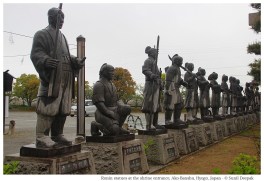
47 Ronin

“Do not take revenge, my dear friends, but leave room for God’s wrath.” Romans 12:19a

47 Ronin

In 2013, Hollywood released the film “47 Ronin” which was loosely based on a famous event in Japan and starred Keanu Reeves. In the ensuing years, this well-chronicled historical incident gained notoriety through several plays and numerous movie versions. As the title indicates, the story centers around rōnin, or former samurai who have been relegated to social outcast status in Japan’s feudal class system.  This loss of prestige is usually due to the death or disgrace of a samurai’s master. Rōnin (浪人) literally means “wandering wave person” and the term is now commonly applied to other societal misfits or wanderers. In modern Japan, the word rōnin is frequently used to describe unemployed white-collar workers or high school graduates who have not been accepted by a university.

According to ancient traditions, a samurai was given the opportunity to commit seppuku (ritual suicide) upon the loss of his master rather than endure a life without honor or status as a rōnin. To do otherwise invited shame, but many rōnin became mercenaries, joined the merchant class or got involved in criminal activities. However, the story of the 47 rōnin was an extreme exception to this pattern.

The legendary tale of these unusual rōnin began with the forced seppuku of Asano Naganori, a minor feudal lord who had assaulted a powerful court official named Kira Yoshinaka in April 1701. However, contrary to accepted traditional patterns, 47 of Asano’s samurai refused to accept their fate and secretly vowed to avenge the death of their master. Led by a samurai named Ōishi, they agreed to disperse and take on ordinary roles as tradesmen and monks to lull their enemy into complacency. Over a year later, on January 31, 1703, the 47 rōnin broke through Kira’s lax defenses and succeeded in killing him, carrying out their intricate plan for vengeance. Knowing that authorities would not condone their vendetta, this band of dedicated rōnin proceeded to place Kira’s severed head on their master’s tomb in the Sengaku-ji Temple and then laid down their weapons in surrender. These infamous assailants were then ordered to commit seppuku, which only served to further cement their legendary status throughout Japan. As Asano’s devoted retainers, the 47 rōnin were ceremonially buried near their master, which over time, become a place of veneration due to their enduring example of loyalty, perseverance, honor and sacrifice.

Although there are many noble attributes associated with this famous tale, the darker motive of revenge primarily drives the narrative. While it is certainly true that the name and honor of Asano Naganori was restored through the heroic deeds of his loyal subjects, they too had something to gain. Their honor as samurai was preserved, a wrong was avenged and their names live on in history. But this does not overlook that the essence of revenge is basically rooted in selfishness where one tries to get even for a personal wrong suffered at the hands of corrupt or uncaring people. The core premise of revenge is that another form of evil must be used to counteract evil.

However, the Scriptures call us to pursue a higher alternative based on faith and grounded in the character of God. “Do not take revenge, my dear friends, but leave room for God’s wrath, for it is written: ‘It is mine to avenge; I will repay,’ says the Lord.” (Romans 12:19) The very act of revenge requires one to assume the role of God, dispensing justice and retribution based upon personal slights and a limited understanding of transpired events. We live in a world that seems dominated at times by injustice and lies, but we must remember that ultimate justice and truth are God’s exclusive domain. As an act of faith, we must leave these matters in His hands and to His Son, who was shamed like a rōnin but died on our behalf. The cross paradoxically represents both justice and injustice. It is an unprecedented story, with only one hero, who changed the course of not just history, but eternity.

Different Deaths

 “Who can live and not see death, or who can escape the power of the grave?” Psalm 89:4

Different Deaths

Mr. Watanabe* was only 39 years old when he suddenly passed away, shocking everyone who knew him. In contrast, Mr. Suzuki’s* death at age 64 was not particularly unusual, but it shocked people for different reasons. Further details revealed that Mr. Watanabe probably died from karōshi (“death from overwork”) and the circumstances associated with Mr. Suzuki’s death classified it as a “solitary death,” or kodokushi. The common Japanese character in both of these terms for death is shi (死). It is often used in association with other characters to indicate the particular nature of a person’s demise, such as death from starvation, disease, suicide or battle.

The term karōshi, was coined in 1978 to describe the increasingly reported phenomenon of relatively young adults dying prematurely and the cause of their deaths being primarily linked to extreme overwork. Most of these individuals labored for long hours over an extended period of time with no days off until they eventually collapsed due to a combination of stress, exhaustion and poor dietary habits. Heart attacks and strokes were the most common results and many resorted to taking their own lives in desperation. Some surviving relatives began to file lawsuits against companies that were guilty of forcing impossible working conditions upon their employees. The disturbing trend of such deaths eventually came to the attention of public authorities and prompted government intervention. Karōshi hotlines were set up to offer help, laws were enacted to limit overtime and companies were educated to implement frequent health checks and better working conditions for employees. Workers were also encouraged to take their allotted days off and personal vacation time which many had previously foregone due to work pressures. 

Kodokushi, or “lonely death,” points to a different sociological problem where people become isolated from communities for various reasons and die alone in their residence with their bodies remaining undiscovered for long periods of time. This social anomaly was identified in the 1980s and came to the nation’s attention following the Great Hanshin earthquake in 1995, when thousands of elderly Japanese were relocated to isolated residences and many mysteriously started to die alone with their deaths going unreported. Further research reveals that this alarming trend is almost unique to men who are over fifty, unemployed, live isolated lives and have minimal contact with family. In some cases, the bodies of such individuals remain undiscovered for years until their bank accounts eventually become depleted, triggering a cessation of automatic payments for their rent and utilities. Toru Koremura, who operates a specialized cleaning company that deals with the unpleasant after effects from such deaths ironically commented, “Dead people have taught me how to live better.” Read the article “The Lonely End” by Matthew Bremner for a sobering account of this phenomenon.  

Regardless of the circumstances of one’s death or the cause of death, there is one common denominator of truth that is universally avoided: we will all eventually die. Some deaths may be unusually tragic, others heroic and some barely noticed, but no one is exempt. Everyone dies, but paradoxically, we generally live our lives pretending otherwise, as the alternative is too frightening. This approach explains why death is described as our ultimate enemy in I Corinthians 15:26, but the passage goes on to announce the glorious news that the power of death is eternally broken by the sacrificial death of God’s own Son (vv. 55-57). Koremura is correct in observing that we can learn much from death, but we need not fear it. I have stood before many graves and read the powerful words “Where, O death, is your victory? Where, O death, is your sting?” The answer? It has been defeated by the Cross.

*Both are fictional characters

Empty Foundations

For he was looking forward to the city with foundations, whose architect and builder is God.”   Hebrews 11:10

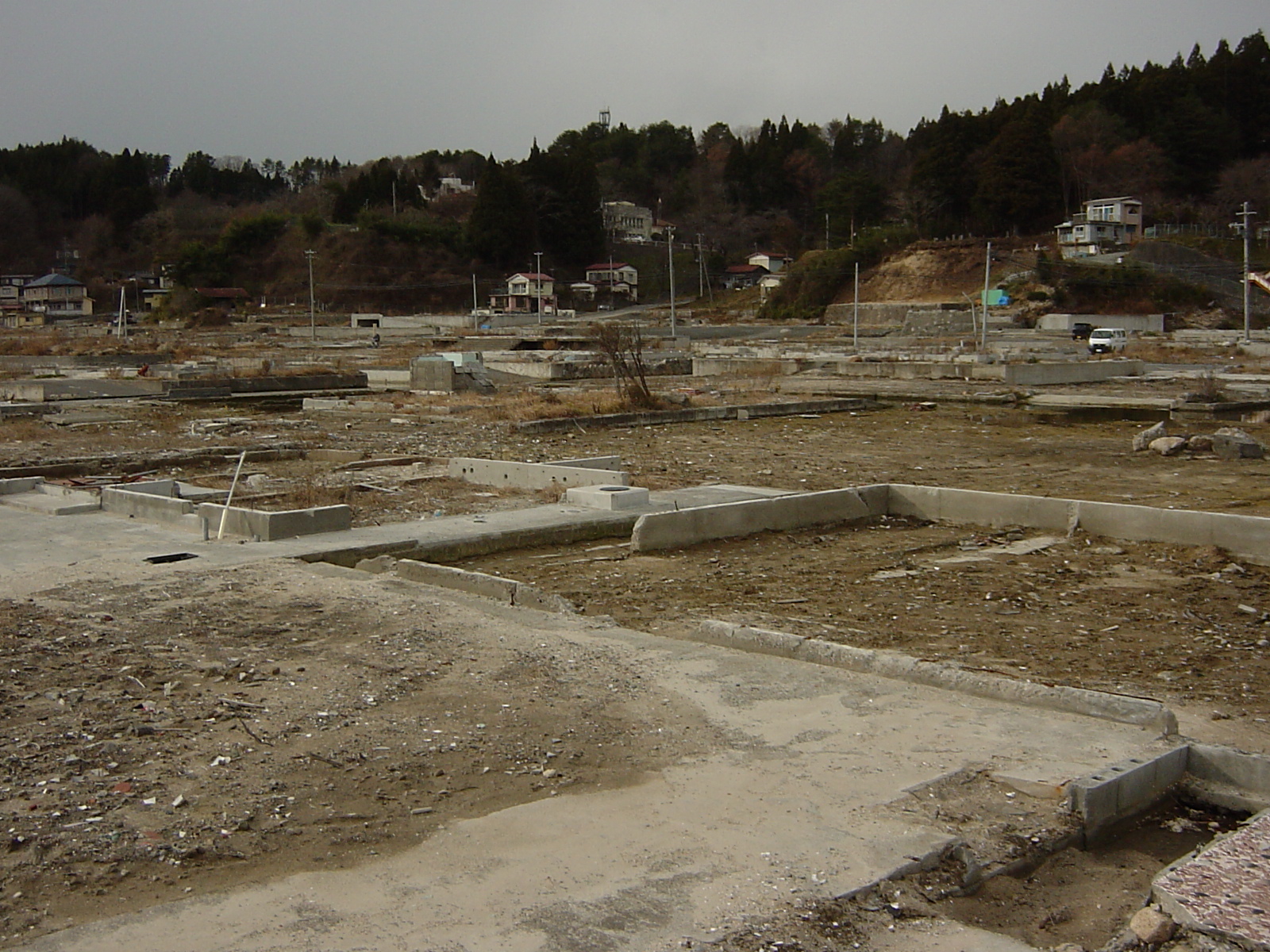
Empty FoundationsFollowing the Great East Japan Earthquake in March 2011, a familiar sight along the 500-kilometer (310 miles) stretch of devastated coastline were empty foundations in field after field where bustling towns and villages once stood. Over several months, mountains of debris caused by the tsunami were painstakingly removed and the only remaining evidence of prior human habitation were thousands of vacant concrete slabs. Vegetation slowly took over and the seemingly empty fields eventually begin to appear like ancient archeological ruins lingering from a previous civilization. Long stretches of collapsed sea walls usually accompanied these sites, offering muted testimony of their failure to protect the inhabitants against the destructive forces of nature.

Most of the survivors from this massive disaster were relocated to hastily assembled temporary housing units that were tucked further inland on higher ground. There, the survivors stoically waited for months and then years for the return of normalcy and some form of permanence in their lives. Each community worked with government officials to develop master plans for rebuilding and renewal as they struggled to recover from the past and yet still dreamed of future prospects.

This process understandably took time, and transpired in phases as mammoth machines moved earth and rubble to give way to a new infrastructure, hosting new communities. As part of this transition process, temporary buildings sprang up everywhere, almost like weeds, providing a variety of badly needed services. Temporary grocery stores, gas stations, drinking establishments, restaurants, local shops, business offices, clinics, police stations and even a public bath dotted the landscape, reminding everyone of past and present hardships while fostering hope of a better future. Some businesses managed to reopen on the top floors of badly damaged structures that would later be demolished. All of this served as a constant reminder that we lived in the midst of a deeply stricken community desperately struggling to survive.

Living in such a prefab world only served to increase our thirst for things of a permanent and even eternal nature. As we tread carefully among the rubble of people’s lives, our thoughts were often lifted heavenward and we began to “look forward to a city with foundations, whose architect and builder is God.” (Hebrews 11:10) Much like our spiritual father Abraham and other heroes of the faith, many of whose lives are chronicled in that same chapter, the incompleteness or temporary nature of things characterizing our lives reminded us daily of heavenly realities that yet awaited us. As we often pondered on what those empty foundations represented in the past, they also served as a powerful reminder of much greater things that were only visible through eyes of faith. That’s the city we should seek in the midst of life’s storms.

Disaster Kits

“Have not these disasters come on us because our God is not with us?” Deuteronomy 31:17b

Emergency kit

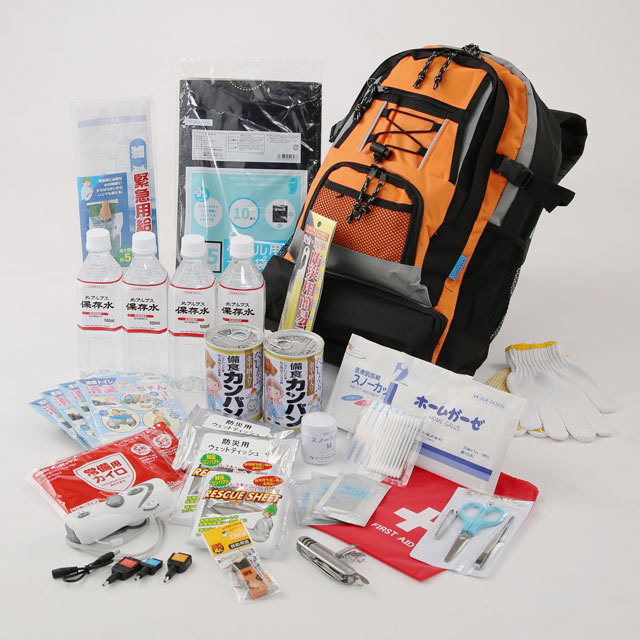
Members of our mission organization typically receive a personal emergency evacuation backpack when they first arrive in Japan. This unusual item is a standard provision because a wide variety of natural disasters such as typhoons, earthquakes, tsunamis, volcanic eruptions, landslides and floods frequently hit Japan and they often occur with minimal warning. These disaster kits are to be kept handy in the event of an emergency and we are frequently reminded by the government to periodically conduct an inventory of the contents to make sure batteries and other perishable items are kept up to date.

The recommended standard contents for an emergency bag would include such items as food and water for three days, a flashlight, a lighter, cash, a radio, a first aid kit, rope, toiletry items, extra batteries, a change of clothing, a multi-purpose tool, copies of important documents (passport, driver’s license, etc.) and essential medications. No one knows when a disaster will strike, so it is always good to be prepared. As part of that preparation, the Japanese government regularly conducts emergency drills in local communities, schools and places of business.

However, disasters, by their very definition, often occur without much warning and at irregular intervals so it is human nature to become lax in preparedness. The important emergency evacuation bag might get shoved to the back of a closet so its location easily slips from one’s memory. In addition, carefully stored food can become stale or spoiled, making it inedible. Batteries corrode over time and become useless. Copies of important documents can become out of date and fail to serve their intended purpose. The often-quoted proverb, “Out of sight, out of mind,” applies to this natural tendency to push recognized priorities aside while focusing on more immediate, visible matters.

The term “disaster,” actually covers a wide gamut of unexpected and unwelcome circumstances that can wreak havoc in our lives. The death of a loved one. The loss of employment. Financial ruin. A burned-out home. War. A pandemic. Failing health. A broken relationship. Food shortages. A natural emergency. Or as Texas recently experienced, a prolonged ice storm. It is during these times of extreme calamity where life seems overwhelming and we feel that we have lost all control over the events cascading around us. Such disasters generally interrupt our patterns of normalcy and many unfortunately, have life-long consequences. These unexpected catastrophes can either drive us to utter despair or to increased dependence on God who is somehow sovereign over all such occurrences.

This truth points to the reality that there are often deeper elements or purposes behind many of the calamities that alter our lives. Some are self-inflicted, and the resultant consequence was often rightly perceived in the Old Testament as a form of punishment from God for willful disobedience. (Deuteronomy 31:17b) But other disasters seem to come out of nowhere and devastate both the wicked and the godly with impartiality. While such things are difficult to comprehend and even harder to embrace, they serve as a critical reminder to turn to the only emergency kit that will suffice in such adverse circumstances. That is God Himself. “Therefore, we will not fear, though the earth give way and the mountains fall into the heart of the sea.”  (Psalm 46:2) “I will take refuge in the shadow of your wings until the disaster is passed.” (Psalm 57:1b) This is the true emergency evacuation bag we must keep close at hand to sustain us in times of trouble.

Funerals & Finality

“Just as people are destined to die once, and after that to face judgment.”                   Hebrews 9:27

Funeral

As I joined the immediate family in the crematorium, I was rather surprised when chopsticks were solemnly distributed to everyone present. “We’ve just eaten,” I thought to myself. “What are these for?” My question was soon answered as the partially cremated remains of the deceased were wheeled into the room and we proceeded to carefully place the bones, from the feet up, into the provided urn. I stole an irked glance at my more experienced senior coworker who had inexplicably neglected to communicate this unusual detail in Japanese funeral procedures.

Japanese funerals are, from beginning to end, quite different from the traditional funeral practices of the West. The differences are partially due to the Buddhist emphasis which views death as merely a passage from one life to the next, but that does not account for all the peculiarities of Japanese funeral procedures. For example, the deceased receives a new Buddhist name (called a kaimyō) in Chinese characters, with the length of the name determined by the amount of money donated to the temple. All participants at the ceremony are expected to wear black and bring a gift of money in a special envelope. In many funerals, the attendees will be expected to offer incense to the dead and make prayers on his or her behalf to assist them in their journey. The casket is surrounded by flowers, traditionally chrysanthemums, with a large picture of the deceased loved one prominently displayed. When the ceremony is over and the priest has finished the chants from a Buddhist sutra, each participant will then place a flower in the casket before it is closed. Only the immediate family and a few close friends will accompany the body to the crematorium, usually riding together on a chartered bus.

Instead of the American practice of embalming, the corpse is placed on dry ice and minimal makeup is applied to restore a natural appearance. The body is dressed in formal attire and placed in a simple wooden casket since it too will be incinerated. In some cases, a few favorite items of the deceased will be placed in the casket to accompany the deceased on their final journey.

Japanese funerals are actually comprised of many different ceremonies, beginning with a wake, known as an otsuya, or “passing of the night,” followed by the main funeral and then a final service at the crematorium. The funeral urn is then taken home and eventually placed in the family grave or some other alternative. Depending on local customs and the desires of the family, smaller ceremonies are subsequently conducted by priests on the 7th, 49th and 100th days commemorating the deceased’s death. Escalating costs of funerals coupled with shrinking families and a rapidly aging population are creating significant changes in the funeral industry, altering some of these traditional practices.

While ceremonies related to death vary from culture to culture, every funeral serves as a stark reminder of our finiteness in light of eternity. We should certainly mourn the loss of a loved one, but such events also provide a valuable opportunity to reflect on our own status before a Holy God who holds our destiny, both in this present life and the one to come, in the palm of His hand. In the West, we are embedded in a culture that worships at the altars of youth, beauty and strength, but all of these things will eventually fade, no matter how much we strive to deny it. This is why the author of Ecclesiastes wisely said: “It is better to go to a house of mourning than to go to a house of feasting, for death is the destiny of everyone; the living should take this to heart.” (7:2) While all of us would certainly prefer to dwell in the house of feasting, it is in the house of mourning that we are more prone to ponder on the deeper things of God, including His defeat of death through the power of the cross.