
Persecution

“Blessed are those who are persecuted because of righteousness, for theirs is the kingdom of heaven.”      Matthew 5:10
Persecution

Protestant Christianity came to Japan in 1859, but Catholic missionaries arrived approximately three hundred years earlier, making a significant impact.* Francis Xavier (1506-1552) was a Jesuit priest who is historically credited for introducing Christianity to Japan and he was followed by many other Catholic priests and monks. These early missionaries encountered an initial measure of success as they baptized over 100,000 converts, including a number of local feudal lords. This new religious movement was initially unopposed by the ruling Shogunate, but the Japanese leaders eventually became suspicious of the outsiders who represented countries intent on expanding their colonial empires. Fearing a loss of power, the Japanese rulers proceeded to launch a ruthless persecution of Christianity and its followers.

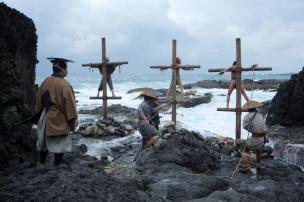
To aid them in this endeavor, these Japanese despots developed an effective method called “fumie” (踏み絵), to help identify adherents to the new religion.  Fumie means literally “to stamp or trample on an image,” referring to a religious icon usually bearing a likeness of Jesus or Mary. Utilizing this devious scheme, suspected Christians (Kirishitan) were rounded up in each village and forced one by one to trample on the venerated image placed before them. If they refused to do so, the Kirishitans were turned over to the professional torturers to either recant or die for their faith. The commonly used methods of torment included immersing victims in scalding hot springs, burning some Kirishitans alive, hanging others upside down over pits full of excrement or attaching some to crosses in the ocean where they were slowly drowned by the incoming tide. Government authorities were so zealous in their persecution efforts that they continued the practice of fumie for several years, even to the fourth generation in their attempt to completely stamp out any remnants of Christianity in Japan.

Many believers understandably went underground with their faith and religious practices and were soon referred to as “Kakure Kirishitans” (隠れキリシタン) meaning, “hidden Christians.” In subsequent decades and even centuries to come, the Kakure Kirishitans continued to secretly gather for worship, using prayers modified to sound like Buddhist chants and retained portions of the Bible through oral transmission. The famous Japanese author, Shūsaku Endo, creatively captured the events of this dark period in Japanese history through his novel “Silence,” which was recently brought to life as a major motion picture by the same name.  Viewer discretion is advised for the following clips from the movie:

A Jesuit priest recants his faith: https://www.youtube.com/watch?v=EOX8-c-_uVY

Martyrdom through drowning: https://www.youtube.com/watch?v=Uhqa8KylUM8

On a hill in Nagasaki now stands the Church of the 26 Martyrs, which was erected in 1962 to commemorate the lives of 26 Christians who were executed on that exact site on February 5, 1597. It stands as a solemn reminder that those who identify with Christ and take up their own cross to follow Him are not exempt from persecution. Like the early Japanese martyrs who forfeited their own lives by living for the kingdom of God, we are called to pursue righteousness and godliness, while living among the kingdoms of this earth. We must resist all evil influences that would sway us to trample on the things of God.

*There is some evidence that Christianity was actually introduced to Japan almost 1,800 years ago through early Nestorian missionaries, but failed to achieve a significant foothold in the country.

God Spoke

“In the past God spoke to our ancestors through the prophets at many times and in various ways, but in these last days he has spoken to us by his Son…”  Hebrews 1:1-2a

Emperor Hirohito

On Aug. 15, 1945 a “god” spoke. When Emperor Hirohito of Japan directly addressed his subjects for the very first time, life came to a temporary standstill around the world. Hirohito’s announcement of Japan’s unconditional surrender not only ended a war and brought peace, it ended the myth that the emperor of Japan was divine. He spoke and the world changed.

Because of this historical event, much changed in Japan as well. A new constitution was adopted and war was renounced. Democratic ideas took root in Japan and the emperor was reduced to a figurehead.  Japanese industries flourished and a new middle class rapidly emerged, resulting in a booming economy. The phrase “Made in Japan” stamped on manufactured goods was no longer derided as symbol of cheapness or inferiority, but esteemed as a mark of quality and success. Expensive vacations, quality education, designer clothes and the latest electronic gadgets could be purchased by the masses and it seemed the lone threat to a peaceful, prosperous society was the legendary Godzilla!

Certainly much changed after the emperor spoke, but in some regards nothing changed. The gods of war had only been replaced by the gods of materialism. At the same time, the traditional gods of Japan were still venerated through worship at Shinto god shelves or Buddhist altars in homes throughout the country. Japanese still made periodic pilgrimages to the local shrines or temples for various life events and relied on good luck charms for success and protection. An occasional church could be found in obscure corners of Japan, but temples and shrines remained the symbol of the country and retain a strong grip on Japanese hearts. Everything has changed and yet nothing has changed.

However, according to the Book of Genesis, everything changed when the God of the Universe spoke and the world as we know it came into being. The sun, moon, stars, oceans, dry land, vegetation, life and mankind itself were created by the mere voice and directive of God. But God didn’t stop there. He continued to speak to the hearts of men, as the author of Hebrews explains, calling them to repentance and into a relationship with Himself. This God who speaks ultimately provided eternal reconciliation to mankind, not through superior weapons of war and powerful armies, but through the death of His Son. This ultimate act of love and sacrifice brought eternal change to the world. Through the cross, God offered peace, not just between men, but more importantly, between God and man. The Living God has spoken, and hopefully, people in Japan and around the world will listen.

Shinto Blessings

“From the Lord comes deliverance. May your blessing be on your people.”  Psalm 3:8

shinto blessing2

While sitting in the office of the local Shinto priest, my gaze fixed upon a placard on the wall which advertised (in Japanese) set charges for services rendered:

  • ¥10,000 for a car blessing
  • ¥5,000 for a school entrance exam blessing
  • ¥10,000 for a baby blessing
  • ¥15,000 for a new home blessing
  • ¥10,000 for a marriage blessing

The whole concept stunned me on many levels and several questions came to mind as I chatted with my gracious host in a very unfamiliar setting. “How can mere mortal men place themselves in the position of dispensing blessings on behalf of the gods?” was something I asked myself. I did my best to politely nibble around the edges of this concept as I conversed with the Shinto priest. He explained, according to the Shinto religion, that nearly all objects, including both animate and inanimate, possess a spiritual essence known as kami (神). These kami are everywhere, but they are not regarded as omnipotent, omniscient, or even immortal. The term “Shinto” (神道) means literally “way of the kami” and they reportedly number over eight million. These spirits are duly venerated across Japan at various public shrines and private god shelves. It is believed by many adherents that kami have the power to dispense blessing on their devotees through rituals, good luck charms and designated intermediaries such as the priests.

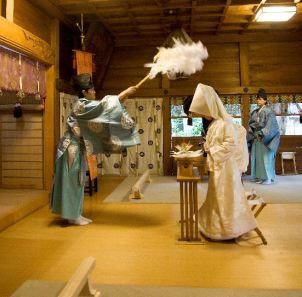
As I sat in the office of the local priest, other questions continued to fill my mind such as: “How can one charge money for a blessing?” From my perspective, such a practice seemed to reduce religion to a mere business transaction. This thought led naturally to another related question, which was, “Why would people actually participate in such obvious duplicity?” Perhaps the explanation to this conundrum resides in the standard practice of Shinto religious ceremonial procedures, where devotees have a sense that they cannot approach the kami with a request without some form of ritual purification to remedy their unclean state. This rite of purification is called harae (祓) and it usually begins with a symbolic washing using water near the shrine entrance. The next phase in absolution is conveniently performed by the priest (for a fee!), who rhythmically waves a large paper shaker called an ōnusa (also referred to as a haraegushi) over the object or person to be purified and blessed. Only after these procedures are performed can one approach the kami and hope to have their request granted.

Lying at the heart of the many intricate rituals of Shintoism is the basic human desire to be blessed by something or someone greater than one’s self. We want a healthy baby, success on a test, protection from infectious diseases, safety on the road, a good paying job, and a happy marriage, but such objectives often elude us because they lie beyond our control. Therefore, we are tempted to turn to a higher power to obtain them. Fortunately for us, there is a Higher Power who graciously dispenses such blessings on His people (Psalm 3:8) despite our unclean condition. We are beckoned to approach this God to request such favors, not because of our worthiness or the intercession of others, but because of the forgiveness provided through the cross by His Only Son. No fee is charged; God has paid it all. A few years later, this same priest reached the same conclusion and turned to Jesus for eternal absolution.

Gods on a Shelf

“How long will you love delusions and seek false gods?”                Psalm 4:2b

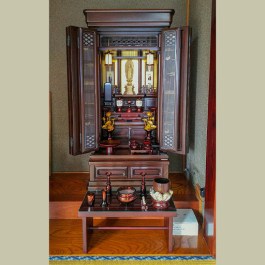
Butsudan2

We watched silently as the flames steadily consumed the butsudan (仏壇), or Buddhist altar that represented the gathered family’s dramatic break from the false gods they and generations before them had previously served. A butsudan is a shrine commonly found in temples and homes in Japan. It basically consists of an ornate wooden cabinet that typically houses a Buddhist religious icon and other accessories known as butsugu. These items are usually candlesticks, bells, incense burners and elaborate dishes where rice, tea or fruit are placed as an offering to deceased ancestors. A photo, memorial tablet (ihai), or ashes of a venerated family member are often placed within the butsudan, which represents a unique combination of traditional Buddhism and ancestral worship. Local Buddhist priests are usually called in to conduct periodic formal ceremonies in front of the butsudan, as determined by the date of the deceased’s death. Many households also maintain a simple daily ritual at the Buddhist altar of offering prayers, putting out food or burning incense; this responsibility usually falls on the wife.

Worship before the butsudan was traditionally viewed as an essential element in Japanese life, as it represented the center of a family’s spiritual faith and their historical heritage. While this practice is still quite common in the more rural areas of Japan, the responsibility of maintaining the family Buddhist altar is a burden modern Japanese are increasingly unwilling to bear as their religious convictions and lifestyles continue to evolve. The high price of these butsudan and the space they require in crowded homes are additional deterrents to owning one.

The butsudan is not to be confused with a kamidana (神棚), which is a Shinto god shelf and represents an entirely different religion unique to Japan. Many Japanese adhere to both Buddhist and Shinto practices. In contrast to the butsudan, kamidana are much more simplistic in appearance and are even sold as inexpensive kits at the local hardware store if you want to construct your own. The general purpose of a Shinto god shelf is to house a local Japanese kami or spirits, which are believed to inhabit all things. According to Japanese mythology, there are eight million of these quasi spirits who should be properly venerated.

Unlike a butsudan, a kamidana is typically placed high on a wall above eye level in a place where people will not walk under it. The Shinto god shelf contains a variety of items, but the most important one is the shintai. This is an object designed to house a particular kami, by providing a physical form to enhance worship. A shintai is usually a small circular mirror, but it can also be a stone, jewel or some other object with symbolic value. Worship at a kamidana is believed to invite success or good fortune, so is it is quite common to see Shinto god shelves on prominent display in places of business.

Idolatry actually comes in many forms and is not limited to images or objects commonly condemned in the Bible and currently present in Japan. The Ten Commandments begin with a prohibition of placing any other gods before the One True God where one constructs images of such gods or bows in worship before them. While very few of us place such obvious idols in our homes and worship them, our hearts are unfortunately inclined to value people, things, or objectives ahead of God and wrongfully give ourselves to them. Such “gods” should have no place on the shelves of our lives.

My Protection

“Blessed are all who take refuge in him.”    Psalm 2:12

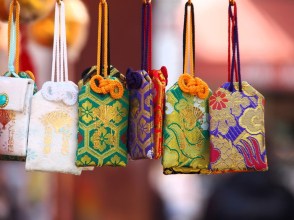
omamori2

During my first taxi ride in Japan, I couldn’t help but notice an elaborate ornament swinging back and forth on the rear view mirror as the driver navigated through traffic. I later learned that this and a whole array of similar talismans or amulets are called “omamori” (お守り), which literally means “protection.” These small good luck charms are typically made from paper or wood and are usually protected inside an ornate bag along with a written prayer. They are sold at temples and shrines throughout the country with the promise that they will bring good fortune or protection to the bearer, but cynics largely view them as a clever means to raise money.

These omamori can be spotted on bags, hanging in cars, attached to various objects and are even used as cellphone straps. They come in many shapes, sizes and colors and different ones are advertised to possess different powers. Some offer businessmen success in the financial realm while others promise students a good outcome in their test scores. Other omamori guarantee general prosperity, protection from evil, happiness, traffic safety, good health, fertility, and a happy love life. The simple thought behind such charms is that the power and strength of the gods is somehow invested in these brocaded bags so they are not to be opened, as the blessing could be released and thereby lost.

It is generally understood that the shelf life of an omamori is only good for one year, which means a replacement must be purchased, conveniently bringing additional revenue to the local shrine or temple. These “expired” good luck charms must be properly disposed of, usually by burning, preferably at the place they were originally purchased. Eager to grab a share of the enormous profits in the good luck industry, it is now common for stores to sell generic omamori featuring the images of Hello Kitty, Mickey Mouse, Snoopy and other popular characters.

The search to obtain protection from harm or to procure good fortune is a natural inclination of the human heart. Such a quest can take many forms and it is often shaped by our culture, circumstances and worldview. But all such attempts to manipulate one’s personal future are doomed to failure because they are based on the false assumption that we are in control of our own fate. We all seek desired outcomes in life that avoid pain and bring pleasure, but it is arrogant to think that we are in control of such matters, or that we possess the discernment to always know what is actually good or bad for us. Our uncomfortableness with the unpredictability of life is in fact a reminder that we should seek protection and refuge in God, who is our only omamori, or real source of protection. Everything else is a mere trinket.