
Car Names

“and whatever the man called each living creature, that was its name.”  Genesis 2:19b

Car Names

A few years ago, we bought a used two cylinder, 660cc Honda mini car to match our new Tokyo lifestyle.  (Imagine a classic VW Beetle and think smaller.)  The name of our car, N-One, initially puzzled us, but we soon learned that the “N” stood for “New,” “Next,” “Nippon” (“Japan”) and “Norimono” (“vehicle”).  Apparently, we were driving a car with an identity crisis!  We didn’t mind the intriguing name as it was a great car that served us well for several years. We soon nicknamed it “Panda” as the color scheme reminded us of a giant panda. A few years later, I discovered that there are actually websites to help owners come up with nicknames for their cars as they become like members of our families.

Car names in Japan have actually been a continuous source of humor among foreign residents.  We couldn’t help but chuckle sometimes when we pulled up behind a Dunk (Honda), a Scat (Daihatsu) a Lettuce (Mitsubishi), a Homy (Nissan), a Bongo (Mazda), a Joypop (Suzuki), a Noah (Toyota) a That’s (Honda), a Scrum Wagon (Mazda), a Charade (Daihatsu) and the prize-winning, Naked (Daihatsu). I’m sure there were many good reasons for selecting these particular names and the attributes they supposedly represented, but not all such choices successfully stand the test of time.

For a few years we owned a Subaru (スバル) and wondered about the symbolism of its logo on the back of the car. Someone eventually informed us that “Subaru” is the Japanese name for the constellation Pleiades, which is cleverly represented by the six stars in the Subaru logo. A little further investigation into the name origin of various Japanese car companies reveals the following:

  • The Toyota (トヨタ) Company was founded by Kiichiro Toyoda, whose slightly modified surname was used for his new car company founded in 1937. Toyoda means literally “fertile farm field.”
  • The Nissan (日産) name comes from the combination of two Japanese kanji. The first one, 日 (ni), meaning “sun,” is also the first character for Nihon (日本), which means “” The second kanji, 産 (san), means “production.” Taken together, Nissan translates to “made in Japan,” a very appropriate name.
  • Honda (ホンダ) is less interesting as its name is derived from its founder, Soichiro Honda.
  • Mitsubishi (三菱) Motors is actually a collection of companies, which explains why the word “mitsu,” meaning “three,” is incorporated in the name and stylistically represented by the three red diamond Mitsubishi logo.

The power of name giving was one of the first responsibilities God entrusted to Adam when all the animals were brought to him in the Garden of Eden (Genesis 2:19). This ritual symbolized the authority that mankind was granted over all of God’s creation and man’s supreme position, as he alone was created in the image of God. The pattern of name giving is particularly highlighted in the Book of Genesis as each generation gave way to the next one with many of the names steeped in symbolism or prophetic significance. But the unparalleled name of God, “I AM,” first revealed to Moses (Exodus 3:14), stands out among them all. This name is described as “holy,” “majestic,” “powerful,” “glorious,” “praiseworthy,” “awesome,” “fearsome,” “merciful” and “good.” It is a Name we would do well to remember, and to revere.
Personal Seal

“A good name is more desirable than great riches;” Proverbs 22:1a

hanko

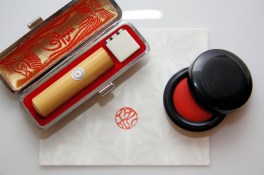
Shortly after our initial arrival in Japan many years ago, we visited a local shop to have our personal seal or “hanko” (判子) made. We had been informed that a simple signature would no longer suffice to open bank accounts or enter into any contractual relationship, but instead, a personal seal was required for all such transactions in Japan. Once it was decided how our name would be written in Japanese, a hanko was ordered and we were soon ready for business. We used that same seal for 34 years to sign for deliveries, purchase cars, register for health insurance, enter into cell phone contracts, withdraw cash from the bank and sign rental agreements.

Each hanko, like a signature, is unique and they can be made of wood, plastic, ivory or stone. The cheaper ones cost $10-20 USD, but more expensive versions sell for a few hundred dollars. The word inkan (印鑑) is often used interchangeably with hanko, but technically an inkan is the actual stamp on the paper whereas a hanko is the physical object used to make the stamp. Only red ink is used with the hanko and businesses or local government offices generally provide the stamp pad when you are requested to affix your seal to a document. These personal seals are usually protected in specially designed cases and it is important to register your hanko with the local municipal office. The government officials will in turn provide a document called an “inkanshomeisho” (印鑑証明書) required for important transactions, as it serves to verify that is your legal seal.

All businesses, organizations and even churches have their own official seals which are carefully protected due to legal liabilities if they are misused. As the representative of our mission organization, I was required to use a specially designed square hanko to authorize certain official documents. However, our religious registration as a mission changed, which called for the creation of a new hanko that was supposed to be round in shape. This anomaly confirmed what I had long suspected… I was a square peg placed in a round hole!

The author of Proverbs highlights the importance of maintaining a good name (Proverbs 22:1) in reference to our character or reputation. A hanko is designed to represent its owner, but how do our actions, words and attitudes represent us? This is a critical question we must periodically ask ourselves since the possession of a good name is far more valuable than great riches, power or influence. A good name can last well beyond our short existence here on earth and it potentially puts us in a position to in turn, have a meaningful impact on the lives of others. In contrast to this, a person with a bad name, who manifests an ignoble character, is not only judged by men, but by God Himself who alone can accurately evaluate such matters. A hanko serves to represent us legally, but a good heart is the best indicator that we are healthy spiritually. “Let love and faithfulness never leave you; bind them around your neck, write them on the tablet of your heart. Then you will win favor and a good name in the sight of God and man.” (Proverbs 3:3,4)

Lucky Bags

“He who did not spare his own Son, but gave him up for us all—how will he not also, along with him, graciously give us all things?”  Romans 8:32

Lucky BagsJapan has a popular New Year’s custom where stores offer sealed bags filled with random contents and sell them for a substantial discount. These special bags, known as “fukubukuro” (福袋) or “lucky bags,” are eagerly snatched up by customers who flock to the stores on New Year’s Day looking for a bargain. This established promotion is actually a clever means by which merchants unload excess or unwanted merchandise from the previous year. Obviously, this practice serves the dual purpose of attracting customers into the store to hopefully make additional purchases. The fukubukuro tradition also loosely ties into the Japanese superstition of starting the year with a clean slate as it clears the store of a number of unwanted items.


These goodie bags can contain a variety of items, but in major department stores, the contents are usually restricted to things sold in the specific department in which the bags are located. Prices for fukubukuro vary widely, depending on the store and the quality of the items they contain. The contents may include anything ranging from food, clothing, cosmetics, electronics, jewelry and miscellaneous household goods. It is essentially a form of gambling as some bags may prove to be duds while others may be an excellent bargain. Hence, they are called “lucky bags” and are widely used as gifts to family members and friends.

 As one would expect, the contents of a fukubukuro can be hit or miss, and even Santa’s legendary bag can leave many recipients dissatisfied come Christmas morning. However, there is nothing insufficient or inadequate in what God provided for us on that first Christmas. From His infinite storehouse of treasures, God spared nothing and gave us, not His leftovers, but the greatest gift of all—His Son. This is why the Japanese character for “lucky” (福) is also used as part of the very important biblical word “fukuin” (福音) which means “good news” or the “gospel.” It is, however, critical to understand that the good news of eternal salvation has nothing to do with our traditional concept of luck, but rather, is rooted entirely in the grace and goodness of God. The gift of eternal life and forgiveness of sins is a “lucky bag” that God alone can provide and its value far exceeds anything else this world has to offer. Best of all, the purchase price has already been paid by God at the cross. This is indeed fukuin, or good news.

Business Cards

“You have searched me, Lord, and you know me.” Psalm 139:1

Meishi3

Following a subtle bow of acknowledgement, I pretended to study the information on the card I now held politely with both hands. As the situation demanded, I feigned proper interest in the card and the individual I received it from did the same with mine as we engaged in what I call the “meishi dance”. A meishi (名刺) is a Japanese business card which is routinely exchanged in initial encounters, particularly in business relationships. The work I was currently engaged in involved meeting hundreds of individuals, so over the course of time, I had accumulated quite a stack of meishi along with a jumbled collection of faces those cards represented.

Like many other customs in Japan, there is an established protocol for the exchange of meishi. To fully grasp the subtleties of the meishi dance, it is important to bear in mind that each card serves as an extension of the person whose information is recorded on it. Therefore, the meishi itself should be treated with respect which in turn, has bearing on how the card is received. For example, it is best to stand erect when receiving or presenting a meishi and the information on it must face the recipient, holding the card carefully in the corners so it can be easily read. A respectful bow should precede the passing of the meishi and the card should be received with both hands. The information recorded on the meishi should then be carefully studied, particularly noting titles or status. If you are in a meeting where everyone is seated, the card(s) should be placed in front of you on the table for reference. Upon receiving someone’s meishi, you should never treat it disrespectfully like jamming it into your pocket or writing notes on it. Many businessmen carry around mini cases for protecting their own meishi and for the temporary storage of those they receive.

There is, of course, a limitation as to how much information a person can include on a meishi, even if both sides of the card are used. In brief social or business interactions, our capacity for absorbing details and even caring about the individual standing before us is restricted by our time, energy, mood, circumstances and intellect. But not so with God. The psalmist marvels at the extent that God intimately knows us, not just through observable actions, but from probing our thoughts and intentions from the moment we were conceived up to the minute when we draw our final breath.

This means that I am infinitely more than just a few scraps of information recorded on a card collecting dust in someone’s file. I am a creation of the God of the Universe who knows me far, far more than my most faithful friend, closest relative or intimate love interest and He genuinely and passionately treasures me. Such knowledge and care should provoke me to respond, not in feigned interest, but to bow in adoration and obedience. Perhaps in response, it is best to observe the protocol modeled by the same psalmist in Psalm 139. This is a meishi dance worth emulating:

  • I praise you because I am fearfully and wonderfully made; your works are wonderful. (14)
  • How precious to me are your thoughts, God! How vast is the sum of them! (17)
  • Search me, God, and know my heart; test me and know my anxious thoughts. (23) 
  • See if there is any offensive way in me, and lead me in the way everlasting. (24)

Cash Only

“Do not store up for yourselves treasures on earth…”  Matthew 6:19

money

A tray full of money representing roughly half a million dollars in Japanese cash was nonchalantly placed in front of us like afternoon tea. My colleague and I stared open-mouthed at the mound of money and couldn’t resist taking pictures. We had just purchased a building and of course like everything else in Japan, cash was used to seal the transaction. The seller then proceeded to place his portion of the stack of bills in a paper bag and the bank employee routinely whisked the larger pile back to the bank vault.

We should not have been surprised. After all, cash is routinely used for everything in Japan. All our shopping is done in cash. We pay our rent in cash. Even higher priced items like cars are purchased with cash. Most people routinely carry several ¥10,000 notes (worth roughly $100 each) in their wallets. Although changes are slowly taking place, Japan is basically a cash-driven economy. Cashiers are trained to efficiently return change without mistakes and cash dispensing machines are available everywhere to facilitate this dependency on cash. While Japanese normally adapt quickly to newly emerging trends, they have been slow to wean themselves from using hard currency for daily transactions. In this matter, Japan with its low cashless rate in 2015 of only 18%, stands in marked contrast to neighboring Asian countries like China (60%) and South Korea (89%).

There are many reasons behind this propensity to use cash. Chief among these would be Japan’s antiquated banking system that encourages cash transactions, but also not to be overlooked is the general public distrust in anything other than real currency. The low crime rate in Japan also encourages people to carry around large amounts of money without fear of being robbed. However, the government is trying to change the public’s dependency on cash since it is inefficient and puts Japan at an economic disadvantage compared to other Asian countries. Signs of such changes are increasingly evident as more Japanese are using their smart phones for financial transactions and the use of prepaid cards is becoming much more common.

Jesus taught a lot about money and frequently used it as a topic to drive home important spiritual principles in the form of parables. He never discouraged the usage or accumulation of money, but rather, warned about it capturing our hearts and pushing God out. The things we treasure in this life that Jesus refers to are not limited to just money or material possessions, but include all our resources, such as our time, energy, God-given gifts, expertise and acquired skills. These are not to be hoarded just for our own benefit, but to bless others as God directs. Treasure on earth may last for a lifetime, but treasure in heaven, Jesus taught, lasts for eternity. That is the commodity that should underpin all of life’s transactions.