
Live Food

Nothing outside a person can defile them by going into them. Rather, it is what comes out of a person that defiles them.”   Mark 7:15

ikizukuri2

I had previously eaten sashimi, which is fresh raw fish, or meat sliced into thin pieces, but the bizarre culinary creation that now lay before me was an entirely new experience. Artfully displayed on the table where we were seated was a live fish still opening and closing its mouth. Observing the reaction of my fellow diners who were reaching for their chopsticks, I soon realized that this was the centerpiece of our meal. Now, I am no stranger to live fish as a fisherman, but this was something altogether different from my previous forays into the wonders of seafood. I soon learned that this Japanese delicacy is called ikizukuri (生き作り), which is roughly translated as “prepared alive.”

We had actually chosen our “victim” when we entered the restaurant from several tanks containing live fish, octopus, shrimp, lobsters and squid. I had naturally assumed that the fish would then be sliced into traditional sashimi, fried or broiled. Instead, a specially trained chef deftly removed the edible portion of the still living fish, sliced it into tiny bite-sized pieces and expertly placed it all back into its original location. The obvious objective of this culinary dish is to provide the ultimate experience in feasting upon fresh sashimi. This, of course, is evidenced by moving gills, tail, antenna or tentacles, depending on the creature being consumed.

As to be expected, this unique practice has invited a certain amount of controversy from critics who consider the custom barbaric and cruel to animals. In reaction, a few countries have even gone so far as to outlaw food prepared in this manner. However, ikizukuri advocates claim that the muscle twitching observed in the entrée is merely the residual response of the dead creature’s nervous system, rather than the labored movements of a dying victim. As for me, I thought the sashimi that evening was particularly delicious, but I was careful the whole time to avoid eye contact with the fish that became our meal!

The Old Testament contains numerous prohibitions of things not to be eaten, or how they were not to be eaten, as part of its ceremonial law. For example, some types of meat were declared to be “clean” and others were considered “unclean” and, therefore, to be avoided under all circumstances. These ceremonial laws were rigidly adhered to and enforced by many of the religious leaders in Jesus’ time, but their zealousness to preserve such practices caused them to lose sight of far more important matters. Jesus pointed this out when He said to them, “Nothing outside a person can defile them by going into them. Rather, it is what comes out of a person that defiles them.” In saying this, Jesus contrasted the huge difference between ceremonial defilement (what is outside a person) and spiritual uncleanness (what comes out of a person). The latter is called “sin” and all of us are under its dominion as evidenced by our proclivity to lie, lust, slander, judge, hate, boast, envy, etc. Judging from outward appearances, we may look appealing, like the ikizukuri fish on a plate, but no matter what we do, we are still dead in our sins. Our attempt to achieve righteousness through our own efforts is mere twitching on the platter. Only God can resurrect the dead and truly cleanse us.
Folded with a Purpose

“I praise you because I am fearfully and wonderfully made; your works are wonderful, I know that full well.”             Psalm 139:14

Origami2

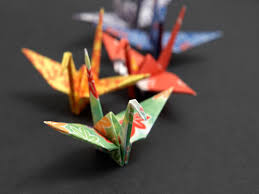
A basic handicraft enjoyed throughout Japan by both young and old is origami (折り紙). Originating from the words ori, meaning “fold,” and kami, meaning “paper,” origami is simple enough for an unlearned novice or child, yet sufficiently challenging for the most trained expert. The goal of origami is to transform a simple piece of paper through a series of folds into a finished sculpture. Before it is manipulated into a work of art, all origami begins as a square sheet of paper which is sold in packages at most local stores.

Modern origami procedures generally discourage cutting, gluing or marking the paper, unlike older Japanese versions that permitted such actions. When Japan began to import ideas and technology from the West in the 1800s, the present style of origami gradually became common practice. This pattern came largely through German influence, which had its own style of art and rules connected with paper folding.

Japanese origami dates back to at least 1680 when it was briefly referred to in a short poem by Ihara Saikaku. Since then, it has evolved into various types, with some actually having moving parts. Another category is called “modular origami,” which requires assembling multiple origami creations to form a larger object. The practice of paper folding has even been applied to currency: “moneygami” converts ordinary paper money into intricate works of art.

Perhaps the most beloved origami model is the Japanese crane, which is traditionally associated with mythical powers of health, luck or long life. According to Japanese legend, the gods will grant extended life or good fortune to anyone who folds a thousand cranes. Literally hundreds of these thousand-crane-strands are typically hung in the atomic bombing peace memorial sites, representing a desire for peace and prayers for the souls who perished nearby.

The skill and craftsmanship required to produce the more intricate forms of origami is stunning, but it doesn’t begin to compare with the incredible creativity and power on display in the life of every human being on this planet. The psalmist marveled at the work of God when considering his own mortal frame and in turn responded in praise of His Creator. We were “folded” with a purpose, and that is to honor God in the unique way that He has created each one of us. We are His works of art, demonstrating God’s favor upon us.

Bonsai

“That person is like a tree planted by streams of water, which yields its fruit in season and whose leaf does not wither—whatever they do prospers.”                    Psalm 1:3

bonsai

To celebrate our ten-year wedding anniversary a number of years ago, my wife and I decided to purchase a bonsai tree as a gift to ourselves and as a symbol of our marriage. Thirty-two years later, I’m happy to report that our marriage is still intact, but the same cannot be said for our bonsai, which suffered from neglect and had an untimely death. Through that experience, we learned the hard way that bonsai trees require a considerable amount of care and expertise in order to thrive.

Bonsai means literally “tray planting” as it is planted in a portable, ceramic container (i.e. “tray”) in order to control its growth. Bonsai care is actually an art form that involves cultivating a miniature tree to mimic the shape and scale of a full sized tree. This process requires pruning and root reduction using special tools under optimal water, nutrient and light conditions. Visiting a quality bonsai exhibition is like attending a famous art display. The artistic effects are stunning and the variety of trees that can be successfully cultivated as bonsai is equally impressive. One of the oldest known living bonsai trees, believed to be over 500 years old, was cared for by the Tokugawa shogun Iemitsu and is now kept as part of the Tokyo Imperial Palace collection. Obviously, this ancient Japanese ruler knew far more about bonsai care than we did!

In the natural world, trees need a steady supply of water and nutrients in order to grow and produce fruit. The same is true for God’s people who are to grow spiritually and in turn, produce spiritual fruit (Galatians 5:22-23). Quality time in God’s Word, fellowship with other like-minded saints, meaningful worship and an active prayer life are the essential elements to cultivate godliness, much like a tree strategically planted by a flowing stream.

However, bonsai are purposefully removed from their normal environment as they require intentional nurturing under the hands of a skilled gardener. The natural propensities of the bonsai are shaped and redirected by outside forces, while life giving nutrients, water and sunlight are meticulously provided in carefully measured amounts. Under the watchful eye and care of the bonsai master, a common tree can become a unique object of beauty bringing glory to its creator. This is not unlike the analogy in John 15, where Jesus compared us to branches that must abide in Him as the vine, but are meticulously nurtured by God. Ultimately, like a carefully maintained bonsai, we are to submit to the purposes of our Master and in turn, produce fruit to honor Him.

Fake Food

“My food,” said Jesus, “is to do the will of him who sent me and to finish his work.”            John 4:34

fake food samples2

Unable to read the menu, I managed to coax the waitress to the front of the restaurant through a series of charades and broken Japanese and pointed to what I wanted to order. Enclosed in a glass case was the entire food repertoire appealingly displayed, but none of it was real. Known as shokuhin sampuru (食品サンプル), or “food samples,” these are exact replicas of dishes offered by the restaurant.

The production of these food models has evolved into an art form over time and it was initially pioneered in the late 1920s by Japanese artisans who used paraffin for their creations. These fake food samples enabled customers to order food without the use of menus, but over time, paraffin proved to be an inadequate medium as the colors slowly faded when exposed to heat or sunlight. Now constructed using a synthetic resin called polyvinyl chloride, these shokuhin sampuru can last indefinitely. This improvement in technique has unwittingly hurt the fake food industry so it has tried to expand its market outside of Japan.

There is a great deal of craftsmanship required to produce these fake food models, so plastic food manufacturers fiercely guard their trade secrets to protect their share of the market. Models are often custom tailored to the individual menus of each restaurant, which makes them quite expensive. Most customers are unaware that the plastic food they casually survey behind the glass typically cost the proprietor of the restaurant several thousand dollars. Their attention is naturally focused on satisfying their hunger and hopefully, something on the menu will fill that need.

What then is real food? Ask a man, and he might say steak and potatoes. Ask a vegan, and they might say quinoa and kale. Ask a Japanese, and they might say rice and fish. But when Jesus was asked a similar question, He gave a totally different reply. He said: “My food is to do the will of him who sent me and to finish his work.” Obviously, Jesus was not talking about real food, or even plastic food, but a different kind of nourishment that is essential for our spiritual well-being. While we are certainly flesh and blood beings that need physical nourishment, our spiritual natures require sustenance as well. We were created to fill the purposes of God, not just fill the physical desires or needs of the flesh. As Jesus famously expressed in the Sermon on the Mount, we are to hunger and thirst after righteousness (Matt. 5:6). We need both physical and spiritual food as part of a healthy diet. At the same time, we need to be cautious of the many “fake foods” that can entice us away from the greater things of God. Bon appetit!

Hidden Art

“As the heavens are higher than the earth, so are my ways higher than your ways and my thoughts than your thoughts.” Isaiah 55:9

rice paddy art

The gathered crowd responded with amazement when they reached the top of the viewing platform and looked down. Once formerly hidden from their view on ground level, everyone could now see a massive work of art beautifully laid out in the midst of what initially appeared to be an ordinary rice paddy. As the spectators gazed with wonder, they were dutifully informed that in previous months, local farmers, townspeople and students had worked hard to produce the masterpiece now spread before them based on that year’s chosen theme. A simple rice paddy had become an art canvas and it pulled in thousands of visitors every year to this small rural village.

Rice field art, known as “tambo art” in Japanese, was initiated in 1993 by the villagers of Inakadate, located in Aomori Prefecture, as a means to revitalize their local economy by attracting tourists. Using rice seedlings of varying color in a designated rice field, the town folk have created incredible pictures which evolved in scale and complexity as their skills steadily improved with each passing year. Themes from past productions represent a wide variety of genres, ranging from Japanese folklore characters, iconic places, famous people and popular movies. The artwork can only be seen from an elevated observation deck cleverly constructed to imitate a castle tower. Every year over 100,000 visitors travel off the beaten pathway to take in this unusual sight.

Unless the artwork is pointed out to them, out of town travelers passing by on nearby roads are oblivious to its existence as the pictures can only be seen from a higher perspective. In the spiritual realm, the same is true in everyday life as events can easily pass by on a seemingly endless continuum where one seldom catches a glimpse of their possible eternal significance. As flesh and blood creatures, our perspective is often limited to what we can actually see and experience in the world around us, but the Creator of the Universe knows no such limitations. His ways, purposes and actions may remain hidden from our sight, but we are promised that one day, equipped with a heavenly perspective, all these things will be revealed to us. Until we ascend that elevated platform where we gain a better view, we are called to live by faith, trusting God’s masterful handiwork in the midst of what we do not presently understand.

Go to the link Japanese Rice Paddy Art to learn more about the phenomenon of tambo art and be sure to check out the embedded video for a short history lesson.