
Yakuza

“Now the earth was corrupt in God’s sight and was full of violence.” Genesis 6:11

My first introduction to the world of yakuza was at a Japanese hot spring where a sign discreetly indicated that anyone with tattoos was prohibited from using the facility. This directive was a euphemistic way of saying that yakuza were not welcome. After all, it was easy to enforce such restrictions upon a certain dark segment of society who are readily identified by their rather unique and prominent tattoos known as “irezumi.” I soon learned that there were other means for picking out yakuza, or Japanese gangsters, in society. For example, they are sometimes missing a part of a finger and they often drove large foreign cars like Cadillacs, which were very scarce in Japan.

Yakuza are members of a large organized crime syndicate in Japan with its roots dating back to the Edo Period (1603-1868). Their criminal activities usually center around extortion, racketeering, human trafficking, drugs, gambling, questionable real estate practices and even arms smuggling. Different yakuza factions focus on different enterprises with some of these extending beyond the borders of Japan. The yakuza reached their zenith of influence in the 1960s with a membership of more than 200,000, but since then their numbers have significantly dropped. This decline is primarily due to the enactment of several laws restricting their activities and changes in market opportunities. The present number of yakuza is estimated to be roughly 28,000 members; the island of Kyushu has historically served as their prime recruiting ground. Approximately 60 percent of yakuza members come from burakumin, or members of the traditional outcast class, and 30 percent are recruited from Japanese-born Koreans.

The Japan film industry created a popular genre of movies centered on the yakuza world. Several manga series have also picked up on this theme and, together, they romanticize the underworld activities of these Japanese gangsters by emphasizing their strict codes of conduct and rigid hierarchical structure. Yakuza gangs tend to mimic the senior/junior (sempai-kōhai) relationship pattern common throughout Japan, but do so on an exaggerated scale as members are required to cut their family ties and transfer their loyalties to a gang boss. Sometimes this fealty is demonstrated through the partial or complete amputation of the left little finger in a ritual known as yubitsume, which is also used as a form of penance for any perceived failure. Some yakuza now wear prosthetic fingertips to hide this distinctive mark and avoid attention.

A propensity towards violence was one of the initial indicators of man’s fall and departure from godly behavior. The first crime recorded in scripture following man’s eviction from the Garden of Eden was Cain’s extreme violent act of murdering his own brother. Violence among mankind then escalated to such an extent that God felt it necessary to exercise judgment on the entire earth in the form of a flood because it “was corrupt in God’s sight and was full of violence.” (Genesis 6:11) Pride and violence are sometimes linked together in the Bible (Psalm 73:6) because a self-centered independence from God (pride) can potentially unleash horrific actions normally condemned in civilized societies. The yakuza are well-known as occupants of the dark underworld in Japan, but another form of darkness occupies the hearts of all mankind and it is only the grace of God that curbs its full manifestation.
Robots

“He made himself nothing by taking the very nature of a servant, being made in human likeness.” Philippians 2:7

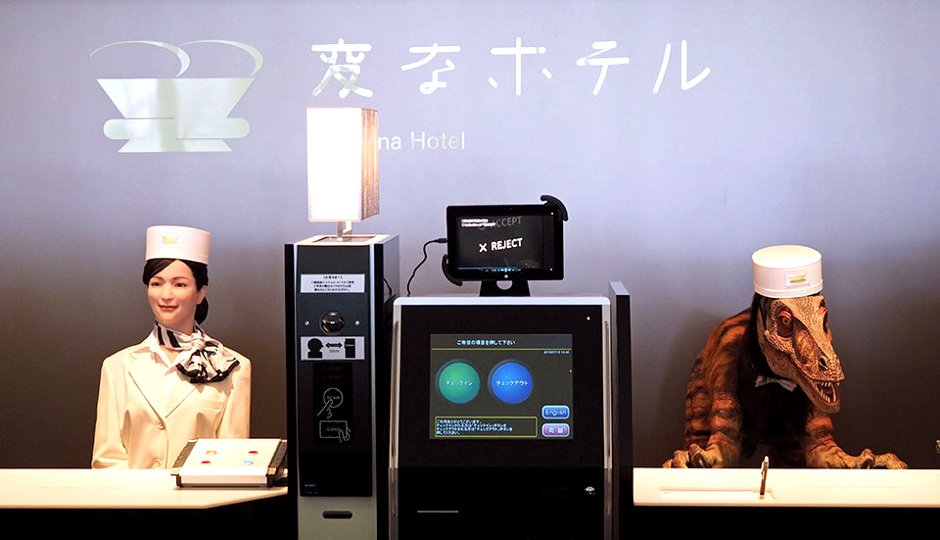
  Robot Hotel  Opened in 2015, the Henn Na Hotel chain in Japan (translated “Weird Hotel”) is largely staffed by robots. Upon entering this unique hotel, guests are initially greeted in the lobby by a female-faced android, followed by a multilingual dinosaur proceeding to check them in. Another robot soon appears to transport the guest’s luggage to their assigned room and a face recognition system conveniently unlocks the door. An assortment of other robots fill various work roles in this impressive semi-automated lodging. However, half of the robotic labor force was recently “laid off” as some of the robots tended to create more work rather than reduce it. Innovation to improve the efficiency and capacity of robots continues to progress, not just within this hotel chain, but throughout Japan where robots are increasingly utilized.



The general purpose of robots, which are called “robotto” (ロボット) in Japanese, is to free up humans from difficult or mundane tasks while vastly improving productivity. This purpose explains why the industrial usage of robots has skyrocketed, with Japan ranking among the world leaders in robotic technology along with South Korea, Germany, Singapore and Taiwan.  Many experts think that the solution to Japan’s chronic shortage of labor, due to population decline, is automation, not immigration. This accounts for the country’s heavy reliance on robot labor. Japan’s love affair with robots is somewhat rooted in its past, echoing back to karakuri ningyo, or mechanical dolls that were developed in the 17th century using imported European clock-making technology. Such ingenious developments eventually led to the creation in 1928 of a robot called “Gakutensoku” by Nishimura Makoto. This robotto could make facial expressions and perform a few rudimentary actions. It was the first of its kind in all of Asia.

Robotic technology now dominates the industrial sector of Japan and android robots are becoming increasingly common, performing a variety of duties in social, medical, security, entertainment, senior care, food service and educational circles. It is not uncommon to discover a robot in airports, places of business or hospitals greeting people and performing some kind of basic service. Aibo, the first mass-produced commercial robotic dog sold on the market by Sony, became the precursor of other robotic inventions designed primarily for entertainment. Life-like robots that perform certain religious functions at temples and shrines have also been deployed and used on a limited basis. The city of Yokohama recently put on display the world’s largest robotto which stands 60 feet in height (18 meters), weighs over 25 tons and is modeled after the Gundam robot from the famous anime series.

The advancements in robotic technology are very impressive as robots continue to improve in their imitation of human skills, intelligence and appearance. However, all such developments pale in comparison to the greatest transformation of all, where God took on full human form to redeem mankind (Philippians 2:6-8). This was no poor imitation like a robot, but rather, God fully submitted Himself to take on all the frailties of human flesh to such a degree that He hungered (Mark 11:12), grew tired (John 4:7) and most telling of all, He wept (John 11:35). As the writer of Hebrews so aptly put it: “He too shared in their humanity so that He might break the power of him who holds the power of death.” (Hebrews 2:14a)

Minister of Loneliness

“Turn to me and be gracious to me, for I am lonely and afflicted.”   Psalm 25:16

Loneliness

Japan has a parliamentary form of government where the chief executive, known as the Prime Minister, appoints ministers to assist him in his various responsibilities. These important officials traditionally include the Minister of Foreign Affairs, the Minister of Justice, the Minister of Finance, the Minister of Defense, the Minister of Health and other well-known positions. However, on February 12, 2021, the media announced the surprise appointment of Tetsushi Sakamoto to fill a newly created cabinet position in response to recent troubling trends. In an attempt to reduce widespread loneliness, social isolation and increased suicide rates accelerated by the restrictions of COVID-19, Mr. Sakamoto now serves as the official Minister of Loneliness.

This new position is called kodoku mondai tantō kokumu daijin in Japanese, which is a rather lengthy title, but the key words in it are “kodoku” and “mondai.” Together, they mean “loneliness problem,” which is admittedly, an unusual title for a government official, but these are unusual times. Loneliness had already been identified as a growing problem among the Japanese populace in previous years, but the extreme measures recently taken to curb the spread of COVID-19 only served to hasten this harmful trend. For the first time in eleven years, there has been a rise in the number of suicides in Japan after several years of decline due to various public campaigns. In fact, more people died from suicide in one month than the total number of deaths associated with COVID-19 in all of Japan in 2020. Loneliness has also been linked to other serious health issues such as heart disease, eating disorders and mental instability to name a few. Women and the elderly have been particularly affected by recent job losses and the implementation of draconian social limitations. The prolonged depression of the Japanese economy and an alarming decline in birthrate are symptomatic of related social dysfunctions that seem to be eating away at the heart of the country. It can be said that loneliness is one of many elements contributing to these negative patterns.

While innovative government initiatives to reverse this destructive trend of loneliness are commendable, a sustainable and truly effective solution to such a deep-rooted problem lies well beyond the authority and power of political leaders. From the very beginning of time, when God created man in His own image as a relational being, He declared that “it is not good for the man to be alone.” (Genesis 2:18) Recognizing this inherent need for relationship, God created the first woman to fill Adam’s social, physical and emotional needs and through them, mankind continued to expand while living in community.

However, such communities were chronically dysfunctional because of man’s fallen state which gave way to broken and imperfect relationships. Even though mankind was created for fellowship and relationship with others, the presence or risk of pain has prompted many to withdraw and restrict their social contacts with the purpose of self-preservation. For many, this withdrawal is a deliberate choice, but for countless others, such a response has been forced upon them by circumstances not of their choosing. The end result is loneliness, which if left unaddressed, can lead to a destructive, downward spiral in other critical areas. While there are no simple remedies for such heartaches, we would be wise, like the psalmist, to turn to the Creator of man’s heart when such burdens seem too heavy to carry alone. “Turn to me and be gracious to me, for I am lonely and afflicted.” (Psalm 25:16)

Real Truth

“Do not swear—not by heaven or by earth or by anything else. All you need to say is a simple “Yes” or “No.” Otherwise you will be condemned.”   James 5:12

truth3

Every husband, who values his well-being, knows the correct answer if his wife asks him the paradoxical question: “How do I look?” The stock answer of “You look fine dear!” is certainly the safest reply, but it may not necessarily be the most truthful one. This is what the Japanese call a “tatemae” answer and they have elevated this form of communication to an art form that many foreigners find difficult to comprehend. Tatemae (建前) means literally “built in front” or “façade,” in contrast to its opposite term, “honne” (本音), which can be translated “true sound.” Honne, simply put, is one’s true feelings and opinions, whereas tatemae is what one perceives others want to hear. In this sense, honne is the real “sound” or voice of an individual, but for various social or personal reasons, the speaker deems it best to express a safer alternative, or tatemae, answer as a form of protection. This “safer” response could be intended to protect a personal or working relationship, and it is certainly common in diplomatic communication, which can lead to all sorts of misunderstandings.

Some consider the use of tatemae as a subtle form of lying, but in reality, every culture employs a certain degree of such communication to avoid needlessly hurting or offending those around us. In English, we may call a slight stretching or distortion of the truth a “white lie,” but such falsehoods often stem from selfish, ulterior motives. In contrast, the Japanese propensity towards using tatemae responses is generally far more complex. In Japan, the group usually takes precedence over the individual so there is an invisible, but widespread pressure to ensure that things go smoothly. Therefore, great care is taken not to potentially disturb harmony in relationships. Avoiding possible conflict is a high value in Japan and tatemae answers can be very useful to that end.

However, such a practice can lead to other challenges where one is constantly required to discern when an invitation, compliment or offer is genuine or just a tatemae response. This intentional vagueness is why sociologists classify Japan as being a high-context culture, meaning that communication is often implicit and relies heavily on context. Direct answers are often eschewed and ambiguous, innocuous replies like “daijoubu” (it’s all right), “omoshiroi” (interesting) or “yōji ga aru” (I have something to do) are frequently employed in everyday conversations. Most people are reluctant to state a contrary opinion and stand out, so they “build a wall” using tatemae, which serves to ward off unwanted scrutiny.

Because of people’s natural propensity to tell lies and not follow through on their promises, oath taking became a common practice to demonstrate the veracity or trustworthiness of an individual in both ancient and modern times. While culture can certainly complicate the best of intentions towards honesty, as a general principle, God’s people should be characterized as truth tellers. James exhorts (James 5:12) us to avoid the taking of oaths by simply being people of our word. This verse is almost a direct quote lifted from Jesus’ famous Sermon on the Mount (Matthew 5:33-37) where He challenged His listeners to strive for a higher, God-honoring form of communication. A “true sound,” or honne, flows naturally from a true heart that belongs to God.

Protocol Priorities

“Let us then approach God’s throne of grace with confidence, so that we may receive mercy and find grace to help us in our time of need.”        Hebrews 4:16

sports day2

We felt like royalty as we entered the large Japanese department store. All the staff and salespeople were formally lined up on both sides of the aisle, bowing low to welcome us. The store had just opened for the day, but it was standard protocol to greet the initial customers, even though we were accompanied by a dozen hyper children who seemed oblivious to the expected decorum. This experience was just one of many reminders that Japan is a country built upon proper protocol for various situations and everyone is expected to know and abide by these set guidelines to ensure a well-ordered society.

School graduations, admission ceremonies and sports days, in addition to funerals, weddings and company entrance events, are among the most common social occasions that have established procedures which everyone must dutifully follow. Underlying all of these activities are a multitude of other traditional protocols or values that facilitate smooth programs, constructive relationships and desired outcomes. Such protocols would include: being on time, extensive practice, multiple preparatory meetings, a flawlessly scripted schedule, a well-thought out seating plan, trained volunteers and recognition of all attending dignitaries. Of course, all participants would be appropriately attired and use honorific language befitting their social position. These values and expectations spill over into countless other daily routines that make Japan appear at times as one great well-oiled machine that always performs at peak efficiency.

This rigid adherence to proper protocol was once put to the test many years ago by an acquaintance at a local McDonald’s. It is customary for all McDonald’s employees working at the front of the premises to welcome every customer with a deep bow and extend a greeting of “irasshimase,” meaning, “welcome.” On this particular day, my somewhat mischievous colleague impetuously decided to exit the restaurant and immediately enter again. As expected, he received the same attention as if he had entered for the first time. Continuing with his somewhat rude social experiment, he exited and returned again, receiving the same treatment from the conscientious McDonald employees. After repeating this cycle several times, he finally gave up, realizing these meticulously trained workers could not depart from their established protocols for corporate behavior. These and other similar protocols are part of the unique underpinnings that hold Japanese society together.

In stark contrast, America can be generally regarded as a land of spontaneity and freedom where protocols can be much more easily dismissed or adapted to fit a particular situation. Perhaps because of this, the incredible significance of the invitation to approach the very throne of God (Hebrews 4:16) can be lost on a society where inviolable protocol is a lesser value. We are totally unqualified and unworthy to appear before an Almighty, Most Holy God, but the invitation is genuine and we are welcome not because of our position, but because of His grace. God’s protocol demands that we enter by means of the cross, where mercy replaces judgment and we are amazingly received as sons and daughters.

Getting it Right

“Be perfect, therefore, as your heavenly Father is perfect.”            Matthew 5:48

Getting it Right4

The ringing doorbell surprised us as we were guests at a vacation home and there was a horrific blizzard howling outside. “Who could it be?” we wondered and opened the door to be greeted by a local postal worker covered in snow bowing in apology. Through his shivering explanation, we learned that the local post office had mistakenly overcharged us 30 yen (23¢) for a letter we mailed the day before. He asked us to accept their sincere apology for the error and dutifully handed over the money with additional bows. Thoroughly impressed, but slightly amused, we assured the conscientious civil servant that all was forgiven and that we were satisfied with the outcome. He then bowed several more times, before turning to trudge back to the post office in knee-deep snow. That little snapshot from our past serves to capture the Japanese value of getting it right.

Perhaps this tendency is best summed up in the Japanese word “kaizen” (改善), which combines the two concepts of “change” (kai) and “good” (zen). Taken together, the equivalent translation comes out as “change for the better,” or “continuous improvement.” The application of kaizen then becomes an ongoing attempt to eliminate defects in a product or to improve a process with the ultimate goal to achieve better results. This requires an extreme attention to details, which can easily morph into a form of perfectionism in a ceaseless attempt to get it right. This approach can be seen on many levels within Japan, such as in the areas of food preparation, manufacturing, athletics, Japanese arts and transportation. Toyota has actually adopted the concept of kaizen as one of its core values, where all its employees are encouraged to constantly look for ways to improve their operations and products, which accounts for the company’s sterling reputation.

The extra effort it takes to build dependable cars, produce aesthetic masterpieces, achieve athletic success, or attain scholastic recognition is a highly commendable trait that generally produces good results. This is the primary reason why we personally purchase Japanese made vehicles. We want quality and dependability in a car that a commitment to kaizen principles is more likely to produce.

While such a lofty standard is understandably desired for inanimate objects and procedures, it is totally unrealistic when applied to human beings, including myself. Perfection is a worthy goal to aim for, but it remains forever out of reach no matter how hard we strive to attain it. Jesus taught His followers a new standard in His famous Sermon on the Mount (Matthew 5-7) where He set the bar of God’s righteousness or perfection much higher than they previously imagined. This standard is what we are challenged to aim for, but no amount of commitment to kaizen can possibly take us there. We cannot “be perfect, as our heavenly Father is perfect” (Matt.5:48), but there is One who was “once made perfect, and became the source of eternal salvation for all who obey Him” (Hebrews 5:9). That is Jesus. Because of Jesus’ perfect goodness (zen), we can be eternally changed (kai) and that is a kaizen work that only God can achieve, not through our efforts, but by His grace.

Yellow Tiles

“I will lead the blind by ways they have not known, along unfamiliar paths I will guide them; I will turn the darkness into light before them and make the rough places smooth.”  Isaiah 42:16a

Yellow Tiles

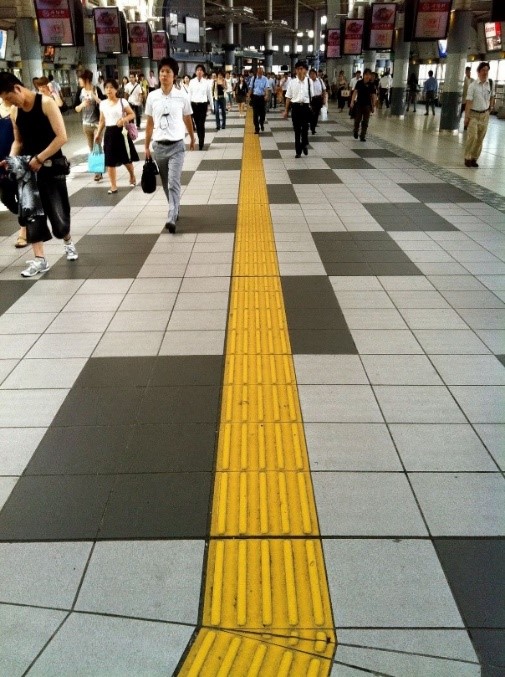
New visitors to Japan are initially puzzled by the bright yellow lines of tile that often line certain streets and intersections. They are even more common near train and bus stations. These lines are technically known as “tactile ground surface indicators” (TGSI); in layman’s terms, they serve as a hazard guide for the visually impaired.  These special tiles are designed to be used by blind people as a means to navigate crowded public places by feeling the texture of the tiles with the help of a cane or through the soles of their shoes.  Differences in the tiles help to indicate directions and potential hazards.  The bright yellow color also serves as a useful reminder to others to be considerate of those who may be visually handicapped.

A closer examination of the tiles reveals that there are two major varieties. One has straight raised lines and the other type has raised circular bumps. Tiles with straight lines indicate it is safe to proceed forward in the direction of the lines. However, when one encounters tiles with bumps, it is a warning to stop or to proceed with caution. Some form of obstruction or potential danger like an intersection, stairs or a train platform edge typically lies beyond this type of tiles. In addition to the yellow tiles, many intersections in Japan play set songs or sounds to indicate which direction is safe for crossing. Braille signage is also quite common for the visually impaired.

When one observes these tiles, it is only natural to recall the classic movie, “The Wizard of Oz,” where Dorothy and her traveling companions are instructed to follow the yellow brick road to reach the Emerald City, where all their problems will be resolved. While none of those famous characters were visually impaired, the purpose of the yellow bricks was the same as Japan’s yellow tiles… to help travelers arrive at their intended destination without incident.

Most of us do not need yellow tiles to aid us in our daily travels, but in a spiritual sense, we are all visually impaired. It is certainly a good thing to be aware of the physical handicaps of others and take measures to assist them, but more importantly, we must acknowledge our own blindness to the things of God that can potentially lead us down paths of destruction. From the Bible, we know that the nation of Israel had turned its back on God and in its blindness, fell into sinful thinking and behavior that invited the wrath of God. But thankfully, God also cares for the spiritually impaired and took extreme measures to assist them… He sent His Only Son Jesus, to die on a cross, in order to save them and us from eternal destruction. In this manner God “will lead the blind by ways they have not known, along unfamiliar paths…” (Isaiah 42:16a). God Himself became our “yellow brick road” to deliver us from harm. An eternal city awaits those who travel upon it.

Hikikomori

He will cover you with his feathers and under his wings you will find refuge;”             Psalm 91:4a

Hikikomori

Ichiro Takahashi* has not gone to school, held a job, met a stranger or left his house for over three years. He is one of a growing segment of modern day hermits known in Japan as “hikikomori.” This unusual phenomenon was first identified by Dr. Tamaki Saito in the 1990s when a number of parents whose children had dropped out of school and had gradually withdrawn from the world, sought his professional help. Observing this pattern, Dr. Saito coined the term “hikikomori” (引きこもり) to describe these individuals, which means literally, “pulling inward.”

Recent surveys of the Japanese population estimate that over half a million people can be classified as hikikomori, with the vast majority of them male and their average age is 31. The Health, Labor and Welfare Ministry now defines hikikomori as an individual who has remained isolated at home for at least six consecutive months without going to school or work and rarely interacts with people outside of their immediate family. Sociologists and psychologists point to a number of contributing factors that lead people to this withdrawn lifestyle. For some, it is the pressure to perform in school; for others, the demand to conform to various societal expectations. Overprotective parenting, particularly by the mother, often compounds the problem and serves to facilitate such behavior. An academic or social failure may be the initial trigger that causes many hikikomori to stray from conventional social circles. They then find it difficult to return to the path of normal life interactions. Many of these self-imposed isolationists may suffer from anxiety, depression, internet addiction or exhibit OCD tendencies that further complicate efforts to assist them.

Concerned about this growing trend, the Japanese government is taking measures to identify the scope of the problem and provide effective solutions. However, reversing such a widespread and deeply complicated sociological shift is proving to be no easy matter. With a steadily declining population, and fewer and fewer able bodies available for the work force, Japan desperately needs young men like Ichiro Takahashi to reengage with life and become contributing members of society. Research also reveals that there are countless more individuals who are not identified as true hikikomori, but are barely coping with routine social demands and are thus described as “functional” hikikomori.

The hikikomori phenomenon is now extending beyond Japan to other countries and is manifesting itself in an array of behavioral patterns rooted in a variety of coping mechanisms. In many ways, the hikikomori represent the extreme end of a social spectrum where we all reside, but in varying increments. All of us are looking for security and safety in some form in a world where the rules are constantly changing and we feel like victims to things beyond our control. Most of us press on in life, despite these threats that can potentially unsettle us, but our conformity to normalcy doesn’t eradicate our longing for sanctuary in the midst of pain and chaos. Therefore, it is essential to recall that God does offer refuge to anyone who turns to Him, like the beautiful analogy where a mother hen shelters her chicks under her wings. While our natural response to the difficulties in life may be to “pull inward” like the hikikomori, we are invited to lean into God. There is no safer place.

*Fictitious name

Too Close for Comfort

“By this everyone will know that you are my disciples, if you love one another.”               John 13:35

crowded train

Desperate for a distraction from my troublesome circumstances, and partially out of curiosity, I began to count under my breath. “One, two, three, four… eleven.” When I finished, I discovered that I was fairly close to my original estimate, but I was still off by two people. There were actually eleven people touching me in the jam-packed train, including the poor woman whose face was planted in my right armpit. Welcome to the Tokyo rush hour on severely overcrowded trains!

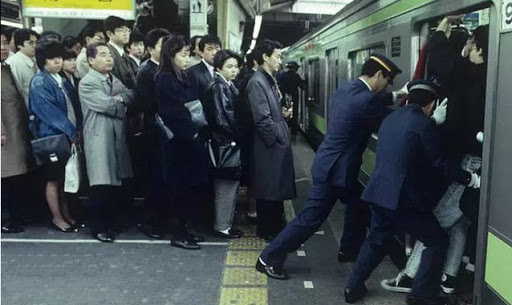
I chastised myself for not planning better as I usually managed to avoid this unpleasant press of people. Fortunately, I don’t commute by train to work, so I generally dodge such circumstances that many have to endure on a daily basis. But on this particular day, I had arranged to meet someone for an early appointment which required me to enter the unwelcome fray of rush hour madness. However, at the more crowded stations in Tokyo, help is available to assist desperate travelers like myself reach their destination on time. These special white gloved assistants are called “oshiya,” (押し屋) which means roughly “professional pusher.” Oshiya are employed part time during peak commuting hours to push people into train cars and ensure that nothing gets caught in the doors, thus enabling the train to depart on time.

The original oshiya were hired to work at the notoriously busy Shinjuku Station and were initially called “ryokaku seiri gakari” (旅客整理係), which meant “passenger arrangement staff.” A lot is certainly being arranged by these dedicated laborers as you can witness for yourself through the following link: https://www.youtube.com/watch?v=E7kor5nHtZQ. My most unforgettable train experience occurred when we were traveling through Tokyo as a family on a crowded train and I hoisted my youngest child above my head with outstretched arms to protect him. The train car suddenly became so packed with people that I was soon trapped in that awkward position, unable to lower my arms. However, my son didn’t seem to mind his lofty perch as he had a great birds eye view of the chaos below while I strained to hold him up for what seemed like an eternity until we finally reached our stop.

While we may not enjoy such close proximity with people when riding on a train, the Word of God teaches us that living in community with one another is actually an essential element in our spiritual growth. The New Testament repeatedly exhorts the people of God to practice the various “one another” commands that promote successful communal life. In so doing, we honor God, who calls us to abandon our natural inclination towards selfishness and beckons us to live together in unity. This is no small task.

Among the many “one another” commands are:                                                               Forgive one another                 Serve one another                                                                 Accept one another                   Comfort one another                                                                Pray for one another                Be kind to one another                                                             Bear one another’s burdens   Encourage one another                                                           Love one another

Like passengers on a crowded train, many of these injunctions seem a little too close for comfort as they demand actions and attitudes of us that run counter to our deeply ingrained sense of self preservation. But as Jesus pointed out in His final exhortation to His disciples, the implementation of these commands is what sets us apart from the world and its modus operandi (John 13:35). Due to the current COVID-19 pandemic, we are rightly advised to temporarily practice social distancing to preserve physical health. But on the other hand, distancing ourselves from others long term invites other potentially deadly consequences. Only love for one another can bring genuine healing to a sick world.

Protruding Nails

“Let your light shine before others, that they may see your good deeds and glorify your Father in heaven.” Matthew 5:16

protruding nail

Many years ago I took a number of Japanese visitors to an event in the United States where the performers on stage tried to recruit volunteers from the audience to participate in the action. Everyone around us eagerly thrust their hands into the air begging to be chosen, but my Japanese guests shrunk back, doing their best to become invisible. I was slightly amused as I witnessed this contrast in reactions and obvious clash of cultures. My Japanese friends were equally puzzled by the circumstances and later asked me, “Why are Americans so eager to rush on the stage and make fools of themselves?” To which I casually replied, “It’s the American way!” While my answer was rather shallow and primarily intended to draw laughter, it did partially capture the vast differences that often separate us as different cultures defined by different values.

The Japanese have a famous proverb that goes, “The nail that sticks out gets hammered in” *(出る釘は打たれる), which succinctly captures the previously described scenario. Due to Japan’s centuries of intentional isolation as an island nation and its mono-ethnic makeup, diversity is generally not encouraged. This serves as a stark contrast to the melting pot of cultures and ethnic groups that typically characterizes the United States, where individuality and the expression of it is considered a high value. However, in Japan, deviance from the norm is often met with resistance, like a protruding nail that is routinely hammered in so it will match the others. Group mentality and the pressure to “fit in” encourages conformity on many levels in Japan, so few are willing to face criticism and risk being singled out. This mindset can be a powerful tool to mobilize effort and energy into a cohesive direction for a particular objective, but it has the drawback of shutting down independent thought and action that sometimes might lead to better outcomes.

Of course, there are exceptions to this trend and nowhere is this more evident than the variety of street fashions in the Harajuku district of Tokyo, where young people express their individuality through unusual clothing and makeup combinations. In addition, some public figures may shun conformity in order to achieve success and are ironically admired for their boldness and innovation. But among the general masses, the desire for safety and tranquility continues to drive responses and few are willing to take the risks that come from being a nail that sticks out.

Jesus, however, essentially called His followers to be that protruding nail. While this presents unique challenges for Japanese believers seeking to live out their faith in a non-Christian culture, it is a problem that all true followers of Christ must wrestle with as the Kingdom of God inevitably clashes with the kingdoms of this world. As the people of God, we are to be actively engaged in a spiritual battle where our good deeds and testimony bear witness to the greatness and mercies of God to others around us. This way of life, of course, leaves little room for shrinking back into a self-protective mode for fear of criticism or rejection. Our light must shine as we become protruding nails within the cultural context where God has uniquely placed us. After all, the ultimate hammer resides in God’s hand and it is His judgment that matters in light of eternity.

* The proverb originally stated, “The stake that sticks out gets pounded,” which doesn’t significantly change the current nuance.