
Boasting

“In God we make our boast all day long, and we will praise your name forever.”   Psalm 44:8

Boasting   Soon after our initial arrival in Japan, we were a little bewildered by some things we observed when we joined a Japanese family who had kindly invited us over for a meal. Before we even sat down to eat, the husband proceeded to demean his wife’s efforts in cooking and house cleaning. Unlike the typical American domicile, we didn’t notice any family photos capturing activities of the children or anything commemorating their individual achievements. Little mention was actually made of the children outside of our hosts’ minimal responses to our polite inquiries. We also thought it odd when they referred to their son as a “baka musuko” (stupid son). We went home that evening rather puzzled by our experience, but later learned that it is considered socially taboo to praise one’s own family.

This experience certainly cut across the grain of what we had been taught to do within Christian circles in the West, where praise and encouragement of family members is actively promoted. While it may be acceptable to directly compliment people you are close to, in Japan, it is perceived as boasting when you make such comments to others outside of your personal circle. One may have a beautiful wife, who’s a great cook, and intelligent children who excel in many activities, but it would be interpreted as bragging or arrogant to express such sentiments to others. This explains why many Japanese adopt a self-depreciating attitude and communication pattern when it comes to the accomplishments of one’s family and even employer.

This tendency to avoid self-promotion is enhanced by humble Japanese language patterns that are routinely used in certain social settings and one is expected to downplay any personal action that might have benefited others. It is quite common in Japan to give a gift when someone has done something for you, but we soon learned the appropriate phrases to be said when presenting such items are: “tsumaranai mono desu ga…” (“this is a boring, uninteresting item…”) or “sasayakana mono desu ga…” (“this is something very meager…”). There is obviously a very fine line between truth telling and false humility, but in Japan, we learned it is better to err on the latter end of the spectrum when communicating with others.

Boasting is usually associated with pride, which is frowned upon in most cultures and certainly condemned in the Bible. For example, boasting is an identifying characteristic of the beast (Daniel 7:11) who is the antithesis of all that God represents. When the Apostle Paul succinctly defines the nature of love in I Corinthians 13, he used a number of negative behaviors to describe what love is not, and among them is a propensity to boast (v. 4). Boasting about one’s own righteousness to claim good standing before a holy God is equally castigated (Romans 3:27-28) as we all stand impoverished in the presence of God because of our sinfulness.

The root motivation behind an inclination to boast is self-promotion, but there is another form of boasting that is actually encouraged in the Scriptures: the promotion of God instead of self. In taking up the topic of boasting again in the 2nd Letter to the Corinthians, Paul advises: “Let the one who boasts boast in the Lord.” (10:17) Such boasting is another form of praise as we ascribe credit to God for all His works and gifts on our behalf, instead of claiming anything for ourselves. This is not false humility, but rather, an honest declaration of who we are and what we have been given before a gracious and generous God.

Saving Face

“Do your best to present yourself to God as one approved, a worker who does not need to be ashamed.”

II Timothy 2:15

Saving Face

Like many men, I am not inclined to linger long in front of a mirror for visual inspections. However, during the long, cold winters in northern Japan when I often let my beard grow, I became more preoccupied with my face as it required more attention. Most Japanese give a lot of attention to another kind of “face” that is sociological in nature. In this usage, “face” represents the honor, dignity, status or reputation of an individual that one strives to protect or maintain at all costs. This concept is somewhat similar to what we refer to as “having a good name” in western culture.

In Japan, one can save face (menboku o tomatsu—面目を保つ), lose face (menboku o ushinau—面目を失う), give face, show face, fix face and even loan face. All of these variations are centered on the personal goal of maintaining respect or the opposite incentive of avoiding shame and humiliation. Japan’s shame culture, which is also prevalent in other parts of Asia, is perhaps the main driving force that prompts this extensive preoccupation with one’s “face.” No one wants to lose face or be embarrassed in front of others, which also motivates people to be careful to maintain the face of others. Therefore, public disagreements are often avoided as someone could lose face in such an encounter. One might refrain from asking direct questions or making requests that may inconvenience the other person. It is also generally considered socially unacceptable to publicly declare someone has made a mistake. Personal relationships and social harmony are considered to be the bedrock of Japanese society, so great care is usually taken to protect each other’s face.

Such a concern for others is commendable in many regards, but taken too far, this kind of superficial interaction can lead to potential misunderstandings and fractured relationships. In the famous song “Eleanor Rigby,” the Beatles sang of a woman who “wore a face in a jar that she kept by the door,” that somewhat reflects the common practice in Japan to put on different faces for different situations. One’s “face” then, is not just what other’s see, but what we want them to see. This projected face may not be in true alignment with the feelings and thoughts that lie underneath, which in turn, makes the art of saving face and maintaining relationships in Japan a rather complex endeavor.

Behind the efforts to save one’s personal face or reputation is often a latent desire to earn the approval of others which can unwittingly invite other negative, or even sinful outcomes. While it is good to be considerate of others, taking into account their opinions and feelings, we must be careful as to who and to what extent we empower with such control over our lives. Our efforts to save face, or not to lose face, can lead us down a dangerous path where the approval of others becomes more important than the approval of our Creator. As the Apostle Paul reminds his young protégé Timothy, there is no shame if we have the approval of God (II Timothy 2:15). This “face” requires our utmost attention and should never be placed in a jar by the door.

Group Photos

“I will remember the deeds of the Lord.”   Psalm 77:11a

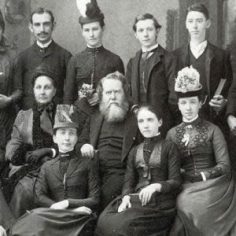
1888-Team-James-Hudson-Taylor-300x300    Long before the term “selfie” carved out a unique niche in our lexicons, the Japanese used an alternative word that eventually became a part of our personal vocabulary and history. It is called “kinen shashin” (記念写真) and it is roughly translated as “commemorative photograph.” Whenever a group assembles for a particular occasion, someone inevitably calls for a kinen shashin to be taken to commemorate the event. If you browse through our personal photo albums (back in the day when we collected physical photographs), you will discover quite a few of these kinen shashin scattered among other pictures portraying family and friends in various locations and activities.

A few of these kinen shashin are now framed and hang on our walls, or sit on our shelves, reminding us of days gone by and God’s grace in our lives. Such events may include baptisms, church anniversaries, a farewell of a coworker, training events, a church dedication, a wedding, an induction of a pastor, a graduation, conferences, the launching of a new church plant, a special concert or a group reunion. Each kinen shashin speaks volumes about God’s faithfulness throughout a jumble of times and circumstances as we walked through life and our paths crossed with those of many others.

But this is where the nuance of kinen shashin departs from our typical preoccupation with selfies. A selfie is generally photographic evidence that you did something, ate something, went somewhere or were with someone in particular. The focus is centered more on ME and things that are related to ME at the time the picture was taken. That is undoubtedly why the term “selfie” was coined to capture the essence of this particular form of photography. Of course, there is nothing wrong with this approach and we ourselves frequently take selfies. However, if given a choice, I would much rather be included in a kinen shashin, where my face may be lost in the crowd, but something much greater than me is being recorded as part of my ongoing faith journal.

In the days before the invention of cameras and cell phones, the psalmist testified “I will remember the deeds of the Lord.” (Psalm 77:11a) which is how we are prompted to respond when we view some of the kinen shashin from our past that depict various people and ministries. When we take the time to peruse through such photos, they serve to remind us of the many “deeds of the Lord” that have transpired over the years, but may have slipped from our memories. We would do well to fondly remember such people and events with thankfulness, but also with expectation for the things yet to come that we can only see now through eyes of faith. While it is sometimes unwise to linger too long in the past, we should certainly learn from it and apply those lessons to new challenges ahead. Kinen shashin can serve such a purpose as they beckon us to focus on community and God, which a selfie often fails to capture.

Omotenashi*

Offer hospitality to one another without grumbling.” I Peter 4:9

Omotenashi

Upon our arrival in Japan, we were initially surprised by the many small extras that were routinely extended to customers, reflecting a level of service and care we had previously not experienced in the States. For example, upon entering a large department store elevator, a perfectly coiffed woman in a smart uniform politely greeted us with a bow and pushed the button of the floor we wanted. Whenever we pulled into a gas station, attendants scurried around our car offering various forms of service and bowed in unison as we departed. When invited over for a meal, our hostess unfailingly laid out slippers for us and then proceeded to quietly turn our outdoor shoes around to easily step into in preparation for our departure.

All such efforts are part of what the Japanese loosely call “omotenashi,” a word usually translated as “hospitality.” However, such a simple summary does a huge injustice to the deep complexities that underlie the concept of omotenashi. The term itself is very unique in that different Chinese characters (kanji) are employed for the same word, adding subtly different nuances to the meaning. For this reason, omotenashi is most commonly written in the alphabetic hiragana as おもてなし, and avoids usage of the kanji. In its most basic translation, omotenashi means “not having two sides,” implying that one must be wholehearted and single-purposed when offering hospitality or a service to others. But “omote” can also refer to one’s public face or the way you present yourself to the world and “nashi” means “nothing.” This aspect of omotenashi then suggests that you are to serve others without public pretense, where ego doesn’t get in the way. This idea takes hospitality to a much higher level that goes beyond the expectations of the person being served and perhaps, even beyond the personal preferences of the one doing the serving. This form of omotenashi requires you to pay close attention to the needs of a guest or customer to the exclusion of your own.

The concept of omotenashi extends throughout Japanese society, including the manufacturing of cars. A great example of this is the circumstances that followed the launch in 1989 of the Lexus luxury vehicle model LS-400. After thousands of this particular car were rolled off of the assembly line and sold, Lexus received two very minor complaints from a couple of disgruntled customers. The company’s response? Lexus recalled all the cars and issued every owner a detailed letter of apology. In that letter, Lexus offered to come to every customer’s home, pick up their car, leave them a free loaner car, repair the car for free, wash it and then return it with a full tank of gas and an expensive gift. That’s omotenashi. Such incredible service closely aligns with the old Japanese proverb, “Okyakusama wa Kamisama,” which means, “the customer is god.”

While the values and practices of hospitality vary widely from culture to culture, we should remember that omotenashi is something all Christians are commanded to do. (Romans 12:13) On top of that, we must keep a close guard on our attitudes that accompany such acts of service as the Apostle Peter warns they are to be offered “without grumbling.” (I Peter 4:9) Biblical hospitality is not driven solely by an absence of self, like omotenashi; rather, it is spurred by higher motives: love of God and love of others. For a good example of this, we need look no further than the precedent Jesus laid down for His disciples when He washed their feet shortly before He was taken away to be tortured and crucified. That is God’s version of omotenashi.

*The idea for this blog comes from Malcolm Gladwell’s Revisionist History podcast “Go and See” on March 5, 2020.

Know Your Place

“There is neither Jew nor Gentile, neither slave nor free, nor is there male and female, for you are all one in Christ Jesus.”  Galatians 3:28

sumo

America is generally, a land of informalities as evidenced by our dress, speech and lack of class distinctions. Therefore, the somewhat hierarchical nature of Japan was a new experience for us when we first arrived. This distinction became obvious once we commenced language study, where we learned that communication patterns in Japan vary according to one’s social position and the person with whom you are speaking. There are respectful language forms (sonkeigo 尊敬語), humble language patterns (kenjōgo 謙譲語), and polite language forms (teineigo 丁寧語), that, together, reflect a person’s social standing in relation to their conversational partner.

When we made our first visit to the city ward office, this tendency towards hierarchy was also conspicuous in the working world as we observed the unusual layout of the employees’ work places. In typical Japanese fashion, there were no partitions or cubicles, but instead, everyone’s desk was neatly positioned among rows of other desks facing the manager’s working area so he could easily monitor them. We also learned that it is common to use both name and title when addressing superiors within one’s company, where everyone knows their place. This ranges from the chairman, or the kaichō (会長), who is often an elderly figurehead, down to the lowest staff member known as a shain (社員). In between these two extremes, you have the president (shachō), general manager (buchō), section manager (kachō), team leader (kakarichō) and supervisor (shunin) with many additional sub categories. These positions are clearly indicated using nametags, desk name plates and personal business cards.

This proclivity towards ranking is particularly noticeable in the traditional sport of sumo. There are six divisions of sumo with multiple ranks within them. Life in the sumo world is akin to a commune where all the wrestlers live, work and eat together. However, there are huge distinctions in privileges and duties between higher and lower ranked wrestlers. The differences are evident in the clothing they are allowed to wear, free time allotted to them, required chores, the degree of privacy they enjoy and training opportunities. These distinctions reflect the general sense of senior (sempai) and junior (kohai) relationships that permeate all levels of Japanese society.

In ancient cultures and still in many countries, the tendency to draw lines between people based on factors such as economics, ethnicity, power, religion and gender is not unusual, and sometimes, it is even necessary. But it becomes a problem when individual rights are violated and those deemed to be at the top of this artificially constructed pyramid take advantage of those considered beneath them. Jesus came to break down such biased barriers that can disrupt relationships and lead to divisiveness. Of course, the greatest barrier of all is the one that existed between men and God, which Jesus broke down through His sacrificial death on the cross. In so doing, He also offers healing to the nations, the removal of prejudicial classifications and the redemption of damaged relationships. While it is important to know our place in this world, it is far more important to know our place in the world to come.

My Hometown

“My people will live in peaceful dwelling places, in secure homes, in undisturbed places of rest.”      Isaiah 32:18

Furusto

Our “choir” for that day featured no gifted singers, but what it lacked in ability was more than compensated for by the heartfelt participation of the predominantly older voices gathered in one of the many temporary housing areas scattered along the northeast coast of Japan. We were serving coffee, tea and homemade cookies to those who had been recently displaced by the tsunami following the Great East Japan Earthquake. A team of volunteers then led everyone in singing the famous Japanese folk song “Furusato,” (故郷) translated “My Hometown.” As my wife and I listened to the well-known words to the song, we were emotionally unable to add our voices to those who had lost so much.

I chased rabbits in those mountains
I fished in that stream
I still dream now and then about those days as a child
How I long for and miss my hometown

How are my father and mother?
Are my old friends okay?
Whenever it is rainy and windy
I recall my happy childhood in my hometown

Some day when I've done what I set out to do,
I will return to what used to be my home
The mountains are green there in my hometown

Described as a song that reflects the heart of Japan, Furusato* is traditionally sung as a wistful contemplation of bygone days with the slight hint of hope that those happier times will someday be recovered. But the words on this occasion seemed empty as they were being mouthed by people who had lost their homes, loved ones, jobs and even their way of life within the span of a few minutes on March 11, 2011. The mountains and streams from their childhood memories still remained, but there would be no returning to the furusato they enthusiastically sang about.

That single moment, among the many we experienced doing relief work, captured for us the uniqueness of the Japanese and their amazing, resilient response to unmitigated, personal disaster. All that remained of many towns and neighborhoods along that coast were vast fields of empty foundations that eerily resembled ancient archeological ruins. Those who remained continued to press on, clinging to the memories of their furusato with little hope of livelihood, and many were still struggling to pay off loans on houses that no longer existed.

Although the song “Furusato” is known by all Japanese, very few are aware that the tune and lyrics were actually written by Christians. As such, the composers used the metaphor of furusato to portray the people of God as sojourners on earth waiting for their eternal, heavenly home. This theme comes out clearly in the last verse where it says “Someday when I’ve done what I set out to do, I will return to what used to be my home.” It is good to keep this worthier objective in mind as we seek to point the way to our eternal furusato to others, while standing shoulder to shoulder with those who have lost their earthly furusato.

*You can listen to the song Furusato through the following link: https://www.youtube.com/watch?v=gcmcXrCihrA 


Gods on a Shelf

“How long will you love delusions and seek false gods?”                Psalm 4:2b

Butsudan2

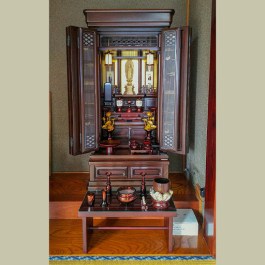
We watched silently as the flames steadily consumed the butsudan (仏壇), or Buddhist altar that represented the gathered family’s dramatic break from the false gods they and generations before them had previously served. A butsudan is a shrine commonly found in temples and homes in Japan. It basically consists of an ornate wooden cabinet that typically houses a Buddhist religious icon and other accessories known as butsugu. These items are usually candlesticks, bells, incense burners and elaborate dishes where rice, tea or fruit are placed as an offering to deceased ancestors. A photo, memorial tablet (ihai), or ashes of a venerated family member are often placed within the butsudan, which represents a unique combination of traditional Buddhism and ancestral worship. Local Buddhist priests are usually called in to conduct periodic formal ceremonies in front of the butsudan, as determined by the date of the deceased’s death. Many households also maintain a simple daily ritual at the Buddhist altar of offering prayers, putting out food or burning incense; this responsibility usually falls on the wife.

Worship before the butsudan was traditionally viewed as an essential element in Japanese life, as it represented the center of a family’s spiritual faith and their historical heritage. While this practice is still quite common in the more rural areas of Japan, the responsibility of maintaining the family Buddhist altar is a burden modern Japanese are increasingly unwilling to bear as their religious convictions and lifestyles continue to evolve. The high price of these butsudan and the space they require in crowded homes are additional deterrents to owning one.

The butsudan is not to be confused with a kamidana (神棚), which is a Shinto god shelf and represents an entirely different religion unique to Japan. Many Japanese adhere to both Buddhist and Shinto practices. In contrast to the butsudan, kamidana are much more simplistic in appearance and are even sold as inexpensive kits at the local hardware store if you want to construct your own. The general purpose of a Shinto god shelf is to house a local Japanese kami or spirits, which are believed to inhabit all things. According to Japanese mythology, there are eight million of these quasi spirits who should be properly venerated.

Unlike a butsudan, a kamidana is typically placed high on a wall above eye level in a place where people will not walk under it. The Shinto god shelf contains a variety of items, but the most important one is the shintai. This is an object designed to house a particular kami, by providing a physical form to enhance worship. A shintai is usually a small circular mirror, but it can also be a stone, jewel or some other object with symbolic value. Worship at a kamidana is believed to invite success or good fortune, so is it is quite common to see Shinto god shelves on prominent display in places of business.

Idolatry actually comes in many forms and is not limited to images or objects commonly condemned in the Bible and currently present in Japan. The Ten Commandments begin with a prohibition of placing any other gods before the One True God where one constructs images of such gods or bows in worship before them. While very few of us place such obvious idols in our homes and worship them, our hearts are unfortunately inclined to value people, things, or objectives ahead of God and wrongfully give ourselves to them. Such “gods” should have no place on the shelves of our lives.

Protruding Nails

“Let your light shine before others, that they may see your good deeds and glorify your Father in heaven.” Matthew 5:16

protruding nail

Many years ago I took a number of Japanese visitors to an event in the United States where the performers on stage tried to recruit volunteers from the audience to participate in the action. Everyone around us eagerly thrust their hands into the air begging to be chosen, but my Japanese guests shrunk back, doing their best to become invisible. I was slightly amused as I witnessed this contrast in reactions and obvious clash of cultures. My Japanese friends were equally puzzled by the circumstances and later asked me, “Why are Americans so eager to rush on the stage and make fools of themselves?” To which I casually replied, “It’s the American way!” While my answer was rather shallow and primarily intended to draw laughter, it did partially capture the vast differences that often separate us as different cultures defined by different values.

The Japanese have a famous proverb that goes, “The nail that sticks out gets hammered in” *(出る釘は打たれる), which succinctly captures the previously described scenario. Due to Japan’s centuries of intentional isolation as an island nation and its mono-ethnic makeup, diversity is generally not encouraged. This serves as a stark contrast to the melting pot of cultures and ethnic groups that typically characterizes the United States, where individuality and the expression of it is considered a high value. However, in Japan, deviance from the norm is often met with resistance, like a protruding nail that is routinely hammered in so it will match the others. Group mentality and the pressure to “fit in” encourages conformity on many levels in Japan, so few are willing to face criticism and risk being singled out. This mindset can be a powerful tool to mobilize effort and energy into a cohesive direction for a particular objective, but it has the drawback of shutting down independent thought and action that sometimes might lead to better outcomes.

Of course, there are exceptions to this trend and nowhere is this more evident than the variety of street fashions in the Harajuku district of Tokyo, where young people express their individuality through unusual clothing and makeup combinations. In addition, some public figures may shun conformity in order to achieve success and are ironically admired for their boldness and innovation. But among the general masses, the desire for safety and tranquility continues to drive responses and few are willing to take the risks that come from being a nail that sticks out.

Jesus, however, essentially called His followers to be that protruding nail. While this presents unique challenges for Japanese believers seeking to live out their faith in a non-Christian culture, it is a problem that all true followers of Christ must wrestle with as the Kingdom of God inevitably clashes with the kingdoms of this world. As the people of God, we are to be actively engaged in a spiritual battle where our good deeds and testimony bear witness to the greatness and mercies of God to others around us. This way of life, of course, leaves little room for shrinking back into a self-protective mode for fear of criticism or rejection. Our light must shine as we become protruding nails within the cultural context where God has uniquely placed us. After all, the ultimate hammer resides in God’s hand and it is His judgment that matters in light of eternity.

* The proverb originally stated, “The stake that sticks out gets pounded,” which doesn’t significantly change the current nuance.

The Virtue of Gaman

“Let perseverance finish its work so that you may be mature and complete, not lacking anything.”   James 1:4

Gaman2

My wife was in extreme agony from labor pain as we anticipated the imminent arrival of our second child. Desperate for relief, we called the nurse for assistance and she simply replied “gaman dekinai?” The word gaman was new to us, but judging by the nurse’s response, we could tell she wasn’t going to do anything. Later, we learned that gaman (我慢) means “to endure the seemingly unbearable with patience and dignity.” Sometimes it is translated as “perseverance” or “patience, but these words don’t do justice to the complexity of the concept in the Japanese context.

Gaman is considered a virtue in Japan, as it is an indicator of maturity and strength in the face of difficult circumstances. The objective is to bear hardship without complaint and thereby cause minimal inconvenience for those around you. This admired character attribute is evident when Japanese silently squash themselves into packed trains, work extremely long hours, endure brutal sports drills or sit in unheated classrooms. When one perseveres in a negative relationship at home, work or school, he is exercising gaman. When one waits patiently in a long checkout line or in a queue to board public transportation, she is demonstrating the power of gaman. Visitors to Japan may observe these responses in action and mistakenly assume Japanese lack assertiveness or initiative. In so doing, they fail to understand the value of gaman which undergirds all of Japanese society, enabling it to function in an orderly manner. This is why gaman is a common character trait among Japanese heroes who typically overcome huge obstacles while stoically enduring injustice and pain to ultimately triumph.

But gaman does have a dark side. It can impose unrealistic pressure on individuals to conform to expectations at the expense of their own physical or psychological health. It can squash self-expression and the free exchange of ideas that may facilitate corporate or personal growth. Japan’s orderly society comes with a cost and if the virtue of gaman is allowed to reign unchecked, other problems inevitably emerge.

Perseverance is extolled as a godly characteristic in the Scriptures and its practice is also a gateway to other virtues that should characterize God’s people. There is much to be admired in the similar concept of gaman, but we must be careful not to let it falsely shape the nobler attribute of perseverance. Their respective goals and the means for achieving them can be significantly different. Biblical perseverance has God at its center and the goal is to glorify Him through our faith-filled responses regardless of our circumstances. Although gaman promotes the worthy goal of maintaining an orderly community or company, it often comes at the expense of the individual and tends to neglect God altogether. The Bible character Job is perhaps the greatest example of perseverance (James 5:11) and how it eclipses the lesser virtue of gaman. Through his powerful testimony, we learn how Job endured the seemingly unbearable with patience and dignity but his actions are not to be confused with gaman. While Job’s amazing perseverance did bless those around him and generations to follow, his ultimate goal was to worship God through his faith filled response. That is worth emulating.