
Shiokari Pass

“Greater love has no one than this: to lay down one’s life for one’s friends.”  John 15:13

Shiokari Pass

Located at the apex of Shiokari Pass in Japan’s northern island of Hokkaido, sits a solitary marker in a desolate spot, commemorating the story of Masao Nagano, a man who sacrificed his life to save others. This newsworthy event took place over one hundred years ago on February 28, 1909. At the time, Nagano san was employed as a railway official in the major city of Asahikawa, where he was highly respected by his superiors and colleagues for his integrity, work ethic and generous spirit. There was one other important fact about this young civil servant that made him stand out to others: he was a Christian. Masao was quite zealous in his faith, even using his own personal funds to help found the Young Railway Men’s Christian Association and was a popular speaker within local Christian circles.

On that particular snowy evening, Nagano san was making his way home from a church meeting on a train that regularly traversed the steep Shiokari Pass. As the train neared the summit, the last carriage in which he and other passengers were riding suddenly became uncoupled from the rest of the train and started to roll backwards downhill towards their certain destruction. Everyone knew the train car would soon pick up speed and likely hurtle off the tracks at the first bend. As an experienced railway worker, Masao Nagano immediately leapt into action and raced to the hand brake at the rear of the carriage. In desperation, he repeatedly turned the brake wheel to stop the descent of the trapped passengers. His efforts succeeded in slowing down the carriage, but not sufficiently to stop their downward movement. However, just when it seemed all was lost, the train car surprisingly came to a stop. All the occupants were saved, but their deliverance had come at a great cost. It was soon discovered that Nagano san had thrown himself under the wheels of the train car and managed to halt its doomed descent.

On Nagano’s body, in the inner pocket of his jacket, authorities discovered a recent copy of his will where, among other things, he had written: “I am equally grateful for all the hardships, happiness, life and death.  With gratitude I offer all I have to God.” He was only 30 years of age, but in his short time on earth, Masao Nagano managed to impact many for the kingdom of God.  Thanks to the efforts of famed Christian novelist, Ayako Miura, Nagano san’s story continues to touch countless lives through her famous novel “Shiokari Pass.” This widely acclaimed book published in 1968 is a fictional story largely based on what is known of Masao Nagano’s life and was later made into a movie.  A candlelight vigil now takes place at Shiokari Pass every year on February 28 to honor the man who selflessly laid down his life for others.

It is generally understood that love of self often impedes empathy of other people’s needs and, consequently, our willingness to take sacrificial action on their behalf. Nowhere is this more evident than our natural penchant to preserve our own life even when other lives are at stake. This tendency is likely why Jesus used the example of sacrificing one’s life for someone else as the supreme demonstration of the meaning of love.  Of course, Jesus later modeled such love on the cross, inspiring one of His disciples to offer up the following challenge: Bottom of Form“This is how we know what love is: Jesus Christ laid down his life for us. And we ought to lay down our lives for our brothers and sisters.” (I John 3:16) We would do well to follow the example of Nagano san, who offered all he had to God at Shiokari Pass.
Tree of Hope

“Such is the destiny of all who forget God; so perishes the hope of the godless.”            Job 8:13

Tree of Hope

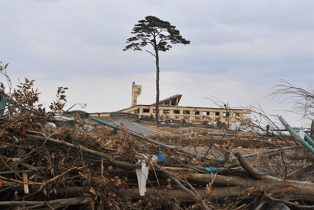
On the shoreline of the small coastal Japanese town of Rikuzentakada, stands a lone, towering pine tree, which is all that remains of a once-flourishing forest of 70,000 trees. All the other trees were obliterated in a matter of minutes by a 42-foot tsunami that swept aside everything caught in its relentless path of destruction on March 2011. Local survivors of that terrible natural disaster were amazed by the resiliency of this one particular tree, and fondly began referring to it as the “Pine Tree of Hope” (希望の松). For many residents on the coast who experienced the tragedy of that fateful day, that single tree became a symbol of hope among those who had lost so much. We ourselves marveled at the seeming miracle of this solitary tree every time we passed through the area while engaged in relief work ministry.

Unfortunately, the extreme salinization of the soil caused by the onslaught of seawater eventually took its toll on the Pine Tree of Hope such that it began dying and, sadly, had to be cut down. However, thanks to Japanese ingenuity and generous donations to the project, the tree was restored and erected in its original location. As part of that process, this natural monument was carefully cut into sections using a giant crane and each portion was carefully treated over the course of months with special preservatives. Then the pieces were reassembled around a uniquely constructed carbon spine as the final stage to bring this powerful symbol of resiliency back to life.

Everyone understandably celebrated the restoration of the Pine Tree of Hope, but if one paused to reflect upon these matters, it seems rather ironic to note that a tree, which is supposed to offer hope, is actually a fake. This bit of irony may lead one to reasonably ask, “What is real hope and how can I obtain it?” Men can certainly replant a forest, but only God, the Creator and Sustainer of all things, can make a tree and give men genuine, lasting hope in the midst of life’s most adverse circumstances.

The biblical patriarch Job, wrestled with such perplexing issues while suffering enormous personal loss. He came to the conclusion that hope is an exercise in futility if it is not grounded in the character and eternality of God (Job 8:13). Interestingly, the word “hope” appears in the Book of Job nineteen times, which almost seems incongruous with the massive setbacks in his life, like a fake pine tree in the middle of a disaster zone. But closer examination reveals that Job’s hope was not centered on the possibility of future positive outcomes, but on God Himself. Such a sure foundation of hope explains why the psalmist confidently declares “Blessed are those… whose hope is in the Lord their God. He is the Maker of heaven and earth, the sea and everything in them—he remains faithful forever.”  (Psalm 146:5-6) In the tsunamis of life, only God, not a tree, can provide real hope.

Persecution

“Blessed are those who are persecuted because of righteousness, for theirs is the kingdom of heaven.”      Matthew 5:10

Persecution

Protestant Christianity came to Japan in 1859, but Catholic missionaries arrived approximately three hundred years earlier, making a significant impact.* Francis Xavier (1506-1552) was a Jesuit priest who is historically credited for introducing Christianity to Japan and he was followed by many other Catholic priests and monks. These early missionaries encountered an initial measure of success as they baptized over 100,000 converts, including a number of local feudal lords. This new religious movement was initially unopposed by the ruling Shogunate, but the Japanese leaders eventually became suspicious of the outsiders who represented countries intent on expanding their colonial empires. Fearing a loss of power, the Japanese rulers proceeded to launch a ruthless persecution of Christianity and its followers.

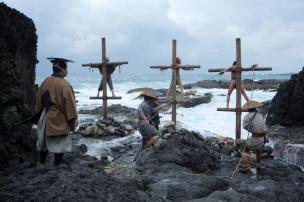
To aid them in this endeavor, these Japanese despots developed an effective method called “fumie” (踏み絵), to help identify adherents to the new religion.  Fumie means literally “to stamp or trample on an image,” referring to a religious icon usually bearing a likeness of Jesus or Mary. Utilizing this devious scheme, suspected Christians (Kirishitan) were rounded up in each village and forced one by one to trample on the venerated image placed before them. If they refused to do so, the Kirishitans were turned over to the professional torturers to either recant or die for their faith. The commonly used methods of torment included immersing victims in scalding hot springs, burning some Kirishitans alive, hanging others upside down over pits full of excrement or attaching some to crosses in the ocean where they were slowly drowned by the incoming tide. Government authorities were so zealous in their persecution efforts that they continued the practice of fumie for several years, even to the fourth generation in their attempt to completely stamp out any remnants of Christianity in Japan.

Many believers understandably went underground with their faith and religious practices and were soon referred to as “Kakure Kirishitans” (隠れキリシタン) meaning, “hidden Christians.” In subsequent decades and even centuries to come, the Kakure Kirishitans continued to secretly gather for worship, using prayers modified to sound like Buddhist chants and retained portions of the Bible through oral transmission. The famous Japanese author, Shūsaku Endo, creatively captured the events of this dark period in Japanese history through his novel “Silence,” which was recently brought to life as a major motion picture by the same name.  Viewer discretion is advised for the following clips from the movie:

A Jesuit priest recants his faith: https://www.youtube.com/watch?v=EOX8-c-_uVY

Martyrdom through drowning: https://www.youtube.com/watch?v=Uhqa8KylUM8

On a hill in Nagasaki now stands the Church of the 26 Martyrs, which was erected in 1962 to commemorate the lives of 26 Christians who were executed on that exact site on February 5, 1597. It stands as a solemn reminder that those who identify with Christ and take up their own cross to follow Him are not exempt from persecution. Like the early Japanese martyrs who forfeited their own lives by living for the kingdom of God, we are called to pursue righteousness and godliness, while living among the kingdoms of this earth. We must resist all evil influences that would sway us to trample on the things of God.

*There is some evidence that Christianity was actually introduced to Japan almost 1,800 years ago through early Nestorian missionaries, but failed to achieve a significant foothold in the country.

Sharp Swords

For the word of God is alive and active. Sharper than any double-edged sword, it penetrates even to dividing soul and spirit, joints and marrow; it judges the thoughts and attitudes of the heart.”                                                                                                                                                                                                                                                       Hebrews 4:12

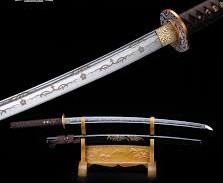
katana2

As I stared at the beautifully crafted Japanese sword on display in the castle, I wondered about its history and the craftsmanship required to produce such a formidable weapon. A katana (刀) is the most well-known among Japanese swords as it was traditionally carried by samurai. A well-trained swordsmith may labor over a year to produce a single exquisite blade that can sell for over $25,000 to enthusiastic collectors in today’s market. Several craftsmen are typically involved in the process of creating a katana, including a metal worker, a polisher, a sharpener and other specialists to create the hilt, hand guard and sword sheath. The production of a typical Japanese katana was considered a sacred art with accompanying Shinto rituals. The bearer of the sword generally regarded it not just as a weapon for fighting, but also as a sort of talisman to ward off evil.

Around 700 AD, a craftsman named Amakuni is credited with creating the first katana, which is a single-edged, curved sword using a two handed grip, but Masamune (1264–1343) is widely recognized as Japan’s greatest swordsmith. Experts in ancient weaponry consider the katana to be among the finest cutting blades in military history and many legends exist regarding the capabilities of this renown sword.

During the Meiji period (1868-1912) that marked the collapse of Japan’s ancient feudal system and ushered in the rise of a modern industrialized nation under the emperor, the ancient samurai class was disbanded and their special privilege to carry swords in public was removed. But the rise of the military state leading up to World War II encouraged the manufacturing of swords once again. All Japanese officers were required to carry a katana in order to boost morale and as an attempt to connect them with the spirits of their ancestral warriors. Following Japan’s defeat, all sword manufacturing and even sword related martial arts were banned for several years. However, sword production was legalized again in 1953 and there are presently around 180 specially trained swordsmiths still working in Japan. They are legally allowed to produce only two long swords per month and all such weapons must be registered with the government.

An old myth still persists that a Japanese katana is so sharp that if a silk cloth were dropped on an upturned blade it would be effortlessly sliced into two separate pieces. However, the law of physics dictates that this is not possible without the application of some form of friction or force. The Word of God is aptly described as being sharper than the finest of swords (Hebrews 4:12), penetrating to a level that is unobtainable through a human crafted weapon. It goes beyond the physical dimension and cuts so deep into our hearts and souls that it reveals even our thoughts, attitudes and motives normally unseen by others. As such, the Word of God is certainly a powerful weapon in the hand of God’s Spirit, who applies the pressure of truth to the dark areas in our lives that need to be exposed to the light. Indeed, as the author of Hebrews goes on to point out in verse 13: “nothing in all creation is hidden from God’s sight.” Unlike sharp swords that were designed to take lives, the Word of God is a sword that has the potential to bring life.

Visas for Life

“I have come that they may have life, and have it to the full.”  John 10:10b

Chiune Sugihara

Most people have heard of the World War II German industrialist, Oskar Schindler, who was made famous by the award-winning movie “Schindler’s List.” Schindler was credited for rescuing 1,200 Jews from the Holocaust, but few realize that he had a Japanese contemporary who played a similar key role by saving many Jewish lives during those tumultuous times.

Chiune Sugihara was a Japanese diplomat who served in Lithuania from 1939 to 1940 as a vice-consul for the Japanese Empire. At the time, Lithuania was occupied by Russian forces. Many Jews already resided in the tiny Baltic country or had fled there from other parts of Europe to escape persecution. Sugihara had been stationed in Lithuania because of his expertise in Russian affairs, his military background and his command of the Russian, German and English languages. As a student at the famous Waseda University, Sugihara joined a Christian fraternity and later openly converted to Christianity (Russian Orthodox Church) when he married. Later on, while carrying out his assigned governmental duties, Sugihara began to experience conflict between some of his ingrained cultural values and his growing Christian conscience when he observed injustices perpetrated by the Japanese. This inner turmoil eventually led Sugihara to actually resign his position as the Deputy Foreign Minister in Manchuria in 1935 as a protest against the inhumane treatment of local Chinese by the occupying Japanese army.


Sugihara’s radical and rather risky action seemed to set the stage for the chain of events that later unfolded in the summer of 1940. In direct disobedience to his orders from Japan, Sugihara san issued transit visas to Japan for Jews stranded in Lithuania and seeking safe passage from war-torn Europe. For a period of one month, he and his wife tirelessly worked twenty-hour days to painstakingly handwrite and grant visas for long lines of desperate refugees begging for help. When Sugihara was ordered to leave his post on September 4, he still continued to issue visas in route to the train station and even tossed them out the window to eager recipients as his train departed. Towards the end of the war, Sugihara and his family were cruelly imprisoned in a Soviet POW camp for 18 months before finally returning to Japan where he lived out the remainder of his days in obscurity and poverty. Although it is impossible to confirm how many visas Sugihara issued, conservative estimates place the number at around 6,000, which means roughly 40,000 descendants of those original refugees owe their existence to Sugihara’s heroic efforts. In 1985, the State of Israel finally recognized Chiune Sugihara, bestowing upon him the title “Righteous Among the Nations” for his selfless and sacrificial actions on behalf of the Jewish people.


Some people have referred to Sugihara’s coveted transit visas as “visas of life” for those fortunate recipients. In the Bible, Jesus frequently affirmed that He is the ultimate source of life for those who follow Him (cf. the Gospel of John) and as such, Jesus offers us the only available “transit” to heaven. Through Chiune Sugihara’s sacrificial advocacy for others, he provided “visas of life” for those who would otherwise perish. But through the cross, God provided the far more important “visa of eternal life” to escape the coming judgment of sin. Therefore, God has bestowed upon Jesus the title, “The Righteous One” (I John 2:1), who brought salvation to His people.

God Spoke

“In the past God spoke to our ancestors through the prophets at many times and in various ways, but in these last days he has spoken to us by his Son…”  Hebrews 1:1-2a

Emperor Hirohito

On Aug. 15, 1945 a “god” spoke. When Emperor Hirohito of Japan directly addressed his subjects for the very first time, life came to a temporary standstill around the world. Hirohito’s announcement of Japan’s unconditional surrender not only ended a war and brought peace, it ended the myth that the emperor of Japan was divine. He spoke and the world changed.

Because of this historical event, much changed in Japan as well. A new constitution was adopted and war was renounced. Democratic ideas took root in Japan and the emperor was reduced to a figurehead.  Japanese industries flourished and a new middle class rapidly emerged, resulting in a booming economy. The phrase “Made in Japan” stamped on manufactured goods was no longer derided as symbol of cheapness or inferiority, but esteemed as a mark of quality and success. Expensive vacations, quality education, designer clothes and the latest electronic gadgets could be purchased by the masses and it seemed the lone threat to a peaceful, prosperous society was the legendary Godzilla!

Certainly much changed after the emperor spoke, but in some regards nothing changed. The gods of war had only been replaced by the gods of materialism. At the same time, the traditional gods of Japan were still venerated through worship at Shinto god shelves or Buddhist altars in homes throughout the country. Japanese still made periodic pilgrimages to the local shrines or temples for various life events and relied on good luck charms for success and protection. An occasional church could be found in obscure corners of Japan, but temples and shrines remained the symbol of the country and retain a strong grip on Japanese hearts. Everything has changed and yet nothing has changed.

However, according to the Book of Genesis, everything changed when the God of the Universe spoke and the world as we know it came into being. The sun, moon, stars, oceans, dry land, vegetation, life and mankind itself were created by the mere voice and directive of God. But God didn’t stop there. He continued to speak to the hearts of men, as the author of Hebrews explains, calling them to repentance and into a relationship with Himself. This God who speaks ultimately provided eternal reconciliation to mankind, not through superior weapons of war and powerful armies, but through the death of His Son. This ultimate act of love and sacrifice brought eternal change to the world. Through the cross, God offered peace, not just between men, but more importantly, between God and man. The Living God has spoken, and hopefully, people in Japan and around the world will listen.

My Hometown

“My people will live in peaceful dwelling places, in secure homes, in undisturbed places of rest.”      Isaiah 32:18

Furusto

Our “choir” for that day featured no gifted singers, but what it lacked in ability was more than compensated for by the heartfelt participation of the predominantly older voices gathered in one of the many temporary housing areas scattered along the northeast coast of Japan. We were serving coffee, tea and homemade cookies to those who had been recently displaced by the tsunami following the Great East Japan Earthquake. A team of volunteers then led everyone in singing the famous Japanese folk song “Furusato,” (故郷) translated “My Hometown.” As my wife and I listened to the well-known words to the song, we were emotionally unable to add our voices to those who had lost so much.

I chased rabbits in those mountains
I fished in that stream
I still dream now and then about those days as a child
How I long for and miss my hometown

How are my father and mother?
Are my old friends okay?
Whenever it is rainy and windy
I recall my happy childhood in my hometown

Some day when I've done what I set out to do,
I will return to what used to be my home
The mountains are green there in my hometown

Described as a song that reflects the heart of Japan, Furusato* is traditionally sung as a wistful contemplation of bygone days with the slight hint of hope that those happier times will someday be recovered. But the words on this occasion seemed empty as they were being mouthed by people who had lost their homes, loved ones, jobs and even their way of life within the span of a few minutes on March 11, 2011. The mountains and streams from their childhood memories still remained, but there would be no returning to the furusato they enthusiastically sang about.

That single moment, among the many we experienced doing relief work, captured for us the uniqueness of the Japanese and their amazing, resilient response to unmitigated, personal disaster. All that remained of many towns and neighborhoods along that coast were vast fields of empty foundations that eerily resembled ancient archeological ruins. Those who remained continued to press on, clinging to the memories of their furusato with little hope of livelihood, and many were still struggling to pay off loans on houses that no longer existed.

Although the song “Furusato” is known by all Japanese, very few are aware that the tune and lyrics were actually written by Christians. As such, the composers used the metaphor of furusato to portray the people of God as sojourners on earth waiting for their eternal, heavenly home. This theme comes out clearly in the last verse where it says “Someday when I’ve done what I set out to do, I will return to what used to be my home.” It is good to keep this worthier objective in mind as we seek to point the way to our eternal furusato to others, while standing shoulder to shoulder with those who have lost their earthly furusato.

*You can listen to the song Furusato through the following link: https://www.youtube.com/watch?v=gcmcXrCihrA 


Gods on a Shelf

“How long will you love delusions and seek false gods?”                Psalm 4:2b

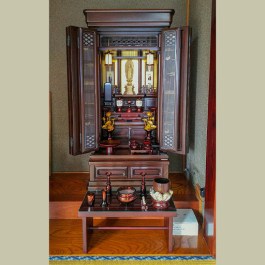
Butsudan2

We watched silently as the flames steadily consumed the butsudan (仏壇), or Buddhist altar that represented the gathered family’s dramatic break from the false gods they and generations before them had previously served. A butsudan is a shrine commonly found in temples and homes in Japan. It basically consists of an ornate wooden cabinet that typically houses a Buddhist religious icon and other accessories known as butsugu. These items are usually candlesticks, bells, incense burners and elaborate dishes where rice, tea or fruit are placed as an offering to deceased ancestors. A photo, memorial tablet (ihai), or ashes of a venerated family member are often placed within the butsudan, which represents a unique combination of traditional Buddhism and ancestral worship. Local Buddhist priests are usually called in to conduct periodic formal ceremonies in front of the butsudan, as determined by the date of the deceased’s death. Many households also maintain a simple daily ritual at the Buddhist altar of offering prayers, putting out food or burning incense; this responsibility usually falls on the wife.

Worship before the butsudan was traditionally viewed as an essential element in Japanese life, as it represented the center of a family’s spiritual faith and their historical heritage. While this practice is still quite common in the more rural areas of Japan, the responsibility of maintaining the family Buddhist altar is a burden modern Japanese are increasingly unwilling to bear as their religious convictions and lifestyles continue to evolve. The high price of these butsudan and the space they require in crowded homes are additional deterrents to owning one.

The butsudan is not to be confused with a kamidana (神棚), which is a Shinto god shelf and represents an entirely different religion unique to Japan. Many Japanese adhere to both Buddhist and Shinto practices. In contrast to the butsudan, kamidana are much more simplistic in appearance and are even sold as inexpensive kits at the local hardware store if you want to construct your own. The general purpose of a Shinto god shelf is to house a local Japanese kami or spirits, which are believed to inhabit all things. According to Japanese mythology, there are eight million of these quasi spirits who should be properly venerated.

Unlike a butsudan, a kamidana is typically placed high on a wall above eye level in a place where people will not walk under it. The Shinto god shelf contains a variety of items, but the most important one is the shintai. This is an object designed to house a particular kami, by providing a physical form to enhance worship. A shintai is usually a small circular mirror, but it can also be a stone, jewel or some other object with symbolic value. Worship at a kamidana is believed to invite success or good fortune, so is it is quite common to see Shinto god shelves on prominent display in places of business.

Idolatry actually comes in many forms and is not limited to images or objects commonly condemned in the Bible and currently present in Japan. The Ten Commandments begin with a prohibition of placing any other gods before the One True God where one constructs images of such gods or bows in worship before them. While very few of us place such obvious idols in our homes and worship them, our hearts are unfortunately inclined to value people, things, or objectives ahead of God and wrongfully give ourselves to them. Such “gods” should have no place on the shelves of our lives.

Sacred Treasures

“for I have learned to be content whatever the circumstances.”  Philippians 4:11b

Sacred Treasures

According to ancient tradition, whenever a new Japanese emperor ascends to power, he is entrusted with three sacred items as part of the enthronement ceremony. The presentation of these special objects by the Shinto priests serves to establish the new ruler’s authority and validates his right to reign. Historically, these items are referred to as the “three sacred treasures” (三種の神器) and consist of a mirror (representing wisdom), a sword (symbolizing valor) and a jewel (signifying benevolence).

Following the devastation of World War II, most Japanese were left destitute and longed for a better life. Therefore, members of the media spoke of the “new three sacred treasures” that everyone was seeking to obtain as a symbol of status and improved living conditions. These “treasures” were identified as a washing machine, a refrigerator and a television, since very few Japanese could afford such luxuries at the time. For example, in the early 1950s, a young salaried worker only earned about ¥10,000 per month, but a small fridge cost around ¥85,000 and a black/white TV was generally priced at ¥140,000. Such everyday conveniences were well beyond the reach of the vast majority of Japanese. However, as the economy steadily improved with prices going down and wages going up, many more people were soon able to purchase these once unobtainable “sacred” objects. This trend increased to such an extent that by 1964, almost 90% of all households in Japan owned these items. As to be expected, new luxury items were sought after, so an automobile, an air conditioner and a color TV were soon identified as the “new three sacred treasures” everyone longed to possess. These in turn gave way to newer or bigger “treasures” such as luxury vacations, expensive cameras, computers, designer goods, cell phones and the list goes on and on. Life became increasingly easier in Japan, but did such treasures bring genuine satisfaction?

Obviously, the answer is “no,” as true happiness does not originate from the quantity or quality of our possessions. Rather, genuine contentment and satisfaction stems from something much deeper, beginning with a heart set on the things of God. The Apostle Paul hinted at this truth when he shared part of his testimony in Philippians 4, where he declared he had learned contentment that wasn’t dependent upon his circumstances. In the course of his life, Paul had experienced both abundance and scarcity, but because God was the ultimate “treasure” that he sought, he was able to find contentment in either situation. This is the opposite approach of the world around us, which erroneously pursues a contentment grounded in things or activities rather than the person of God. This is why Jesus advised His followers not to store up treasures on earth, but instead, store up treasures in heaven. Jesus then went on to wisely note that our hearts are closely linked to whatever treasures we value. (Matthew 6:19-21) In reality, there is only one “sacred treasure” worth pursuing, and that is God Himself. Nothing else is deserving of our devotion, time or energy in comparison.

Hope for the Hopeless

“Where then is my hope—who can see any hope for me?” Job 17:15

Man leaning hands against wall

The train came to an unexpected stop and was shortly followed by the vague announcement: “We regret to inform you that this train has been delayed by a human accident.” While the passengers were annoyed by the sudden inconvenience that likely affected thousands of commuters, no one appeared to be surprised. They all instinctively knew that someone had chosen to take their life by jumping in front of a train. When I first experienced this, I didn’t know which was more shocking… that a person had committed suicide in close proximity to us, or that no one seemed to care. While one life came to a sudden end, life in Japan continued to move on.

Suicide has long been a national issue in Japan as it continues to rank towards the top among countries with high suicide rates. The root causes are many, such as the loss of employment, broken relationships, bullying in school, health issues and financial hardships. In most cases, varying degrees of depression are closely linked with these life calamities. Historically, the incidence of suicide is much higher among men than women in Japan. The high incidence of suicide in Japan may be partly due to a somewhat noble tradition associated with the act of taking one’s own life, particularly in military service. For example, samurai warriors would sometimes commit “seppuku,” using a short sword to avoid dishonor. In WWII, “kamikaze” pilots sacrificed their lives by crashing their planes into enemy ships, and ground troops sometimes launched suicidal “banzai” charges in the face of impossible odds for the higher honor of serving their country. In similar fashion, the modern “warrior,” or Japanese businessman, sometimes feels obligated to take his life in the face of personal failure or an exposed company scandal.

In present times, a large wooded area dubiously dubbed “Suicide Forest,” located at the base of Mt. Fuji, has become a popular place for many hurting souls to end their lives in a natural setting. Leaping onto railroad tracks is another venue frequently used in suicide attempts, but Japan Rail (JR) is implementing measures to curtail this trend. Track barriers are now installed in many stations, notices are posted on the platform urging those considering suicide to contact a special hotline and blue-tinted lights, which supposedly have a calming effect on people, are placed strategically throughout stations.

Research reveals that suicide rates in Japan have moderately declined in recent years, but this does not mask the many underlying problems that lead some to such a point of desperation. Several surveys indicate that Japanese in general, when compared to other people groups, have a more pessimistic outlook on life and therefore, lack a meaningful sense of hope. Despite being a country of affluence and safety, many seem to identify with the biblical character Job, who in the depth of his pain piteously cried out to his unsympathetic friends: “Where then is my hope—who can see any hope for me?”

The pain that flows from the inevitable hardships of life can destructively cause us to turn inward and lead to despair. But as the people of God we are called to turn outward in the midst of such challenges and look up to God, the true source of hope. This hope is not grounded in our feelings, the actions of others or altered circumstances, but in God Himself, who seeks our good and acts on our behalf for His eternal purposes. Therefore, we can genuinely pray with the psalmist “Yes, my soul, find rest in God; my hope comes from him.” (Psalm 62:5) In Him, there is hope for the hopeless.